Body
Food, hydration, supplements, movement, sleep, rest, routines and practical self-management.
A Different Kind of Wellbeing Environment
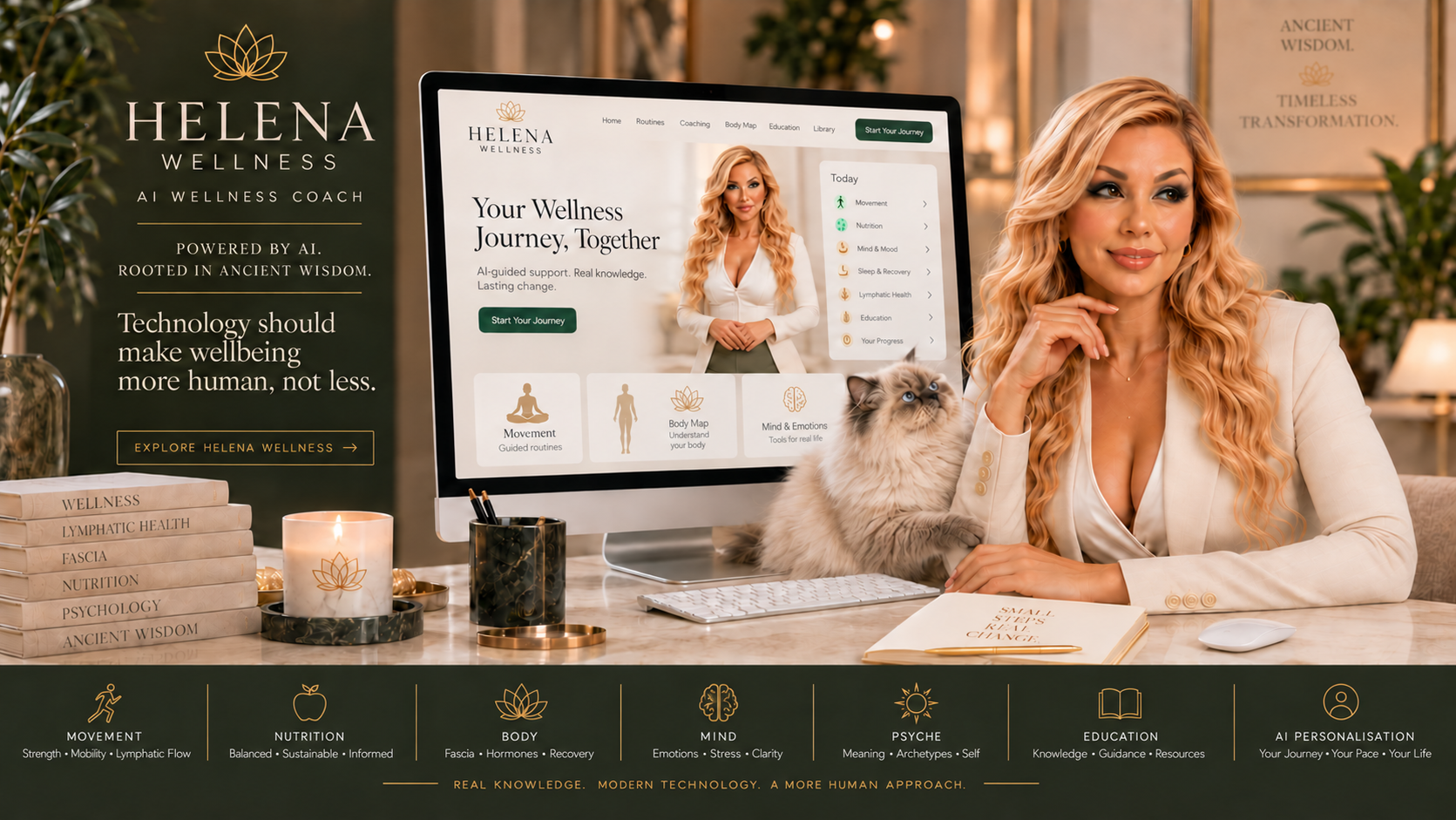
Helena Wellness is a developing personalised wellbeing environment for women, created by public historian, cultural heritage specialist, Jungian scholar and applied systems designer Helena B. Scott. It brings together historical healing knowledge, psychology, nature, embodiment and contemplative practice within one evolving environment designed to help women understand, organise and actively participate in their own wellbeing.
At its heart is a simple principle: wellbeing is not one thing. It is physical and psychological, practical and emotional, individual and environmental. It is shaped by what we eat and drink, how we move and sleep, what we remember and forget, how we manage stress, the stories through which we understand ourselves, and the habits we are actually able to sustain.
Born From a Real Need
Helena Wellness began as something Helena needed herself. Living with Hashimoto’s, a chronic autoimmune thyroid condition, meant managing many small but important elements of everyday wellbeing: supplements and their timing, hydration, nutrition, movement, exercise, rest, stress and the accumulated information involved in caring for a body over time.
“Knowing what to do was not always the problem. Remembering it all, bringing it together — and actually living it — was.”
Helena began designing the system she wished she had: one place capable of holding the practical dimensions of wellbeing alongside the psychological, symbolic and contemplative practices already central to her life and work. What began as a personal solution is developing into something larger.
History of Healing · Medicine · Magic
Helena’s work as a public historian and cultural heritage specialist gives Helena Wellness another foundation. Her developing research in the history of medicine and healing examines ancient and classical medical traditions, medieval herbals and healing manuscripts, medicinal plants and materia medica, monastic medicine, and particularly the medical and healing cultures associated with the Cistercians, Knights Templar and other medieval religious and military orders.
Her wider scholarship brings this into conversation with alchemy, Hermetic traditions, the history of magic and medicine, sacred landscape and historical relationships between body, psyche, spirit and nature.
These traditions are studied critically and within their historical contexts. Helena Wellness asks: what knowledge have human beings gathered about healing, meaning and living well — and what might still be worth listening to?
Explore Healing, Medicine & Wellbeing Through History →Psyche Matters Too
Helena’s work as a Jungian scholar and practitioner brings Jungian, archetypal and depth psychology into Helena Wellness alongside carefully selected contemporary psychological approaches. Reflection, archetypes, dreams, shadow work, emotional patterns, journalling and psychological exercises can sit alongside practical wellbeing support. CBT-informed tools can help users examine habits and patterns, while symbolic and archetypal work offers another way of exploring meaning, identity and change.

Original Framework · Helena Wellness
Ten historical and mythic feminine figures through which different expressions of faith, freedom, inheritance, influence, mystery, vengeance, strategy, mastery, resistance and independence can be explored through history, archetype, reflection and embodied practice.
The Four Dimensions
Body
Food, hydration, supplements, movement, sleep, rest, routines and practical self-management.
Mind
Jungian, depth and archetypal psychology alongside reflection, emotional wellbeing, habits and CBT-informed exercises.
Spirit
Meditation, Helena’s own guided audio practices, symbolism, contemplative traditions and carefully contextualised spiritual approaches.
Nature
Plants and herbs, aromatherapy, historical materia medica, landscape, natural rhythms and selected complementary traditions, including crystals and the subtle body.
Four · Earth · Human · Divine
The fourfold structure carries an older symbolic resonance. Within Pythagorean and later esoteric number symbolism, three is associated with the spiritual, while four belongs to manifestation and embodiment: spirit entering form, the invisible becoming present in the material world. The tetrad therefore becomes a symbol of structure and created order — the four directions and the four elements of earth, water, air and fire.
Four can also speak symbolically of the human being, the Earth and divine order. In the Judaeo-Christian tradition, the sacred divine name represented by the Tetragrammaton, YHWH, is itself composed of four Hebrew letters. Within Helena Wellness these correspondences are used as historical and contemplative symbolism, not as scientific claims.
Nature is not something outside us. We are nature.
That matters in lives increasingly spent behind walls and screens. The U.S. Environmental Protection Agency reports that people spend, on average, about 90% of their time indoors. Research on nature exposure also suggests that time in natural environments can reduce perceived and physiological stress; systematic reviews have reported associations with lower stress measures, including short-term reductions in cortisol in forest settings.
Psychologically, Helena approaches time in nature as more than exercise or scenery. In a Jungian and depth-psychological frame, leaving the highly managed human environment can create space for image, feeling, reverie and unconscious material to emerge. That is an interpretive framework rather than a biomedical claim — but it sits alongside measurable evidence that nature exposure can support stress reduction.
Cistercian Wisdom · Bernard of Clairvaux
“You will find more in woods than in books; trees and stones will teach you…”
Bernard of Clairvaux, Epistle 106. The fuller medieval passage contrasts what may be encountered in woods, trees and stones with what can be learned from human masters. For Helena, it offers an important historical counterpoint to modern nature-based wellbeing: the Cistercian landscape was not merely a backdrop, but part of a spiritual ecology in which body, labour, contemplation, environment and care of the soul belonged together.
The lineage Helena is tracing begins earlier than medieval monastic medicine. In Philo of Alexandria’s De vita contemplativa, the men and women he calls Therapeutae and Therapeutrides, living near Lake Mareotis outside Alexandria, devoted themselves to contemplation, prayer, study and the cultivation of the soul. Philo explicitly plays on the meaning of their name: their therapeia is described not simply in relation to bodily sickness but as a form of service and care directed towards the soul and the divine. Modern scholarship cautions against simply identifying this community with the Essenes; their precise identity and relationship to other Jewish ascetic traditions remain debated.
That contemplative concern for the whole person also provides an important comparative context for the later Desert Fathers and Mothers and the development of Christian monastic traditions in Egypt and beyond. These traditions are not one continuous institution and should not be collapsed into one another, but they preserve a recurring question that matters to Helena Wellness: what does it mean to care for the human being as body, psyche and soul?
That question continues through Helena’s research into monastic healing, Cistercian medicine and the Knights Templar. Medieval approaches cannot simply be mapped onto modern wellness, but they remind us that care was not always imagined as care of the body alone. Body · mind · spirit · nature are therefore not four isolated compartments within Helena Wellness. They describe one human life situated within a living world.
Within later alchemical and esoteric traditions, the four elements can also point towards a fifth principle — quinta essentia, quintessence — the unifying or animating principle beyond the four: not another compartment, but an image of integration and oneness.
Not every practice belongs to the same category of evidence. Helena Wellness is designed to distinguish historical knowledge, established evidence, emerging research, traditional practice and spiritual or symbolic approaches rather than presenting them as though they were interchangeable.
Human-Centred Technology
The developing digital environment is intended to make wellbeing easier to live, not harder to manage. Rather than asking women to hold another mountain of information in their heads, Helena Wellness is being designed to help organise personally relevant routines, practices, resources and reminders in one place.
AI-supported personalisation can help the environment respond to the individual, while the underlying philosophy remains deliberately human-centred: technology should support agency, not replace it.
Helena Wellness is being developed as a personalised environment for education, reflection, organisation, self-management and sustainable wellbeing routines.
Research · Practice · Partnership
Helena Wellness is designed to evolve alongside Helena’s continuing research and practice. Historical sources, essays, educational resources and carefully contextualised contemporary material can meet within one evolving body of knowledge — connecting what has been inherited from the past with the questions of how we live, heal and care for ourselves now.
As it develops, Helena intends to work with scholars, researchers, psychologists, historians of medicine, heritage specialists, wellbeing practitioners and carefully selected organisations and brands whose work genuinely complements its purpose.
Historical research and commercial recommendations will remain clearly distinguished. Where Helena recommends a product through an affiliate or commercial partnership, that relationship will be disclosed. Trust matters more than filling a shop with products.
Helena Wellness Collection →Coming November 2026 · Initially For Women
The first public release will begin bringing together personalised wellbeing organisation, historical knowledge, psychological and archetypal resources, guided practices and Helena’s developing library of carefully curated material.
Body · Mind · Spirit · Nature
Analytics Preferences
Help improve the Helena B. Scott website
Google Analytics helps understand how visitors find and use the site. If you decline, analytics cookies remain off and only limited cookieless measurement signals may be sent. It is not used for advertising here.