Explore
The Templar Symbolism Companion
Encounter selected symbols, contexts and interpretive pathways at your own pace.
Special Preview · 13 October 2026 · Launching with the Templar Academy · November 2026
Learn to read the language hidden in plain sight.
The Companion
Crosses. Stars. Circles. Roses. Geometry. Number. Animals. Architectural forms. Marks carved into stone.
Templar symbolism is everywhere — and almost never as simple as it first appears.
The Templar Symbolism Companion is a subscription-based research and exploration environment created by Helena B. Scott, MA — public historian, cultural heritage specialist and Jungian scholar — drawing upon a lifelong engagement with the Knights Templar and more than three decades of research into their history and the historical, spiritual and esoteric traditions surrounding them.
It brings selected strands of that research together in one evolving place: something to explore at home, return to while reading, or carry with you into churches, abbeys, museums and historic landscapes.
A symbol opens more than one layer of meaning.
The Companion is an invitation to begin learning how to read them.
The Symbol Is Not the Answer
One of the greatest problems in popular interpretations of Templar symbolism is the assumption that a symbol must mean one thing. A cross means this. A rose means that. A number has one definition.
Symbolic traditions rarely work that way. A symbol can possess an exoteric meaning — outward, historical, religious or social — while simultaneously carrying philosophical, initiatory, mystical or esoteric associations.
Discovering another layer does not necessarily invalidate the first. Historical context, location, relationship to other symbols, knowledge, experience and the training of the person encountering it can all change what becomes visible.
A symbol does not necessarily lose one meaning when another layer is revealed.
It becomes deeper.
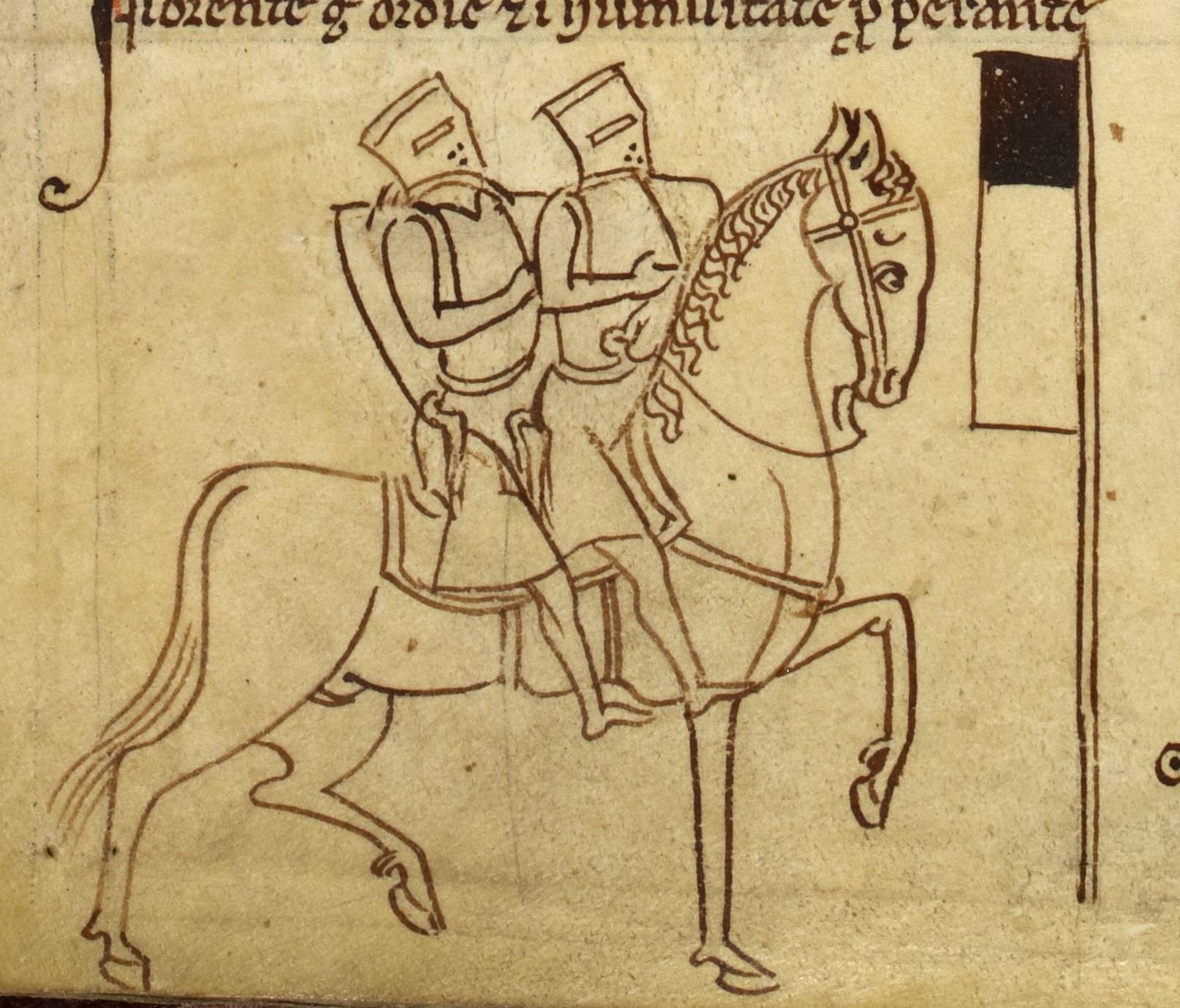
Matthew Paris · Historia Anglorum · British Library, Royal MS 14 C VII, fol. 42v · 13th century · Public Domain
Medieval Evidence · Symbolic Afterlife
Matthew Paris's thirteenth-century image is among the most recognisable medieval representations associated with the Order: two Templars sharing a horse beside the black-and-white banner traditionally identified as the Beauséant.
This image may tell us almost everything we need to know about the problem of reading Templar symbolism.
For centuries, the two riders on one horse have been repeatedly explained as a straightforward emblem of Templar poverty. But the Order's own Rule immediately complicates a literal reading.
The Rule · Horses
A knight brother was normally allotted three horses.
A fourth could be granted at the Master's discretion.
The Retrais · §379
“Et II freres ne doivent chevauchier en une beste.”
“And two brothers must not ride on one mount.”
View medieval French · Règle du Temple §379 ↗The Question
So what are we actually looking at?
The image can operate on an exoteric level — communicating fraternity, collective identity, humility and the ideals through which the Order presented itself — without exhausting what the image may be doing symbolically.
There is another reading. Helena teaches that reading. It is deliberately not given here.
Sometimes the symbol is not hiding.
We have simply been taught to look at it literally.
Learning to Look
For Helena, the Knights Templar are not a subject discovered in adulthood. Their history has been a thread woven through her life since childhood — a lifelong fascination that has grown into more than three decades of research, fieldwork, archaeology, cultural heritage and public history.
Symbolism entered that story remarkably early.
At the age of seven, while living in Rome, Helena was given an Italian copy of Dante Alighieri's Divine Comedy by a friend of her father. Already an avid reader, she became fascinated by a world in which landscape, number, image, theology and spiritual transformation could operate simultaneously and carry meaning on more than one level.
She still owns that same volume. It has travelled with her throughout her life.
Only much later would some of its resonances reveal themselves differently — not least the presence of Bernard of Clairvaux as Dante's final guide in Paradiso, leading the pilgrim towards the culmination of his journey.
What began as childhood fascination became a lifetime of learning to ask: What else is this telling me?
Today Helena's approach brings together a lifelong engagement with the Templar world and more than thirty years of research alongside primary sources, fieldwork, archaeology and material culture, medieval religious traditions, sacred landscape, geometry and number, Western esotericism, the Sacred Feminine and — through her work as a Jungian scholar — archetype and the symbolic life of the psyche.
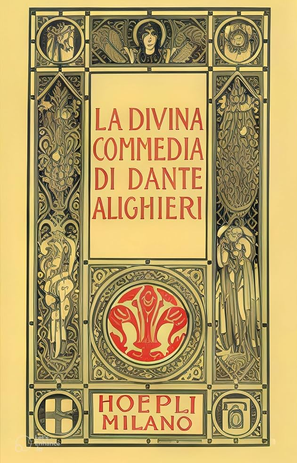
The Book That Began the Journey
At the age of seven, while living in Rome, Italy, Helena was given this Italian Hoepli edition of Dante's Divine Comedy by a friend of her father. Already an avid reader, she became fascinated by a world in which landscape, number, image, theology and spiritual transformation could carry meaning on more than one level.
She still owns that same volume. It has travelled with her throughout her life.
Only much later would some of its resonances reveal themselves differently. Dante's poem itself contains a direct reference to the Knights Templar: in Purgatorio XX he condemns Philip IV of France as the “new Pilate” who turns upon the Temple — a reference to the French king's assault upon the Order. Bernard of Clairvaux then appears as Dante's final guide in Paradiso, leading the pilgrim towards the culmination of his journey.
A Language That Travels
Once we begin paying attention to symbolic language, certain forms begin appearing again — across buildings, manuscripts, sacred landscapes, ritual and initiatory traditions, and across centuries.
Geometry becomes more than decoration. Number acquires structure. Orientation matters. Placement matters. What surrounds a symbol may become as significant as the symbol itself.
Later traditions — including Freemasonry, Rosicrucianism and the wider Western esoteric tradition — preserve sophisticated approaches to layered symbolic interpretation. Historical transmission is established through documentary, material and contextual evidence alongside visual resemblance.
The Companion therefore distinguishes between documented historical evidence, later symbolic traditions, comparative interpretation and esoteric readings. Knowing the difference is part of learning to look properly.
The Green Language · Language of Initiation
In Le Mystère des Cathédrales, the enigmatic twentieth-century alchemical writer Fulcanelli approached the Gothic cathedral as something capable of being read. His work explores the langue verte — the Green Language — and related initiatory modes in which meaning can move through wordplay, image, symbol, number, colour and architectural form rather than ordinary language alone.
For Helena, this offers an important comparative key to symbolic traditions: esoteric languages can communicate while simultaneously concealing, preserving knowledge without making every level of it immediately available to every observer.
The deeper methodology of the Green Language, layered symbolic interpretation and its relationship to Templar symbolism is reserved for Helena's lectures, masterclasses and Templar Academy teaching.
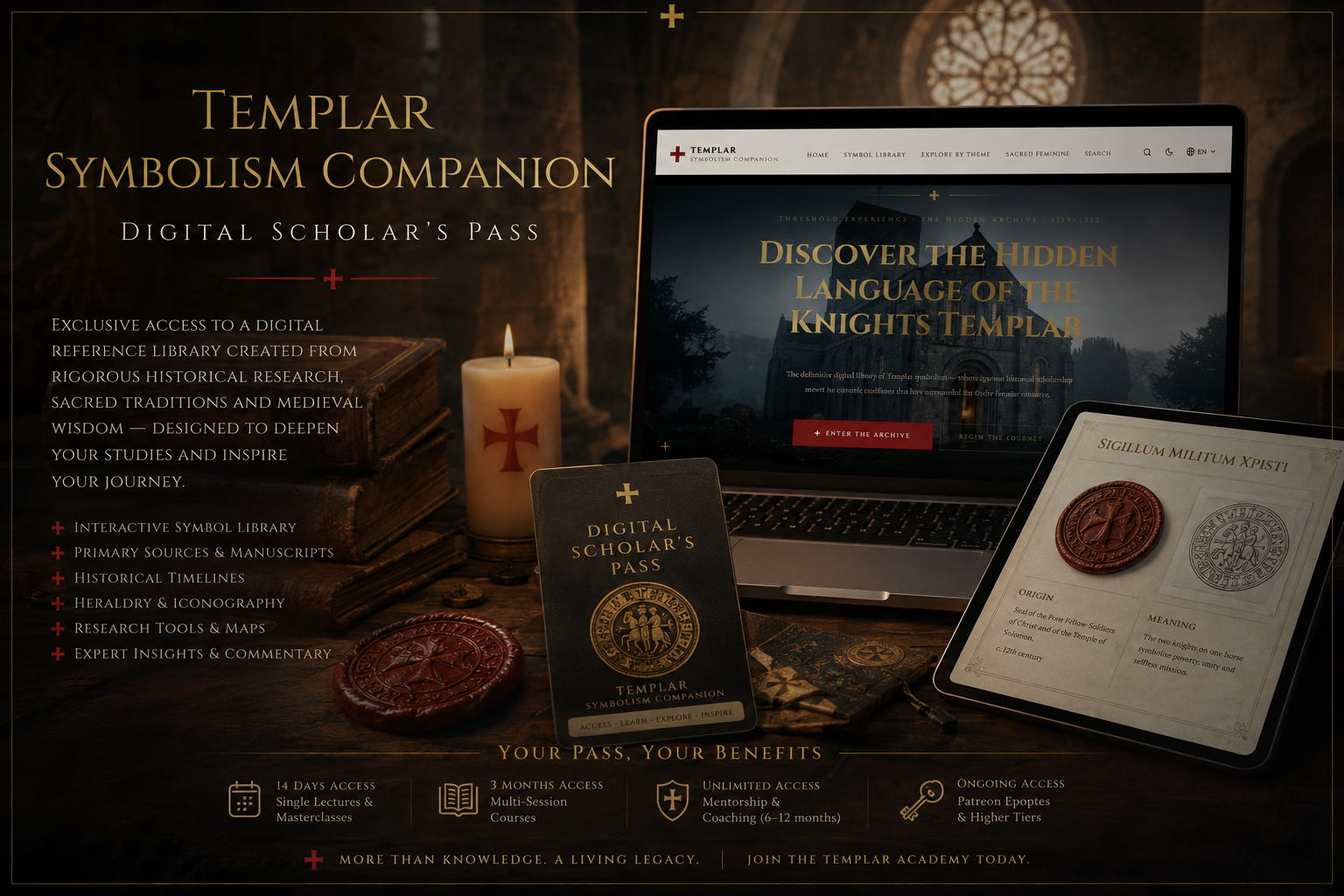
Published at The College of Psychic Studies
Helena's College Enlighten article, “The Green Language of Initiation”, introduces readers to the relationship between Templar symbolism, initiation and the langue verte. It offers a public doorway into themes Helena develops much further through her specialist teaching.
Helena is a tutor and lecturer at The College of Psychic Studies, where the Knights Templar form a continuing strand of her teaching. She also teaches independently through private lectures and events, specialist masterclasses, individual mentorship and the developing Templar Academy.
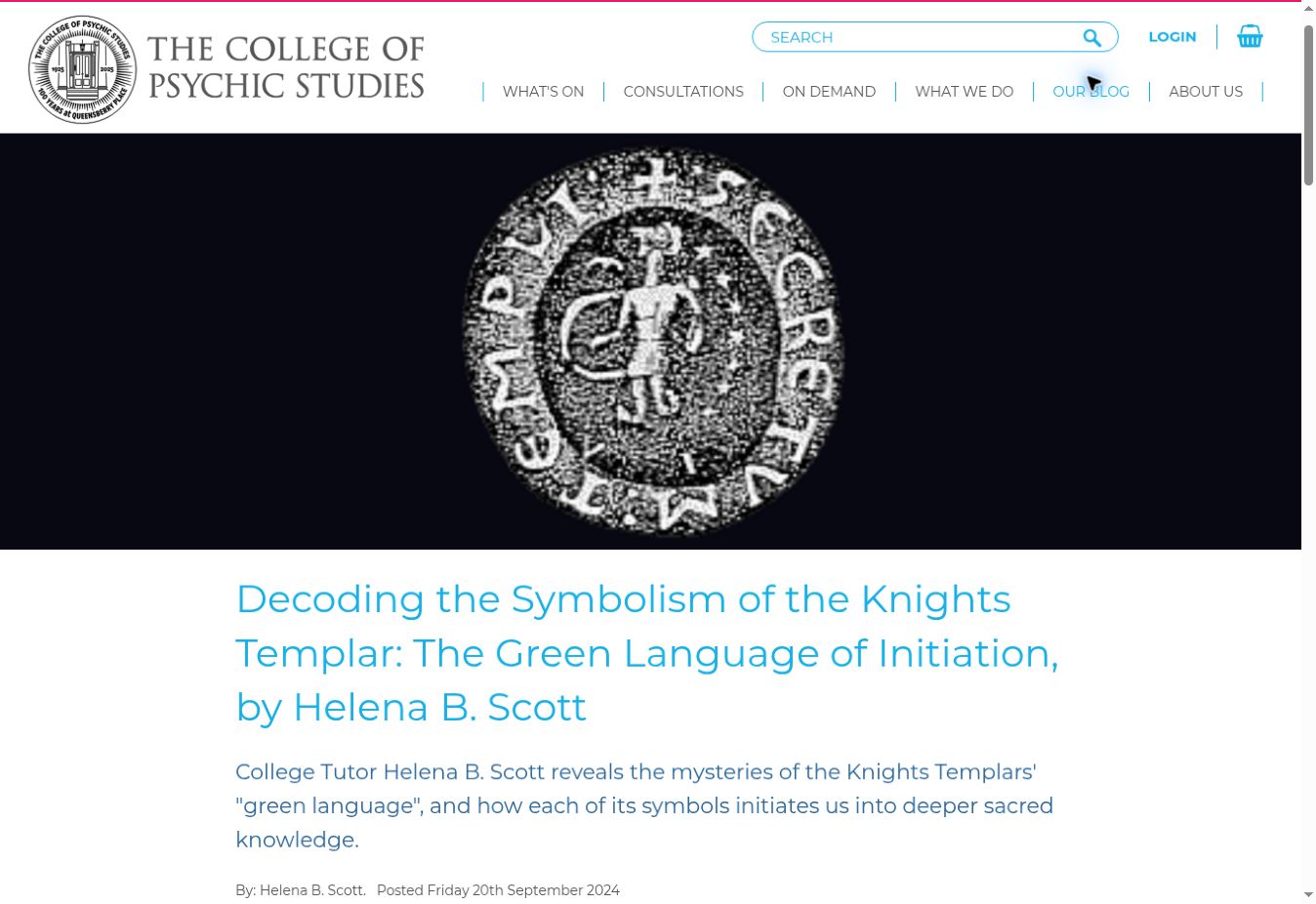 Click to Read ↗
Enlighten · The College of Psychic Studies · 20 September 2024
“Decoding the Symbolism of the Knights Templar: The Green Language of Initiation”
Article by Helena B. Scott
From Stone to Psyche
For Helena, symbols are not merely historical artefacts. They can also become maps of consciousness.
This is where her historical research meets her work as a Jungian scholar. A symbol can operate through image, memory, association and archetype as well as through rational definition. Its significance may therefore change as the person encountering it changes.
The medieval pilgrim travelled through landscape. The initiate passed through degrees of understanding. The Grail seeker encountered trials, questions, signs and revelations. The external journey and the internal journey continually reflected one another.
To work with symbols is to ask both what they meant and what happens when we encounter them.
The Grail Quest
The deepest purpose of the Templar Symbolism Companion is not to provide a collection of clever interpretations. It is to restore something of the quest.
Again and again, Grail literature asks the seeker to notice what others overlook, to recognise what is before them, to ask the necessary question — and ultimately to become capable of perceiving differently.
The destination is not knowing more symbols.
It is learning that there is more to see.
Explore · Study · Go Deeper
Symbolic literacy is a discipline. Understanding how exoteric and esoteric meanings interact; how multiple interpretations can coexist; how historical context changes a reading; and how symbolic languages operate across architecture, ritual, sacred geometry and initiatory traditions requires more than looking up definitions.
The Companion opens the door through a growing selection of symbols, historical context and carefully chosen interpretive pathways. It does not reproduce Helena's complete interpretive methodology.
Explore
Encounter selected symbols, contexts and interpretive pathways at your own pace.
Study
Follow particular questions further through Helena’s specialist teaching on the Templars, Sacred Feminine, Grail traditions, medieval spirituality and Western esotericism.
Go Deeper
Develop a deeper understanding of symbolic interpretation through courses and specialist programmes containing material deliberately not reproduced within the Companion.
The Companion gives you the threshold.
The teaching takes you through the door.
In the Field
The Companion has also been conceived as something that can travel. Take it into a church. Open it beside a carved stone. Return to it after visiting an abbey. Compare what you are seeing with what you thought you understood before you arrived.
Symbolic interpretation changes when we move from a photograph or definition to the material object, architecture and landscape in which the symbol actually exists. Helena's own research combines documentary study with fieldwork for precisely this reason.
Sometimes the most important question is not What does this symbol mean?
But: Why is it here?
Membership
The Templar Symbolism Companion will be revealed in a special preview during Helena's website launch event on 13 October 2026, before its full launch alongside the Templar Academy in November 2026. It will then be available through subscription membership, with new research and material added as the project develops.
Access may also be included with selected Templar Academy courses, lectures, masterclasses, programmes and special events. Some students and attendees may therefore receive Companion access as part of their learning experience, while others may join independently through subscription.
Join the Quest
Selected Helena B. Scott courses, lectures and programmes may include complimentary or time-limited Companion access where specified.
Explore Courses, Lectures & Events →The Symbol · The Seeker · The Quest
Some things cannot be understood until we learn how to see them.
← All ProjectsAnalytics Preferences
Help improve the Helena B. Scott website
Google Analytics helps understand how visitors find and use the site. If you decline, analytics cookies remain off and only limited cookieless measurement signals may be sent. It is not used for advertising here.
