I am deeply honoured to have been appointed Honorary Grand Historian of L’Ordre Souverain des Templiers Saint-Martin (OSTSM). The appointment, dated 22 October 2026, was communicated to me personally by Grand Master Aurelian Roland Boiț on 27 October.
It follows the award of the Meriti Crux (Cross of Merit), the Order’s highest distinction, on 24 April 2026, and my inscription in its Chevalier Register. Read my earlier account of receiving the Meriti Crux.
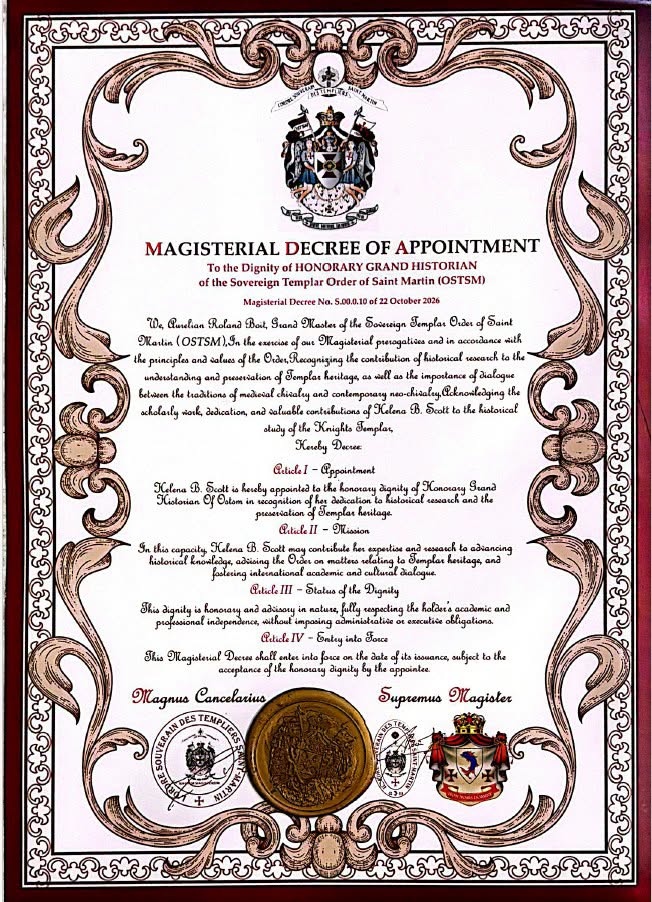
These honours carry particular meaning because this is an Order, and a community of people, that has become very close to my heart.
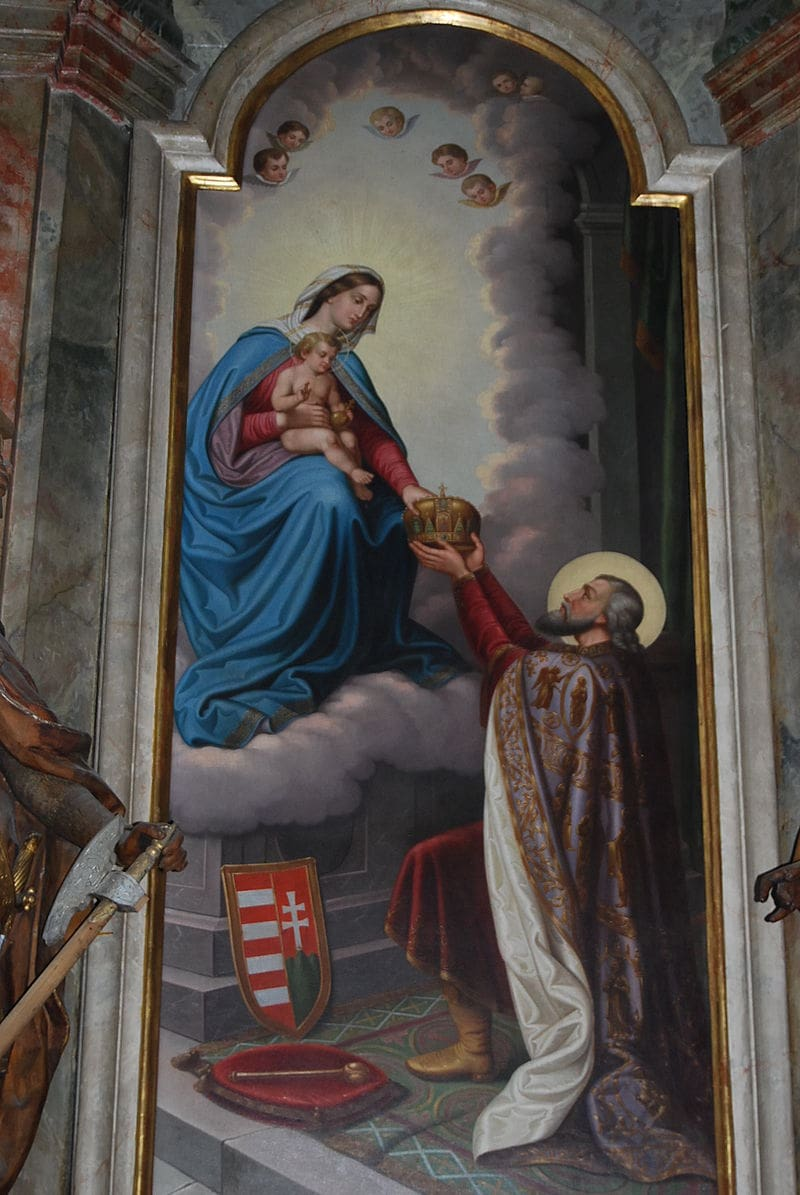
Earlier this spring, their invitation to speak as keynote speaker at the international conference Saint Martin, Precursor to the Christian Chivalric Orders brought me to Arad, Romania, on a journey that also took me through Budapest in Hungary: the Kingdom of Mary, and lands associated with the Order of the Dragon.
Western Romania, including the region around Arad, once formed part of the medieval Kingdom of Hungary. Romania was a country I had long wished to visit, without knowing whether the opportunity would ever arise. The warmth, generosity and friendship with which I was welcomed made that first visit unforgettable.
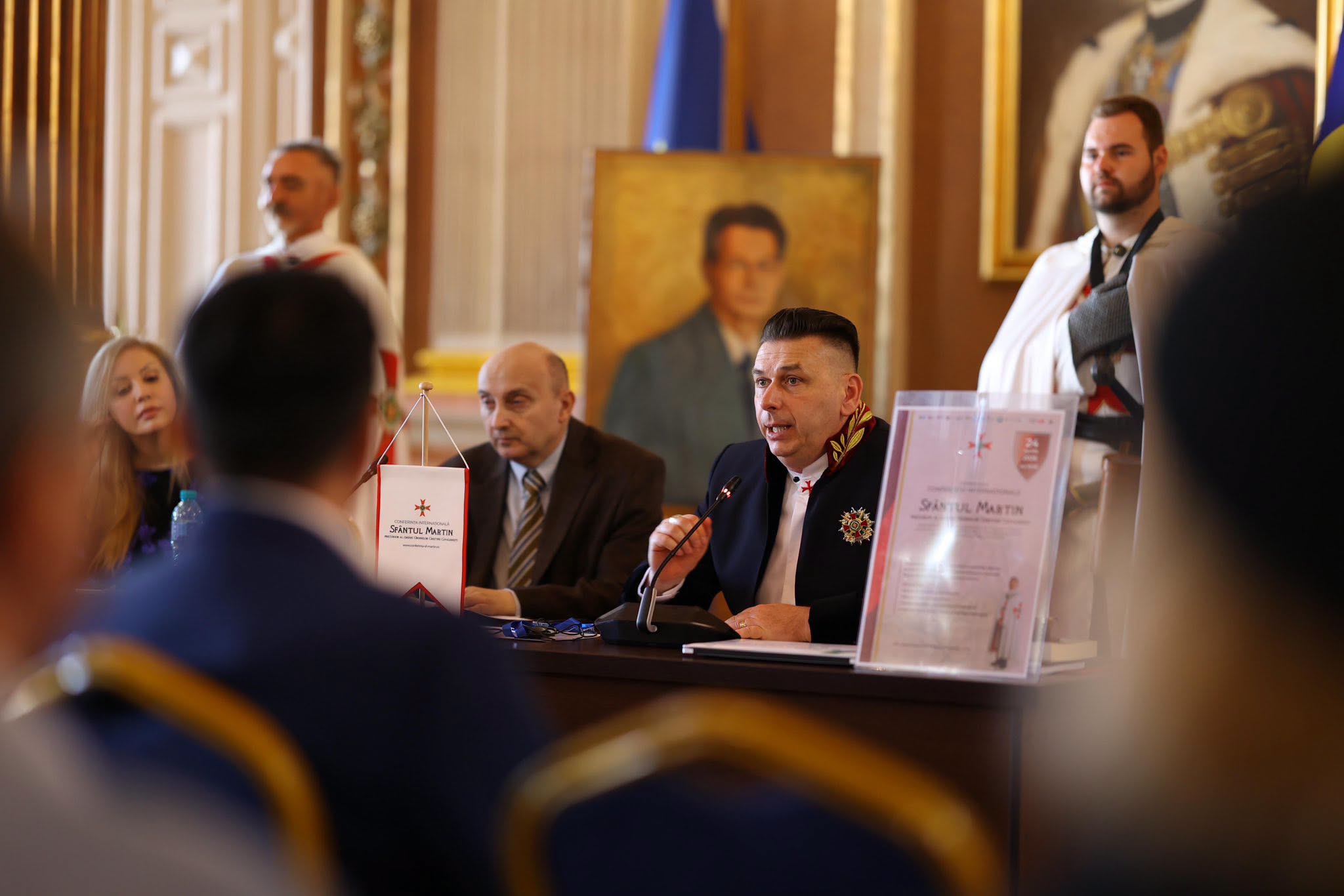
The conference left an equally lasting intellectual impression. I encountered accomplished scholars whose multilingual scholarship, breadth of knowledge and dedication to their cultural heritage made our exchanges deeply rewarding. Bringing together historians, universities, museums and the wider community, the event demonstrated a commitment to researching and understanding the region’s roots as well as preserving cultural heritage.
That commitment matters profoundly to me.
With Grand Priories in Romania, France and Hungary, OSTSM connects its chivalric ideals with cultural initiatives, philanthropy and community service. Among the contemporary Templar organisations I have encountered, it feels especially close to the values I most cherish in the Templar tradition: a love of justice and truth, the preservation and transmission of wisdom and knowledge, and a commitment to responsibility, fellowship, generosity and care for others.
I recognised those values in their dedication to historical research and cultural heritage, and experienced them personally in the kindness of the people who welcomed me.
The Meriti Crux recognised my research and contributions to Templar history, following my keynote presentation on overlooked aspects of the Order of the Knights Templar, including my research into the Sacred Feminine within Templar spirituality and its subsequent suppression and marginalisation in Christian and scholarly narratives.
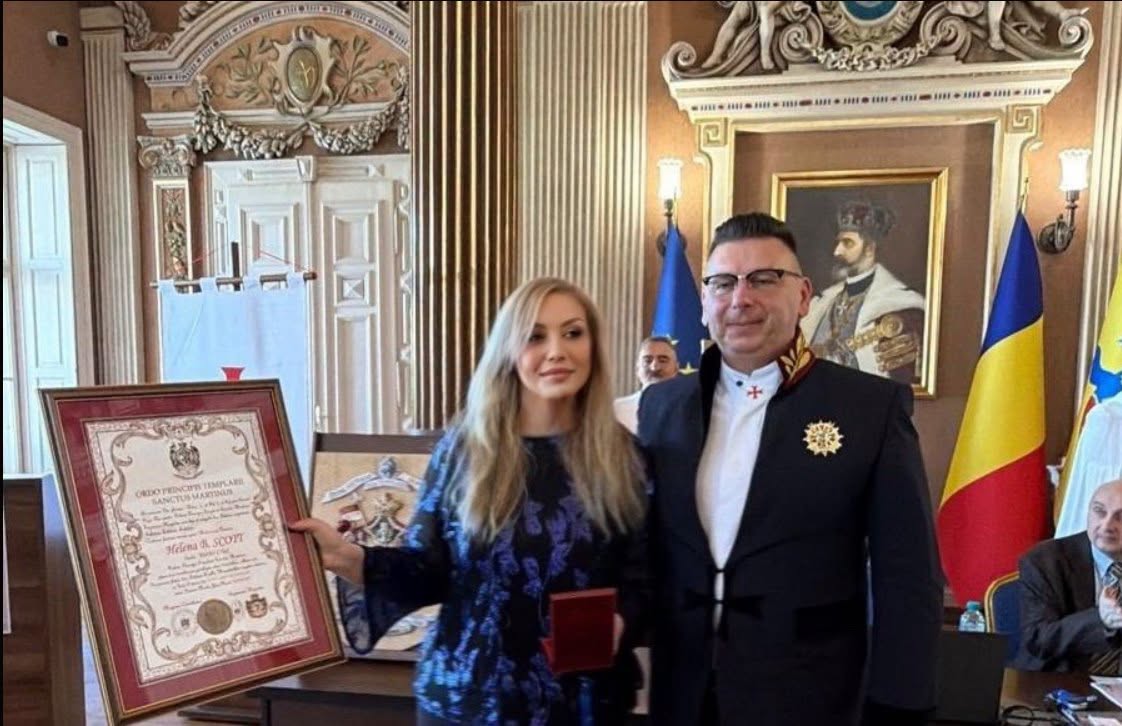
Grand Master Aurelian Roland Boiț’s words accompanying the Meriti Crux distinction express why it means so much to me:
“To receive this distinction means:
– to serve without asking,
– to illuminate without blinding,
– to live with dignity in a confused world.
It is a call to honor, strength and silence.
It is a living commitment.
It is a call to become a knight not just by title, but by deeds.
Because today, nobility is no longer carried in the blood, but in the soul!!”
There is another passage I return to, preserved in the defence presented through Peter of Bologna—Templar priest, canon lawyer and procurator of the Order at the papal court, who helped lead the Templars’ legal defence in 1310:
“…seeing the tribulations and dangers which those who speak the truth suffer continually…”
These words belong to a defence that was gathering strength as hundreds of brothers came forward to challenge the accusations and the validity of confessions obtained under coercion. On 12 May 1310, fifty-four Templars were burned outside Paris following their condemnation as relapsed heretics by the provincial council under Philippe de Marigny, Archbishop of Sens and a royal appointee. The executions effectively silenced the growing defence, advancing Philip IV’s campaign against the Order.
That history gives these words their terrible weight. Fidelity to truth can carry a profound personal cost. I know it only too well.
For me, the search for truth has something of the Grail quest about it. We may feel called to follow it before we understand what it will ask of us. It can change the course of a life, unsettle relationships and require us to relinquish the comfort of belonging where honest questioning is unwelcome.
In Chrétien de Troyes’s Grail romance, Perceval remains silent before the mysteries he witnesses, remembering the instruction not to speak too much. He later learns that asking about the Grail and the bleeding lance could have healed the wounded Fisher King. I find a profound responsibility in that story: we must have the courage to ask the questions that convention, deference or fear might persuade us to leave unspoken.
That is why I question history itself, including established accounts. My work in historical revisionism is evidence-led: I return to the sources, examine inherited assumptions and challenge inaccuracies where the evidence warrants it. Asking questions creates the possibility of recovering what has been overlooked, hearing those who were silenced and correcting what has been misrepresented.
Following that calling also requires humility: conviction alone cannot establish truth, and we must remain willing to question our own conclusions.
As a historian, my responsibility is to pursue the fullest and most faithful understanding the surviving evidence allows. We were not there. Our sources are incomplete, unevenly preserved and shaped by the circumstances in which they were created. There will always be things we cannot know. That uncertainty asks us to work carefully, acknowledge our limits and remain willing to revise our conclusions.
It also asks us to consider whose testimony has survived, whose account became authoritative, and whose voice was denied a place in the record.
My work seeks to restore marginalised voices and overlooked histories to that conversation: women and the Sacred Feminine, the Templars themselves, Gnostic traditions, and people whose experiences were obscured by institutions more powerful than they were. Where the evidence challenges a history inherited from the victors, we have a responsibility to reconsider it.
The Templar Rule, §2, invokes the love of justice and the duty to “defend the poor, widows, orphans and churches.” I find a contemporary responsibility in that principle. Vulnerability extends into the historical record: people with the least power often had the fewest opportunities to preserve their own account of their lives.
Recovering those histories requires us to seek their traces patiently, listen critically to the sources and make room for what earlier narratives excluded.
This is the spirit in which I receive the appointment of Honorary Grand Historian: with gratitude, intellectual humility and a commitment to scholarship through which those too easily forgotten may be heard again.
My heartfelt thanks to Grand Master Aurelian, Grand Dame Daniela, OSTSM, and everyone in Hungary and Romania who welcomed me with such kindness. I look forward to continuing our scholarship, friendship and shared work.
To honour a legacy is to take responsibility for understanding it.
Helena B. Scott, MA (Hons.)
Public Historian · Cultural Heritage Specialist · Jungian Scholar
Honorary Grand Historian, OSTSM


