W. B. Yeats & George Hyde-Lees+
W. B. Yeats and his wife, George Hyde-Lees, were both members of the London Spiritualist Alliance; its historical record describes George as a student of oriental philosophies and occult science, and their shared engagement with psychical and esoteric inquiry provides an important institutional context for the automatic-writing collaboration that later informed A Vision.
Florence Farr & the Golden Dawn+
Florence Farr — actor, theatre producer, musician, writer and ceremonial magician — was a major figure in the overlapping theatrical and esoteric worlds that also shaped W. B. Yeats. Initiated into the Hermetic Order of the Golden Dawn in 1890, she rose to senior leadership: she became Praemonstratrix of the Isis-Urania Temple, responsible for its teaching, and by the later 1890s was effectively one of the leading authorities of the Order in Britain, becoming Chief Adept in Anglia. Her magical work was serious and sustained. She taught Tarot, scrying and Enochian magic, led the esoteric Sphere Group, and developed a particular engagement with ancient Egyptian religion and magic, publishing Egyptian Magic and later co-writing and staging Egyptian sacred dramas including The Beloved of Hathor and The Shrine of the Golden Hawk. Farr's theatre and occultism continually informed one another. She collaborated closely with Yeats, acted in and helped stage his work, and became central to his experiments in recovering poetry as an oral, incantatory art; using the specially made psaltery associated with their work, she recited poetry to musical accompaniment in the distinctive style Yeats described as speaking to the psaltery. Her theatrical career also connected her intimately with George Bernard Shaw: they were lovers as well as intellectual and theatrical collaborators, and Farr produced Shaw's Arms and the Man during her 1894 season at the Avenue Theatre. Farr therefore represents an especially important convergence of theatre, poetry, women's intellectual independence, Egyptian religion, ceremonial magic and the Golden Dawn — all themes that resonate strongly with Helena's own research into Yeats, symbolism, the sacred feminine and the Western esoteric tradition.
Sir Arthur Conan Doyle+
Sir Arthur Conan Doyle — author of Sherlock Holmes, Spiritualist and Freemason — served as President of the Alliance and helped secure its present South Kensington home in the 1920s. His engagement with psychical research and Spiritualism extended across more than forty years, developing from investigation into a public religious commitment to mediumship and the possibility of survival after death. He was also a friend of the illusionist Harry Houdini: despite their sharply opposing conclusions about Spiritualism and fraudulent mediumship, their surviving correspondence shows a genuine friendship in which disagreement over the subject became increasingly profound.
Harry Price, Helen Duncan & Nandor Fodor+
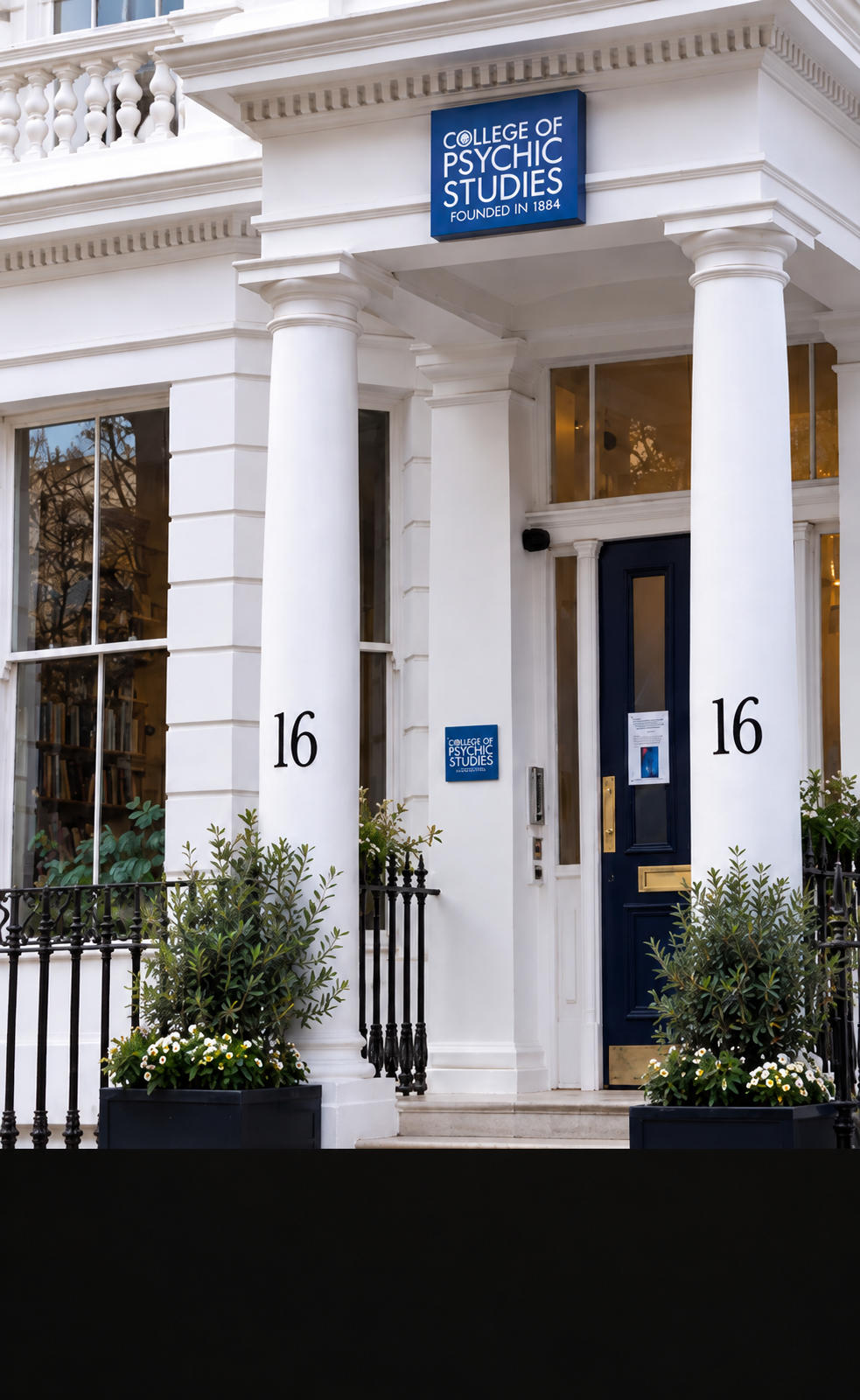
From 1926 to 1930, psychical researcher Harry Price leased the College's top floor for his National Laboratory of Psychical Research, where mediums and psychic phenomena were investigated experimentally; the College's history also includes celebrated medium Helen Duncan and psychical researcher Nandor Fodor.
Ivy Northage & the College Teaching Tradition+
Ivy Northage (1909–2002) was one of Britain's most respected teaching mediums and an important figure in the College's modern tradition of mediumship. She began teaching at the College of Psychic Studies in 1970 and, together with her spirit guide Chan, left a substantial body of teaching on the mechanics and development of mediumship, including trance mediumship. Her influence extended beyond communication itself into the disciplined development of psychic sensitivity: her methods worked with the chakras and the auric field as part of learning how to perceive, regulate and protect psychic awareness. In her recorded College lecture The Influence of our Aura on Others, Northage describes the aura as a reflection of each person's unique spiritual identity — an energetic field through which we affect others, which changes as we learn and grow, and which requires conscious replenishment and protection. Helena trained in the Ivy Northage methods through her own mediumship and psychic-development training and continues to draw particularly on this foundation in trance mediumship and in her work with the chakras and aura. This lineage forms one strand of Helena's broader study of subtle-body traditions, which she also approaches through their historical and primary-source traditions rather than through modern mediumship teaching alone.
Judy Hall & Contemporary Spiritual Practice+
Former College tutor Judy Hall (1943–2021) was an internationally known author, astrologer, psychic, healer and crystal expert whose work became highly influential in modern crystal healing and psychic protection. She wrote more than forty-five books, including the million-selling The Crystal Bible, and worked for over forty years across crystal healing, past-life therapy, astrology, divination, soul healing and spiritual development. Her work was grounded not only in crystal lore but in a wider knowledge of world religions, mythology, psychology and sacred place; her book Crystals and Sacred Sites, for example, drew together a lifelong interest in sacred landscapes with her extensive practical experience of stones and crystals. Helena's connection to this lineage is also practical rather than simply historical: she trained through Judy Hall's lectures and methods at the College and continues to work with approaches Hall taught, particularly the intuitive selection and practical use of crystals, grounding, energetic boundaries and psychic protection. Helena's own affinity with flint and naturally occurring stones sits particularly comfortably within this tradition: Hall herself recommended flint as a grounding stone and repeatedly emphasised direct, intuitive relationship with individual stones rather than treating crystals merely as decorative objects. Hall's work therefore represents an important strand of Helena's formation at the College, connecting crystal practice, psychic development, protection, sacred landscape and the living materiality of stone.
Olivia Durdin-Robertson+
Olivia Durdin-Robertson — artist, author, psychic practitioner and co-founder of the Fellowship of Isis — undertook systematic psychic training at the College of Psychic Studies in London. Her ancestral home, Huntington Castle in County Carlow, Ireland, has also become a second home away from home for Helena, making this strand of the College's lineage a particularly personal one. In 1963 Olivia, her brother Lawrence Durdin-Robertson and his wife Pamela founded the Huntington Castle Centre for Meditation and Study there, hosting seminars and visiting psychics, mystics, occultists and theologians; Olivia developed her guided meditations or “magical journeys” through this work. In 1976 the three went on to found the Fellowship of Isis at the Castle, dedicated to the Divine Feminine, with its spiritual centre and Temple of Isis established within Huntington. Olivia's spiritual imagination was also deeply rooted in the enchanted landscape of the Castle and in experiences of an unseen world that she associated with Ireland from childhood. That atmosphere connects her with the earlier Irish esoteric and literary world of the Celtic Twilight: W. B. Yeats and George Russell (AE), both closely associated with fairy belief, visionary experience and the Irish imagination, were among the notable occult-minded visitors to Huntington during Olivia's formative years. Her later work placed the Goddess, sacred feminine traditions, ritual, psychic development and the figure of Isis at the centre of an international spiritual movement. She is particularly relevant to Helena's work because her trajectory connects the College's tradition of psychic and esoteric study with Ireland, sacred landscape, visionary experience, Goddess spirituality and the sacred feminine.
Together, these strands situate Helena's work within a continuing tradition of inquiry into consciousness, survival, mediumship, symbolism, healing, spiritual experience and the meeting-point between scholarship and the unseen.