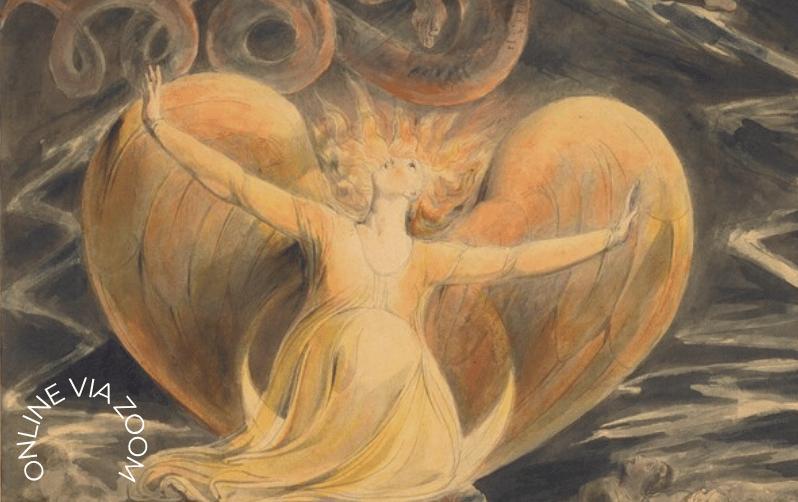
How traditions of hidden and transformative knowledge move through history — from ancient texts and material evidence to religious symbolism, modern esotericism and the psychology of transformation.
Helena B. Scott · Public Historian · Cultural Heritage Specialist · Jungian Scholar
Gnosis · Philosophy · Inner Knowing
What is Gnosticism?
For Helena, Gnosticism is best approached as a diverse field of ancient spiritual and philosophical currents centred upon gnosis: direct, transformative knowing. Its surviving texts preserve multiple schools, cosmologies and voices, and modern scholarship continues to explore the usefulness and boundaries of the category itself. What repeatedly draws Helena back to them is the radical question many of these texts pose in different ways: what changes when knowledge is understood not simply as information or belief, but as a form of awakening and remembrance?
The Nag Hammadi texts opened an extraordinary window onto this lost plurality. Helena's work explores the Pleroma and the divine spark; Sophia and Barbelo; alienation, fragmentation, remembrance and return; the Gospel of Thomas and other non-canonical voices; and the tension between institutional authority and experiential knowledge. She is interested both in these texts on their own historical terms and in the philosophical challenge they continue to pose: whether knowledge can transform the knower, and whether the sacred may be encountered inwardly rather than merely believed from without.
Helena develops this work in conversation with scholarship on Gnostic and early Christian diversity, including Gilles Quispel, Elaine Pagels and April D. DeConick, and with Tobias Churton's work on the wider history of Gnosticism and Western esotericism. She also engages the interpretive tradition represented by the late Stephan A. Hoeller and the Ecclesia Gnostica, particularly where Gnostic myth meets Jungian psychology. Helena places these scholars and traditions in active conversation with primary sources, historical context and her own interpretive work.
Method · Evidence · Reception · Interpretation
Historical evidence comes first. Reception and interpretation follow.
Across this Research World, Helena asks how ideas of awakening, hidden knowledge, fragmentation, transformation and return move between texts, objects, traditions and centuries. Where transmission can be documented, she traces it. Where only resonance can be shown, she keeps that distinction visible. The result is a layered history in which ancient sources, documented transmission, later reception and interpretation can be read together without losing their distinct contexts.
Nag Hammadi · Sophia · The Divine Spark
A Forgotten Library
A different way of knowing
Helena's teaching returns repeatedly to the extraordinary texts associated with Nag Hammadi and to the world they disclose: a remarkable plurality of voices wrestling with creation, consciousness, divine origin, freedom and the problem of human estrangement. Myths of Sophia's descent, the divine spark, the Pleroma, the demiurgic world and the journey of remembrance become ways of asking what has been forgotten — culturally, spiritually and within the self.
Her interest also extends beyond antiquity into the later reception of ideas that have been described, compared or reimagined as Gnostic — including medieval dissident traditions such as the Cathars and later currents of interior spirituality. Helena traces documented transmission, later analogy and changing reception, asking why themes of direct knowing, interior transformation and recovered identity repeatedly become legible through a Gnostic frame.
Material Archive · Nag Hammadi · Upper Egypt
Nag Hammadi Coptic bindings · photograph by Sohilaali869 · 2025 · CC BY 4.0 · via Wikimedia CommonsClick to enlarge ↗
Codex II · Apocryphon of John / Gospel of Thomas · fourth century · public domain · via Wikimedia CommonsClick to enlarge ↗
Codex V · Apocalypse of Paul · fourth century · public domain · via Wikimedia CommonsClick to enlarge ↗
Codex VI · Hermetic text · fourth century · public domain · via Wikimedia CommonsClick to enlarge ↗
The familiar discovery account places the codices in a ceramic jar near Jabal al-Ṭārif in 1945, although the exact find spot and details of the discovery remain debated. The material archive is as important as the ideas: papyrus, leather bindings and Coptic script return “Gnosticism” to physical history rather than abstraction.
Sophia · Barbelo · Thunder · The Feminine Divine
Wisdom & Paradox
The voice that refuses reduction
Across the diverse texts gathered within the study of Gnosticism, feminine divine figures appear in richly varied forms and functions. Barbelo, especially prominent in Sethian materials, belongs to the language of First Thought, divine fullness and generative emanation. Sophia — Wisdom enters other mythic systems through stories of desire, rupture, descent, deficiency and restoration. Helena approaches these figures text by text, allowing the distinctive theology and symbolic language of each tradition to emerge.
Barbelo
First Thought · Fullness · Generation
Barbelo appears in important Sethian texts as a primordial divine reality whose language complicates ordinary gender categories: mother, father, first human and generative source can converge within a single transcendent figure.
Sophia
Wisdom · Descent · Fragmentation · Return
Sophia becomes one of the great figures through whom Gnostic myth thinks about divine Wisdom, rupture and restoration. For Helena, her continuing power lies partly in the question she poses: what happens when what has been separated from fullness begins to remember its origin?
Thunder, Perfect Mind · Nag Hammadi Codex VI,2
The whole voice speaks through opposites
Thunder, Perfect Mind is one of the most enigmatic works preserved at Nag Hammadi. It survives as the second tractate of Nag Hammadi Codex VI in a fourth-century Coptic manuscript, although the work itself is generally understood to derive from an earlier Greek composition; a second- or third-century Alexandrian milieu is often regarded as plausible. The text takes the form of an extraordinary first-person revelatory poem spoken by an unnamed female divine voice. She never identifies herself. Instead, she declares herself through a sequence of deliberate paradoxes: honoured and scorned, wife and virgin, mother and daughter, wise and foolish, speech and silence.
The effect is not simple contradiction but a refusal to let the speaker be contained by any single category. The poem has no conventional narrative frame and offers no final key to her identity. Scholars have brought the voice into conversation with figures and traditions including Sophia, Isis, Jewish Wisdom and other feminine divine revealers, while its precise religious setting and classification remain debated. Helena is particularly drawn to reading the speaker through Barbelo as an interpretive possibility within a text whose feminine voice repeatedly exceeds ordinary binaries. For Helena, Thunder therefore becomes one of the clearest ancient expressions of a problem that recurs throughout this Research World: how wholeness can contain apparent opposites without collapsing into either one.
Listen · Voice · Performance
Thunder must be heard
During Helena’s lecture for the C. G. Jung Society of Melbourne, From Lead to Gold: Gnosticism, Alchemy & the Roots of Depth and Archetypal Psychology, Kirsten Kinsley remarked that Thunder, Perfect Mind should be spoken aloud. The observation matters. Thunder speaks in the first person; its identities accumulate, collide and return through rhythm, repetition and address. Hearing the poem allows its paradoxes to operate as voice rather than simply as propositions on a page.
Translation itself forms part of the enquiry. George W. MacRae's influential translation can be placed beside the later collaborative work of Hal Taussig, Jared Calaway, Maia Kotrosits, Dr Celene Lillie and Justin Lasser, whose study draws attention to the text's grammatical, gendered and interpretive instability. Helena continues to read Thunder as deeply Gnostic, while valuing this scholarship's close attention to the surviving Coptic voice and to the productive ambiguities carried by its language.
George W. MacRae
MacRae’s influential English translation became one of the principal ways modern readers encountered Thunder. Its phrasing makes the poem’s succession of paradoxical identities immediately visible and has profoundly shaped the text’s modern reception.
Taussig · Calaway · Kotrosits · Lillie · Lasser
The later collaborative translation returns attention to the Coptic itself — including grammatical ambiguity, gender and places where an English rendering can make the speaker more stable than the surviving language requires. Read together, the translations reveal interpretation happening at the level of language before any theological or psychological reading begins.
Scholarship in Conversation · 2026
Kirsten Kinsley's Pacifica dissertation, The Remembrance of Sophia: An Alchemical Hermeneutical Approach to the Poem “Thunder, Perfect Mind”, is especially relevant to Helena's current work. Kinsley brings Thunder into dialogue with Sophia, alchemical hermeneutics, Jungian psychology, individuation and the tension of opposites — an independent scholarly convergence with questions Helena has been developing through Gnosticism, alchemy, the Sacred Feminine and her own reading of the High Priestess as an image capable of holding polarity without reducing one side to the other.
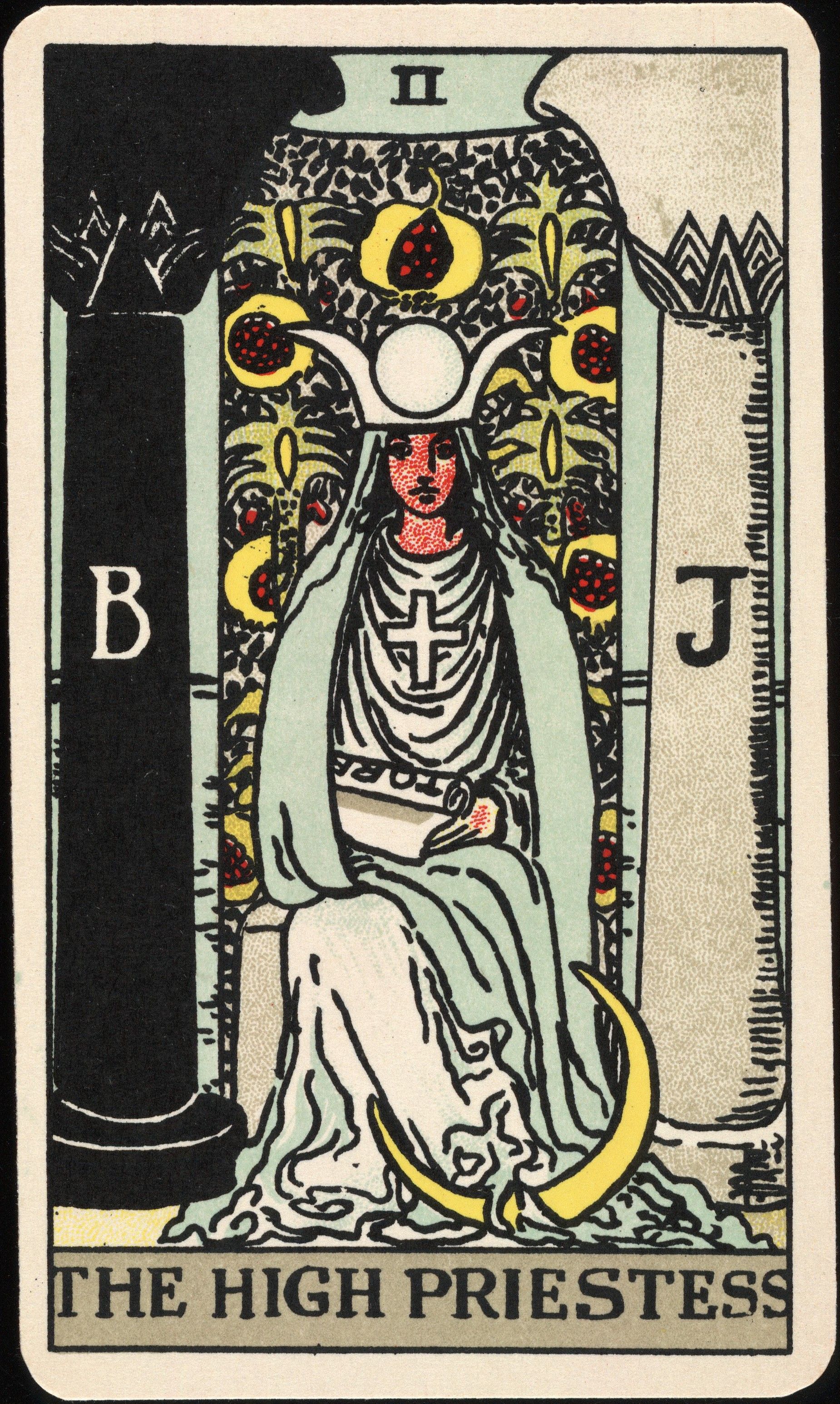
II · The High Priestess · Waite–Smith Tarot · Pamela Colman Smith · Beinecke Rare Book & Manuscript Library, Yale · public domain · via Wikimedia Commons · click to enlarge
The Priestess · Thunder · Coniunctio
Holding the opposites at the threshold
Helena reads the High Priestess as a powerful later image of the problem already encountered in Thunder: the capacity to hold apparently opposing realities without surrendering wholeness. She sits between B — Boaz, the black pillar, and J — Jachin, the white pillar associated with Solomon's Temple. The image becomes a threshold between Gnostic paradox and the alchemical coniunctio: polarity held long enough for transformation to become possible.
Historical Method · Reception · The Making of Esoteric History
Evidence, reception
and the making of esoteric history
The Essene question provides a particularly revealing case study in Helena's method: how an ancient community, later speculation and modern esoteric memory can become layered together until reception is mistaken for origin. The Essenes belong to a specifically Jewish religious world shaped by Torah observance, ritual purity, communal discipline and powerful apocalyptic expectation. Later esoteric and alternative-Christian traditions have repeatedly associated them with Jesus, John the Baptist, Mary Magdalene, hidden healing schools and secret lines of transmission. Helena's approach traces those later narratives back through the ancient sources, revealing where comparison, reception and historical testimony intersect.
The surviving descriptions associated with Essene communities also preserve strongly male communal structures and attitudes towards women that sit uneasily with later attempts to place Mary Magdalene — or a mixed circle of early Christian disciples — straightforwardly inside an Essene institution. Similarities in purification, asceticism, wilderness practice and apocalyptic expectation help explain why Jesus and John the Baptist were later drawn into the Essene story. Following how that identification developed is itself an important part of the history of Christian and esoteric reception.
So where did the other Essenes come from?
Following the familiar story backwards reveals something remarkable. The image of Jesus being educated by an enlightened secret Essene brotherhood owes an important part of its later life to eighteenth-century speculation and historical fiction. Karl Friedrich Bahrdt developed an influential fictional narrative in which the Essenes became an international secret order that selected and instructed Jesus. Elements of that imagined history were subsequently repeated, expanded and absorbed into later esoteric accounts until fiction and historical reconstruction became increasingly difficult to distinguish.
Fiction can shape historical imagination; historical reconstruction begins with the evidence. Once a compelling narrative enters cultural memory, repetition can give it the appearance of antiquity. Helena's research follows that process backwards: asking when a story first appears, what kind of source produced it and what ancient witnesses support it.
H. P. Blavatsky · Theosophy · Esoteric Reception
When spiritual revelation becomes historical genealogy
In the nineteenth century, H. P. Blavatsky became an important contributor to the esoteric afterlife of the Essenes. In Isis Unveiled (1877), she placed the Essenes and Therapeutae within an older initiatory and theurgic current and presented Jesus as educated and initiated among them before separating from their community. Such claims became influential in later occult reconstructions of Christian origins.
Helena works within mediumistic and visionary traditions herself and reads them on two levels at once: channelled, visionary or revelatory material can carry spiritual meaning and become historically influential, while claims about antiquity are tested against the historical record. Revelation can create tradition; historical genealogy is reconstructed through documentary and material evidence.
The modern Essene-Jesus-Magdalene story matters precisely because later religious and esoteric movements inherited and reshaped it. Reading the ancient communities beside the traditions subsequently attached to them reveals how alternative Christian histories are constructed, transmitted and eventually experienced as inherited truth.
Philo · Alexandria · Therapeutae
The care of soul before psychology
Philo's Therapeutae open a different late-antique pathway: contemplation, communal practice, scriptural interpretation and the language of therapeia. Helena studies them within their own Jewish-Alexandrian context while remaining interested in the longer history of spiritual practices concerned with the care and transformation of the inner life.
Revelation · Tradition · Evidence
Experience can create tradition. History traces how it travels.
Visionary, mediumistic and channelled material can be spiritually meaningful and historically influential. Helena reads these traditions alongside the ancient record, tracing both what the historical sources preserve and what later visionary traditions reveal about the communities that created, received and transmitted them.
Children of God began as an expert panel from the outset: three friends and professional colleagues whose fields overlap — Helena, historian Dr Steven Muir, Professor Emeritus of Religious Studies at Concordia University of Edmonton, and Mike Bais, author and teacher of Toledano Kabbalah, Western esotericism and mystical Christianity. Both Dr Muir and Mike also lecture at the College of Psychic Studies. The three decided to come together on Zoom to compare perspectives, test assumptions and share their thinking on a cluster of questions that recur across religious history, esoteric traditions and modern claims of hidden descent. The discussion was recorded and made public so that the conversation could reach beyond the panel itself.
Children of God: Secret Brotherhoods of Light · Expert Zoom Panel · Helena B. Scott · Dr Steven Muir · Mike Bais · Click to play
The panel returned to the origins before following the later genealogies. It asked what the evidence actually tells us about the Essenes, Therapeutae and Culdees (Céli Dé), and how those communities came to be drawn into stories about the Cathars, Knights Templar, Rosicrucians, Freemasons and even later Illuminati traditions. Is there a demonstrable historical chain between them? A symbolic inheritance? Or are several quite different communities being retrospectively folded into one imagined brotherhood?
The Essenes became the panel's sharpest test case. Later esoteric and New Age traditions have repeatedly linked them to Jesus, Mary Magdalene and the origins of Freemasonry, yet the surviving historical evidence presents a community far more rigorous, separatist, Torah-observant and apocalyptic than the tolerant mystical fellowship often imagined today. For Helena, that gap matters. A compelling modern picture of the Essenes has been repeated so often that it can obscure both the ancient evidence and the later history of how the myth was made.
This is also where Helena's current research continues beyond the panel. She is investigating another early community that has received far less attention and may provide a more historically plausible context for some of the qualities later projected onto the Essenes — including proximity to the religious world in which Jesus and Mary Magdalene were known. That argument remains part of her developing research and is intentionally left open here.
Dr Steven Muir
Professor Emeritus of Religious Studies, Concordia University of Edmonton, and lecturer at the College of Psychic Studies. His research includes early Christianity in the Greco-Roman world, biblical studies, ritual, social identity, pilgrimage, mysticism, magic and the methodology of religious studies.
Author, lecturer at the College of Psychic Studies and international teacher of Toledano Kabbalah and the Western Mystery Tradition, trained by Z'ev ben Shimon Halevi. He is also an ordained priest in the Apostolic Succession of Arimathea and teaches through his Circle of Avalon school.
Alchemy is far older, wider and more intellectually serious than the popular image of a medieval man trying to turn lead into gold. Its Western history reaches back into the Greco-Egyptian world of late antiquity, develops through Arabic-language scholarship and practice, and enters Latin Europe before flourishing in medieval and early-modern natural philosophy, medicine, metallurgy, laboratory culture and religious speculation. What later became chemistry grew partly from this practical engagement with matter, while alchemy also retained philosophical, religious and cosmological dimensions that gave the work a far wider intellectual reach.
Before Zosimos · Gnostic Transformation · Spiritual Alchemy
The inner work is already there
Before the surviving alchemical corpus of Zosimos took shape around the turn of the fourth century, several earlier Gnostic texts were already describing transformation through patterns that Helena reads as a form of spiritual alchemy: descent and restoration, division and reunification, stripping away an old condition, rebirth into another mode of being, and the recovery of a lost or higher identity. They preserve a transformative grammar that later becomes central to spiritual alchemy: descent, purification, division and reunion, death, rebirth and the recovery of a higher identity. That pattern is already strikingly present in Gnostic literature composed before or around the period in which Greco-Egyptian alchemy becomes more fully visible.
Gospel of Philip
Bridal chamber · reunion · rebirth
The Gospel of Philip is especially important. Its sacramental language of the bridal chamber imagines salvation as reunion and rebirth: what has been divided is brought back into wholeness, and the initiate is transformed through restored relationship with the divine.
Exegesis on the Soul
Descent · defilement · purification · return
The Exegesis on the Soul presents the soul as descending into estrangement, becoming defiled, awakening to its condition, repenting, cleansing itself and returning toward its heavenly origin — an unmistakably transformative sequence of loss, purification and restoration.
Treatise on the Resurrection
Transformation · incorruptibility · new being
The Treatise on the Resurrection describes salvation not simply as a future event but as transformation into a new condition of being, moving from corruption toward incorruptibility and from ignorance toward awakened identity.
For Helena, these texts establish an earlier history for alchemy's spiritual dimension. Gnostic traditions had already developed powerful mythic and initiatory languages of death, purification, union, rebirth and return. Zosimos enters a world in which matter, revelation and spiritual transformation were already deeply entangled.
At the material level, alchemists worked with metals, minerals, salts, heat, distillation, calcination, dissolution, fermentation and the changing properties of substances. The laboratory mattered. The vessel mattered. The work was physical. Yet the language surrounding that work could also become philosophical, cosmological and religious: matter could be imagined as undergoing death, purification, conjunction and rebirth. In later traditions especially, these transformations of substance became increasingly available as ways of thinking about the transformation of the human being.
A methodological principle
Historical practice before psychological interpretation.
Zosimos of Panopolis · Greco-Egyptian Alchemy
Matter, vision & the vessel
Zosimos of Panopolis, writing in late-antique Egypt, is indispensable to Helena's approach because his surviving work refuses the modern temptation to divide alchemy neatly into either laboratory chemistry or spiritual allegory. Practical operations, apparatus, metals and substances coexist with extraordinary visionary material in which bodies are transformed, dismembered, purified and remade. The vessel is therefore both a physical technology and, in later reception, one of alchemy's most powerful images of transformation.
Zosimos was also working inside the same late-antique textual and religious world in which early Gnostic, Hermetic, Jewish and Christian revelatory traditions circulated. Here the evidence needs to be stated precisely. He directly invokes Poimandres and the Hermetic Krater, draws on Enochic traditions concerning the descent of angels and the transmission of forbidden arts, and in On the Letter Omega refers to Nicotheus, a revealer also associated with the Gnostic text Setheus and with the apocalyptic literature read by Gnostic circles known to Plotinus. His anthropology of the earthly Adam and the higher, luminous human also stands very close to the mythic world preserved in texts such as the Apocryphon of John. Modern scholarship has long examined Zosimos as an alchemist working within an intellectual world shaped by Gnostic, Hermetic, Jewish and philosophical traditions, including concepts of gnosis, purification, ascent, the pneumatic human and liberation from the material condition.
Poimandres & the Krater
Directly invoked by Zosimos
Zosimos explicitly sends the spiritually perfected reader toward Poimandres and the baptismal basin or krater — a Hermetic image of immersion in mind and gnosis.
Nicotheus & Setheus
A Gnostic revelatory connection
In On the Letter Omega Zosimos names Nicotheus, the “hidden one”, a revealer also associated with Setheus and with the apocalyptic writings read by Gnostic circles in late antiquity.
Enoch · Adam · the luminous human
Shared Gnostic and apocalyptic mythology
Zosimos uses Enochic fallen-angel traditions and develops an anthropology of the earthly Adam and the higher spiritual human that closely parallels classic Gnostic materials including the Apocryphon of John.
The relationship is substantial: Zosimos directly uses Hermetic revelatory texts, engages Enochic and Gnostic-associated figures and myths, and works with a conceptual vocabulary that overlaps strongly with the Gnostic literature preserved at Nag Hammadi. His world also restores alchemy to its Egyptian and Mediterranean setting. Panopolis — ancient Akhmim — belonged to a culturally dense landscape in which Greek, Egyptian, Jewish, Christian, Gnostic and Hermetic intellectual worlds met. Helena's research begins with that historical complexity before asking what later esoteric and psychological traditions made of alchemical imagery.
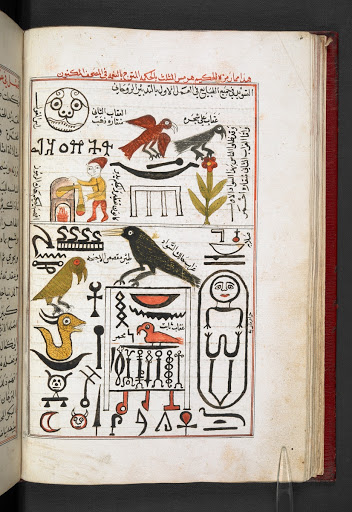
Abū al-Qāsim al-ʿIrāqī · Book of the Seven Climes · 18th-century copy · British Library, Add MS 25724 · public domain · via Google Arts & Culture
Arabic Alchemy · Image · Transmission
A medieval book carrying Zosimos forward
The thirteenth-century alchemist Abū al-Qāsim al-ʿIrāqī gathered and interpreted a remarkable visual inheritance in his Book of the Seven Climes. His illustrations drew upon earlier Arabic alchemical traditions, including material attributed to Zosimos of Panopolis. Ravens, eagles, furnaces, vessels, metals and transformed Egyptian imagery became part of a visual language through which ancient alchemy continued to travel across the medieval Islamic world.
The British Museum's research into the manuscript tradition shows just how dynamic that transmission could be: images were copied, reduced, reinterpreted and supplied with new symbolic meanings across centuries. It provides a particularly vivid material example of how alchemical knowledge could be copied, reworked and recontextualised across languages and centuries.
Yellowing · a stage present in some, not all, later schemata.
05
Rubedo
Reddening · culmination · completion imagery.
Across the alchemical corpus, these colours and operations form a shifting symbolic vocabulary rather than a single rigid sequence. Different texts arrange the work in different ways, while later spiritual and Jungian traditions drew the stages into increasingly coherent maps of transformation. Read historically, that evolution is part of alchemy's fascination: the opus itself changes as it travels.
Physical Alchemy · Spiritual Alchemy
When the work on matter
becomes a language for work on the self
Historical alchemy contains several overlapping modes of practice. Some texts concentrate on substances and operations; others bring laboratory work into close relationship with theology, cosmology, moral purification and the transformation of the practitioner. Later esoteric, religious and psychological traditions make this interior dimension increasingly explicit.
In that interiorised reading, the alchemical opus becomes a powerful language for personal transformation. The prima materia can suggest what is confused, neglected or not yet understood; dissolution can evoke the breaking down of an old form; purification asks what must be differentiated from what; the conjunction brings opposites into relationship; and the philosopher's stone can become an image of an achieved, though never final, integration.
This later interiorisation is one reason alchemy remains so powerful within depth and archetypal psychology. Its imagery offers a language for encounter with what has been neglected, divided or left unintegrated, while retaining the central alchemical idea that transformation requires process rather than instant resolution. Helena reads these later psychological uses alongside the historical alchemical texts, tracing how the imagery acquired new meanings as it moved into modern depth psychology.
Coniunctio · The Tension of Opposites
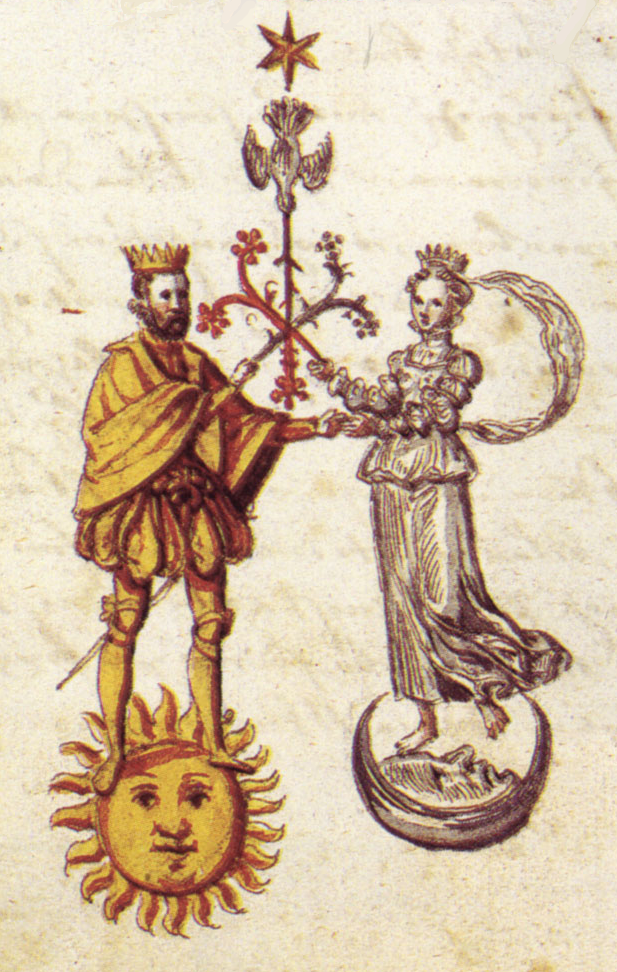
Alchemical marriage of Sun & Moon · Jaroš Griemiller · Czech Rosarium Philosophorum · 1578 · public domain · via Wikimedia Commons
Wholeness is not achieved by destroying one pole
The alchemical conjunction became one of the great images through which later esoteric and Jungian traditions imagined transformation: masculine and feminine, spirit and matter, light and darkness, conscious and unconscious brought into relationship without simply erasing their difference. For Helena, this is also where alchemy enters a particularly fertile conversation with Thunder, Perfect Mind: a voice capable of holding apparent contradiction without surrendering its wholeness.
Mead · Yeats · Modern Gnostic Reception
Ancient Gnosis
Modern Imagination
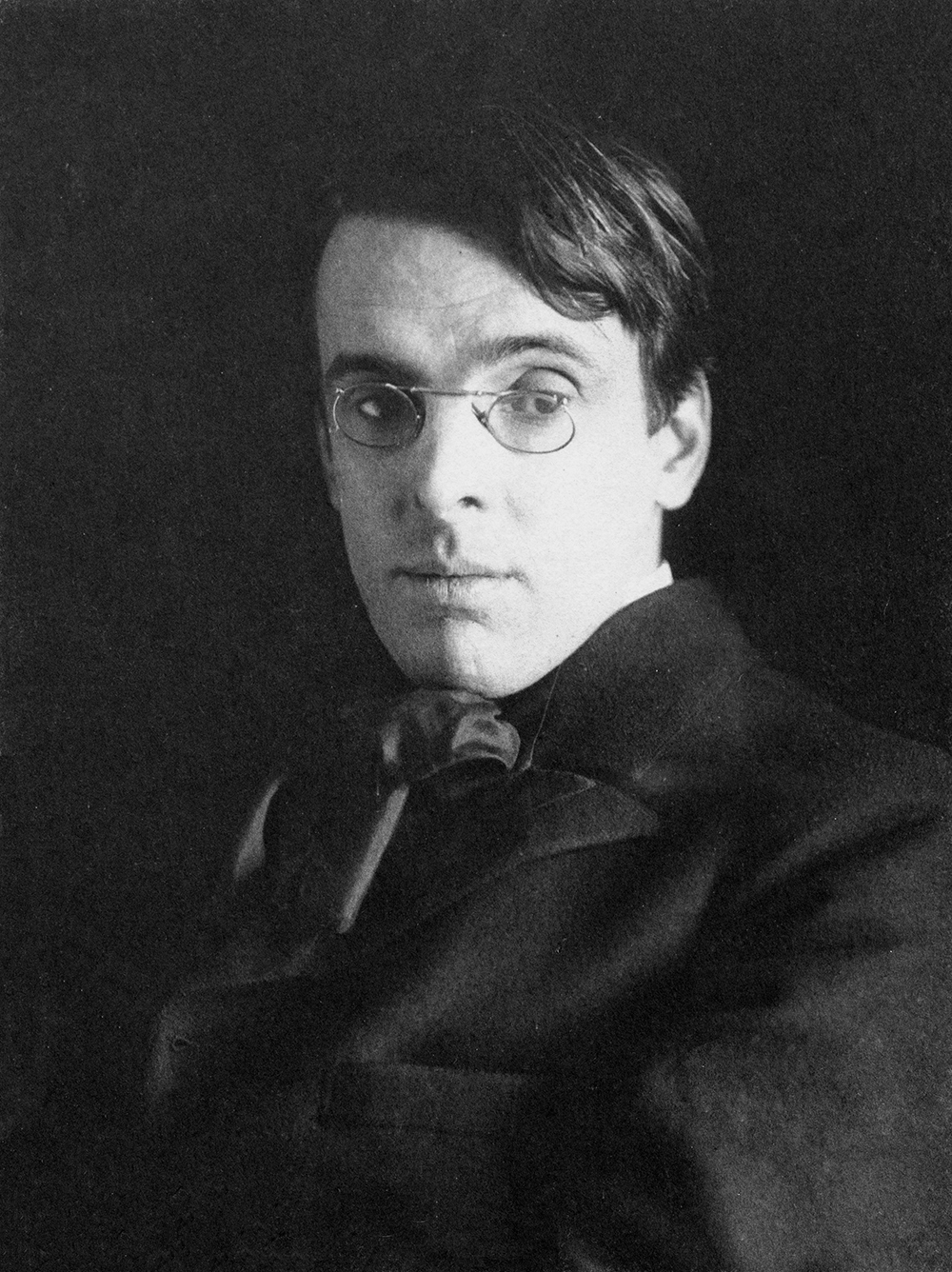
Mead · Yeats · A Vision
W. B. Yeats · photograph by Alice Boughton · 1903 · public domain · via Wikimedia Commons · click to enlarge
Yeats · Occult Papers · National Library of Ireland
The archive behind A Vision
Yeats's surviving occult papers place ritual notebooks, automatic writing, Tarot, astrology, diagrams and initiatory records beside the literary imagination that eventually produced A Vision. The National Library of Ireland's Yeats exhibition provides a remarkable public route into this material world.
The recovery of Gnostic literature did not remain confined to specialist scholarship. G. R. S. Mead — Theosophist, scholar and translator — was one of the crucial figures who made Gnostic material available to English-language readers before the Nag Hammadi discoveries transformed the field. His 1896 Pistis Sophia became one of the earliest substantial English-language encounters with a major Gnostic text, and his writings on figures such as Simon Magus helped transmit Gnostic ideas into the intellectual and esoteric culture of the late nineteenth and early twentieth centuries.
For Helena, Mead is especially important because his connection with W. B. Yeats is not merely one of parallel interests. Mead and Yeats knew one another personally through the Theosophical milieu, and Helena's Yeats research draws on evidence that explicitly identifies Mead as Yeats's friend and as one of the sources through which Yeats encountered traditions surrounding Simon Magus, Ennoia and divine Wisdom. That relationship provides a concrete historical bridge between the modern recovery of Gnosticism and Yeats's own esoteric imagination.
The connection becomes even more significant with A Vision. Mead later reviewed Yeats's A Vision in The Quest in October 1926, making him not simply part of Yeats's earlier esoteric circle but a direct contemporary reader of the mature symbolic system Yeats constructed. Helena is particularly interested in this convergence: a major modern interpreter of Gnosticism reading a work whose architecture is deeply concerned with opposites, cycles, incarnation, spiritual development, hidden knowledge and realities beyond ordinary consciousness.
Yeats is therefore especially significant within Helena's wider research because esoteric thought was not peripheral to his imagination. His engagement with Theosophy, the Golden Dawn, Neoplatonism, spiritualism and systems of correspondence fed into the symbolic world that eventually became A Vision. Helena explores Gnostic resonances that can be traced through that work and across his poetry — including the soul's journey, antinomies and opposites, cycles of incarnation, the search for transformative knowledge and the relation between the visible world and a deeper metaphysical order. She places A Vision within the wider esoteric matrix from which Yeats fashioned his extraordinary private cosmology, allowing its Gnostic resonances to be read alongside its other intellectual and initiatory sources.
This modern reception sits alongside Helena's work on Sophia and the Sacred Feminine, medieval dissident traditions including the Cathars, Western esotericism, Jungian and archetypal psychology, symbolism and the history of spiritual experience. Her work follows these ideas through documented transmission, resonance and creative reception, asking why awakening, exile, hidden knowledge, descent, opposites and return repeatedly re-emerge in new historical forms.
Jung · Quispel · Hoeller · The Gnostic Imagination
From ancient gnosis
to the psychology of transformation
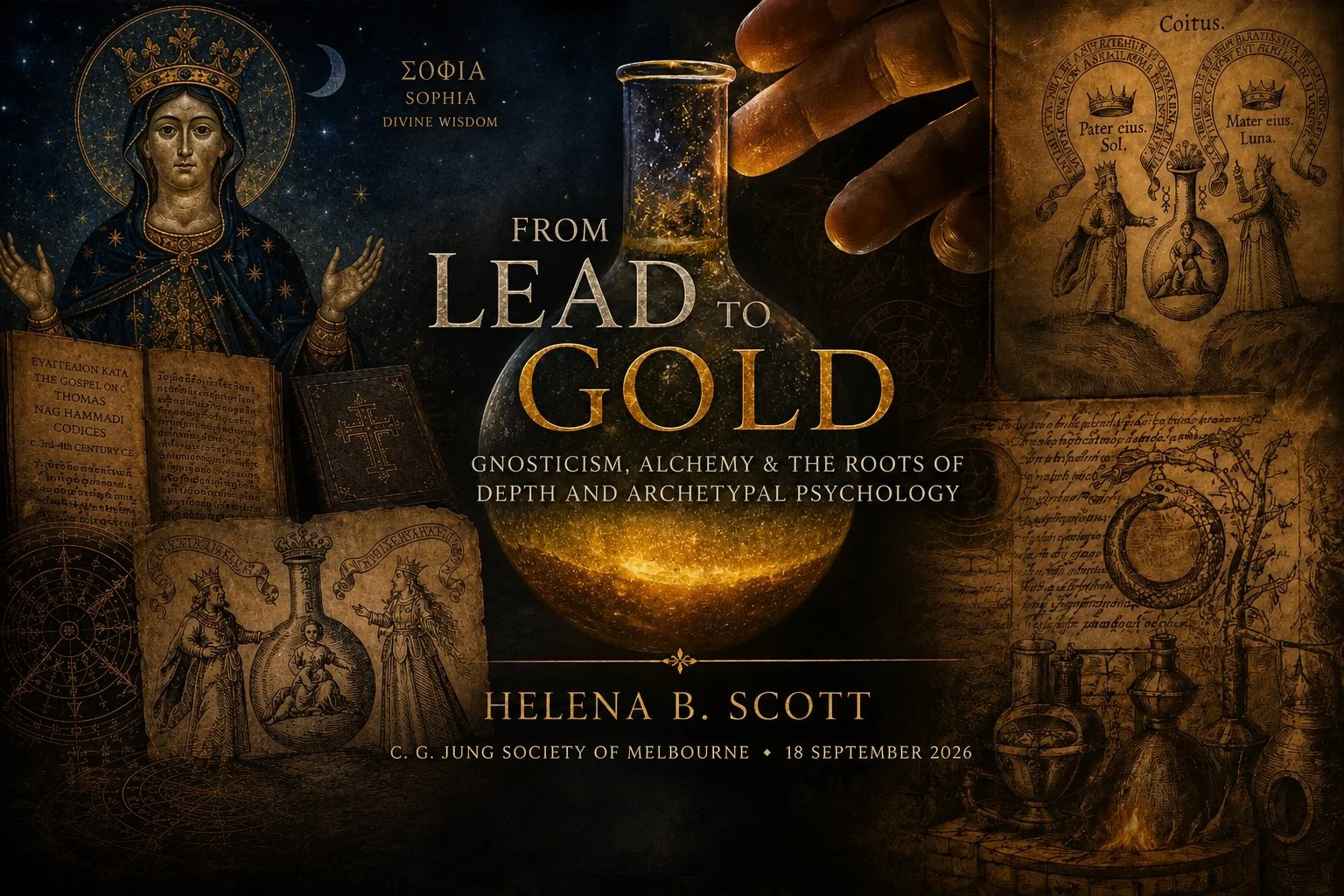
One of Helena's central research questions is what happened when the ancient languages of gnosis and alchemy encountered the modern discovery of the unconscious. Her 2026 lecture for the C. G. Jung Society of Melbourne, From Lead to Gold: Gnosticism, Alchemy & the Roots of Depth and Archetypal Psychology, follows this question from Gnostic myth and Zosimos of Panopolis through the alchemical vessel, the Great Work, Jung's encounter with alchemy, individuation and archetypal psychology.
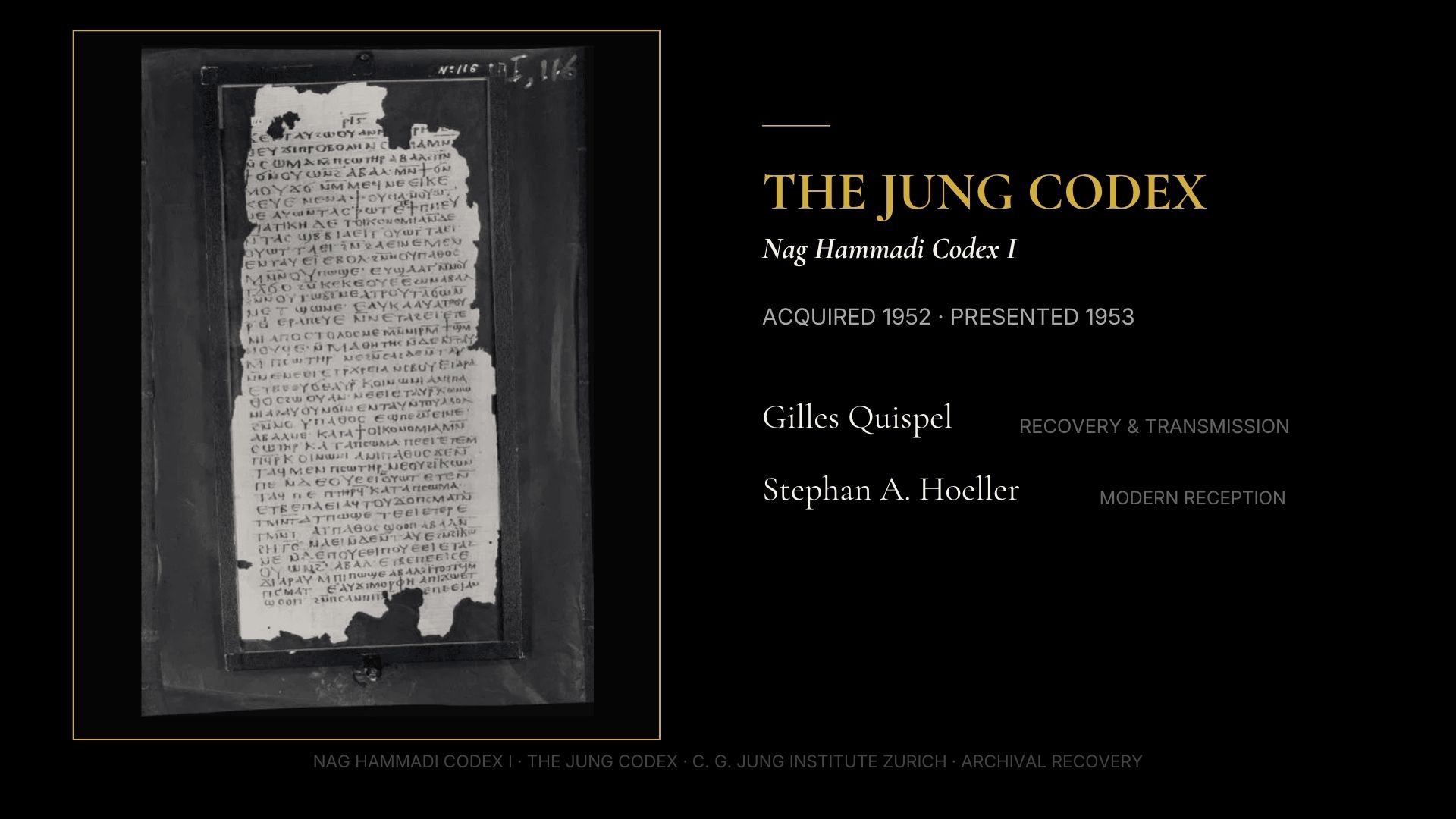
Gilles Quispel is particularly important to this story. A major scholar of Gnosticism and an early editor of the Nag Hammadi material, Quispel knew Jung and was closely involved with the codex that became known as the Jung Codex. That historical encounter between Gnostic scholarship and Jung's psychological world matters to Helena because it provides something stronger than a superficial similarity of symbols: a documented intellectual relationship that can be investigated critically.
Helena's guiding discipline is simple: resonance is not causation. Ancient Gnosticism and historical alchemy must first be allowed to speak in their own voices. Only then does she ask what Jung made of them psychologically, and only after that does she open a clearly marked contemporary interpretation. Gnosticism offers a mythology of transformation; alchemy offers process, matter and an extraordinary imagery of transformation; depth psychology provides another language through which those images can be encountered within the psyche.
Recent International Lecture · 18 September 2026
From Lead to Gold
Gnosticism, Alchemy & the Roots of Depth and Archetypal Psychology
Presented for the C. G. Jung Society of Melbourne, the lecture follows Gnostic myth, Zosimos and the alchemical opus into Jung's understanding of individuation and the transformative work of the psyche. Following the lecture, Helena was invited to return to the Society for a 2027 masterclass.
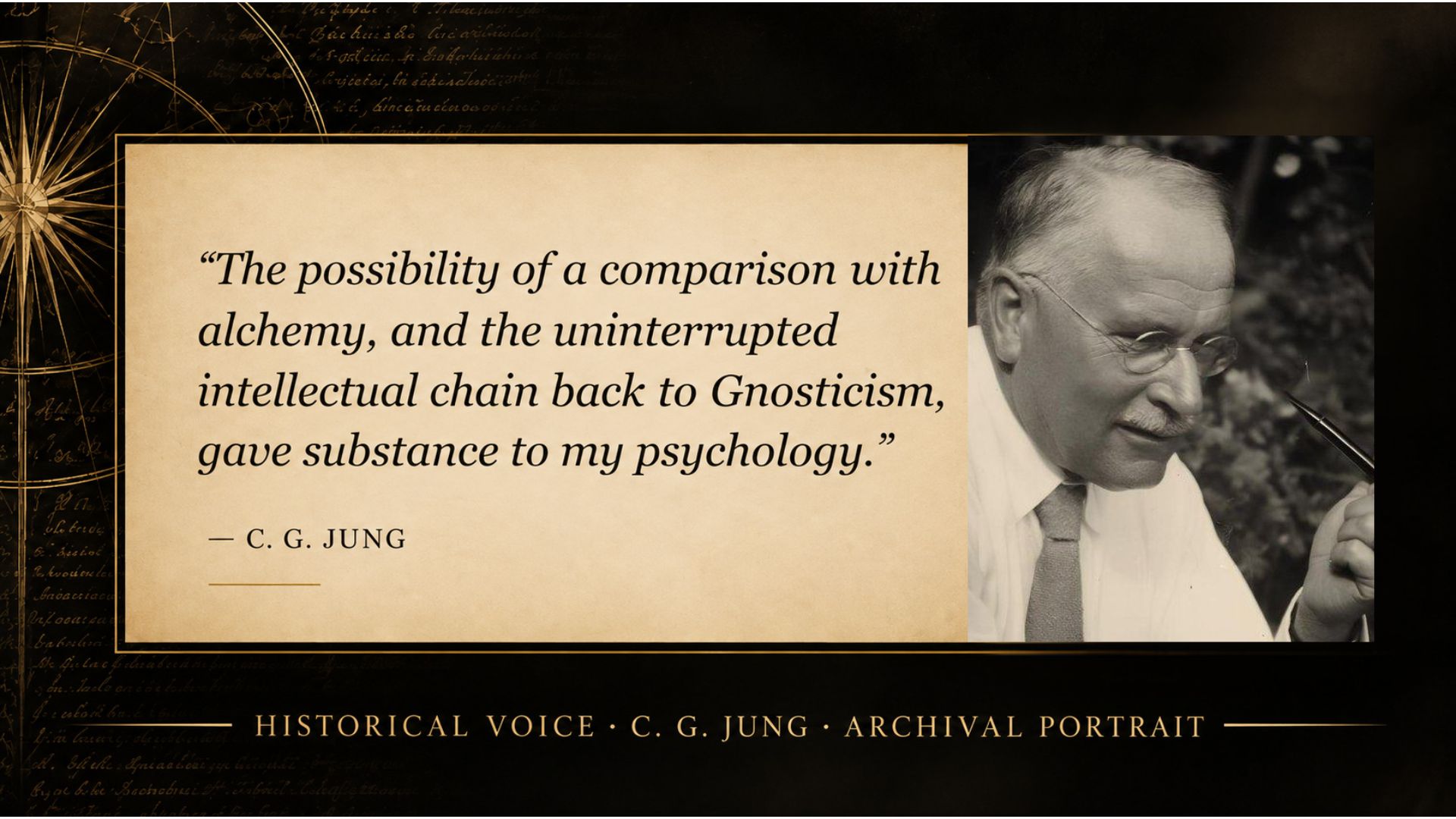
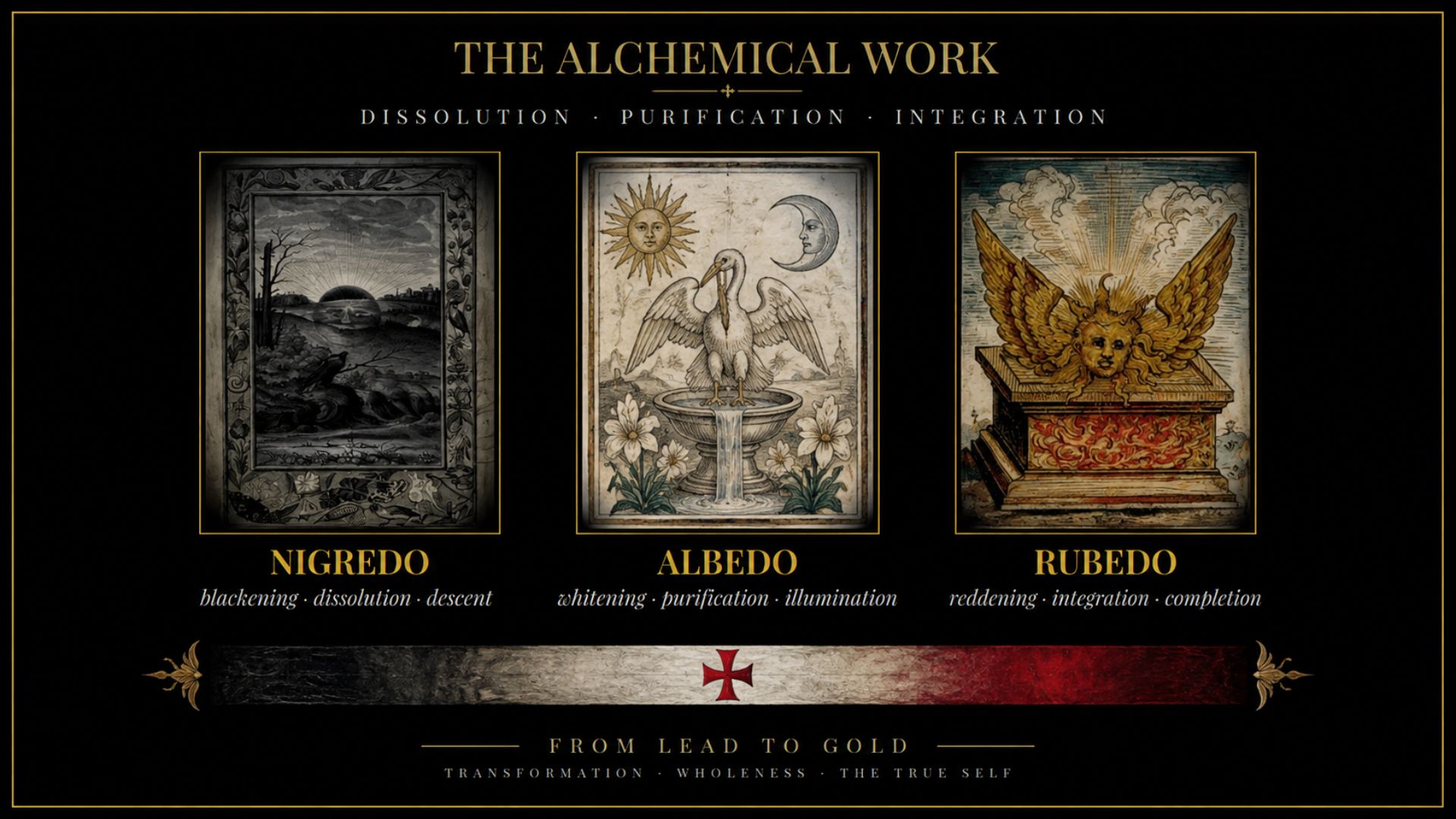
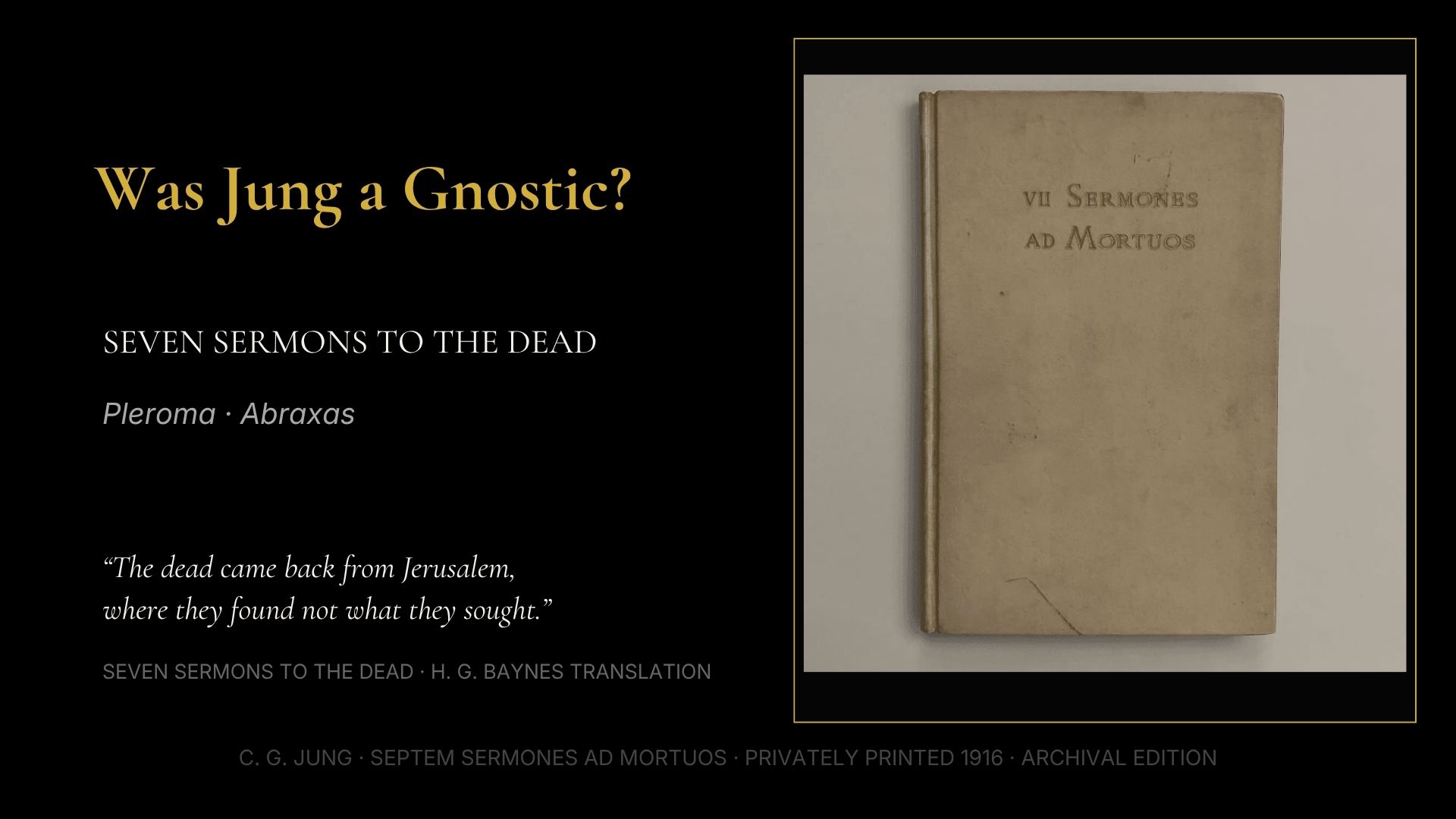
These four slides offer a glimpse of the argument developed in From Lead to Gold: Jung's own linking of alchemical and Gnostic material; the alchemical work as a language of transformation; the remarkable history of the Jung Codex; and the question raised by Seven Sermons to the Dead — was Jung a Gnostic?
01 · Jung in his own words02 · The Alchemical Work03 · The Jung Codex04 · Was Jung a Gnostic?
The Templar Colours · An Alchemical Reading
In From Lead to Gold, Helena brings Templar colour symbolism into conversation with the alchemical work. The medieval Beauséant, divided between black and white, provides an especially striking image of polarity. That visual opposition finds a powerful later correspondence in the High Priestess, enthroned between the black pillar B — Boaz and the white pillar J — Jachin, the names of the two pillars associated with the entrance to Solomon’s Temple.
The Priestess occupies the threshold between the pillars: black and white, darkness and light, two apparently opposing conditions held within a single symbolic architecture. She holds the tension between them.Temperance takes the process further: the opposites enter into movement as the angel pours between the vessels. The Priestess holds the opposites; Temperance works between them.
The modern Templar flag then introduces red alongside black and white, producing a striking correspondence with the alchemical colour sequence nigredo · albedo · rubedo. The Beauséant, Boaz and Jachin, the High Priestess, Temperance and the alchemical work illuminate for Helena a recurring initiatory pattern: polarity → threshold → encounter → transformation → integration.
And yes — while preparing a lecture on Jung and alchemy, Helena was determined to get the Templars in there somewhere. The modern flag gave her the opportunity.
Seven Sermons to the Dead · 1916
Was Jung a Gnostic?
Seven Sermons to the Dead makes the question compelling. Written decades before the Nag Hammadi discovery, it speaks through a distinctly Gnostic imaginative vocabulary: Pleroma, Abraxas, opposites, differentiation and the relation between the human and the divine. The deeper question is what Jung recognised in Gnosticism that allowed its symbolic world to become part of the language through which his psychology was emerging.
The later history of the Jung Codex gives that relationship an extraordinary material dimension. Through Gilles Quispel and the Bollingen circle, Nag Hammadi Codex I became associated with Jung and was presented to him in 1953 — bringing the recovered Gnostic archive into direct historical contact with a thinker who had already been engaging Gnostic imagery for decades.
Research Constellation
Eight paths through the material
Texts, symbols, histories & transformations
Rather than treating Gnosticism and alchemy as a single story, Helena follows a series of connected paths — from ancient sources and material practice to later reception, symbolic interpretation and the questions these traditions continue to open.
Why eight?
Eight has its own long afterlife in traditions of renewal and transformation: the Christian eighth day could signify resurrection and new creation; the eight-rayed star belonged to the ancient iconography of Inanna/Ishtar and Venus; and later Western esoteric systems associated the eighth sefirah, Hod, with Mercury. Helena treats these not as proof of one hidden lineage, but as examples of the way symbolic forms acquire new meanings as they travel.
01
Gnosis · Awakening · Remembrance
+
Gnosis as transformative knowing: the divine spark, estrangement, awakening and return across the diverse texts and schools now gathered under the contested modern category “Gnosticism”.
02
Nag Hammadi · Sophia · Barbelo
+
The recovered Coptic library and the feminine divine: Sophia, Barbelo, Pleroma, creation and the extraordinary plurality of early Christian and Gnostic thought.
03
Zosimos · Matter · The Vessel
+
Alchemy in the Greco-Egyptian world through Zosimos of Panopolis: laboratory practice, visionary experience, matter and spirit, and the vessel as one of alchemy’s enduring images.
04
The Great Work · Nigredo to Rubedo
+
Prima materia, dissolution, purification, illumination and transformation — approached first as historical alchemical language and then, distinctly, through its later psychological resonances.
05
Coniunctio · Opposites · Individuation
+
The union and tension of opposites — light and shadow, spirit and matter, masculine and feminine, conscious and unconscious — and their later importance in Jung’s psychology of individuation.
06
Jung · Gnosis · The Modern Psyche
+
Jung’s documented encounters with Gnostic and alchemical material, from the Seven Sermons and the Red Book to Quispel, the Jung Codex and the question that still provokes debate: was Jung a Gnostic?
07
G. R. S. Mead · Gnostic Recovery
+
The pioneering scholarship of G. R. S. Mead, whose translations and studies helped return major Gnostic texts — including Pistis Sophia — to English-language readers at the turn of the twentieth century.
08
Yeats · Esotericism · A Vision
+
W. B. Yeats as a modern esoteric thinker: Theosophy, occult philosophy, the symbolic architecture of A Vision and the ways Gnostic and related esoteric ideas illuminate his poetry and imaginative system.
Study & Living Gnostic Traditions
Primary texts, trusted communities and contemporary voices.
Study · Primary Sources · Trusted Communities
Where to study Gnosticism
Begin with the texts. Then follow the living traditions.
Helena's approach begins with the surviving Gnostic sources themselves: the Nag Hammadi codices, related apocryphal writings and the historical worlds in which they were produced. She distinguishes this source-led study from later occult systems that use Gnostic language while combining it with Thelema, O.T.O. ritual, Freemasonry or other modern esoteric frameworks. Those later traditions have their own histories, but they are not interchangeable with the ancient texts.
Study with Helena
Gnosticism & Alchemy
Helena teaches Gnosticism and alchemy through lectures, guided reading, courses and one-to-one mentorship, beginning with ancient texts and historical context before moving into reception, Jung and later esoteric interpretation.
For those seeking a living sacramental Gnostic tradition, Helena recommends the Ecclesia Gnostica in Hollywood, whose modern life was profoundly shaped by the late Bishop Stephan A. Hoeller. His teaching remained closely engaged with the classical Gnostic scriptures, Jungian interpretation and the wider Gnostic tradition, and his legacy continues to inform the community.
Helena is grateful for the support she has received from the Gnostic Union, and in particular from Bishop Jody Bédard, Bishop Jason Jones and Bishop Nathan Wilson. Their encouragement and openness to her work have made the Union an especially valued part of her wider Gnostic network. The Union is a growing independent network of Gnostic Christian communities and individuals, with much of its activity currently taking place online.
For anyone beginning independently, the Gnosis Archive is one of the most useful free online collections of Gnostic primary texts, translations, historical resources and material connected with the Nag Hammadi library.
Bishop Nathan Wilson also hosts the YouTube channel Spiritual Level of Being, which Helena recommends for its substantial material on Gnosticism, scripture and Gnostic Christianity. Helena's own interview with Bishop Wilson appears below.
A conversation with Bishop Nathan Wilson on Gnosticism, the Knights Templar and the wider questions that connect Helena's historical and esoteric research.
Aeon Byte Gnostic Radio · Miguel Conner
The Gnostic Knights Templar
Helena joins her friend and professional colleague Miguel Conner on Aeon Byte Gnostic Radio to discuss the Gnostic dimensions of her Templar research. Miguel has spent many years bringing Gnostic texts, scholarship and contemporary debate to a wider audience, and Helena values his continuing contribution to the modern Gnostic conversation.
Listen Further · Aeon Byte Gnostic Radio · Stephan A. Hoeller
Remembering the Life & Legacy of Stephan Hoeller
In this special Aeon Byte Gnostic Radio episode, Miguel Conner gathers a circle of friends, colleagues and members of the wider Gnostic community to honour the life of the late Dr Stephan A. Hoeller. The programme is both memorial and celebration: participants reflect on his influence as one of the major modern interpreters and teachers of Gnosticism, his work with the Ecclesia Gnostica, and the spiritual freedom his teaching encouraged.
The published episode is credited to “Various Astral Guests” rather than naming every contributor individually in the public description. Miguel opens the programme by recalling his own personal encounters with Hoeller, including attending an Ecclesia Gnostica service and their many conversations over the years. The episode is therefore valuable not only as tribute, but as a glimpse of Hoeller's living impact on people who knew, studied with and worked alongside him.
For Helena, this is also an appropriate companion to the recommendation above: anyone approaching the Ecclesia Gnostica today should understand the scale of Hoeller's contribution and the community of scholars, clergy, students and seekers shaped by his work.
From public scholarship and institutional programmes to advanced study and one-to-one work.
Teaching · Lectures · Living Tradition
From ancient texts to questions that still matter
Helena lectures on Gnosticism, alchemy and their place within the Western esoteric tradition, introducing audiences not only to names, dates and doctrines but to the questions that made these traditions endure: What is the nature of the self? What does it mean to awaken? Can a person be transformed rather than merely informed? How do we recognise what is false, fragmented or inherited within us — and what might a more integrated life require?
Helena's long relationship with the College of Psychic Studies is especially meaningful here. She trained there for more than a decade and now teaches there; the College's historic concern with the exploration and awakening of consciousness speaks directly to what draws her to gnosis itself — knowledge understood as an awakening of consciousness rather than the passive accumulation of information.
Her teaching moves between primary sources, historical context, symbolic imagery and carefully marked modern interpretation. Students encounter Gnostic cosmologies and Sophia traditions, the material reality of the alchemical laboratory, the changing symbolism of the opus and the later spiritual and psychological readings that made alchemy one of the great languages of transformation in the Western imagination.
Helena's aim is to make these subjects intellectually alive: to let readers and students understand why people across centuries returned to images of exile and remembrance, lead and gold, dissolution and conjunction, death and renewal — and why those images still speak so forcefully to people trying to understand their own inner lives.
College of Psychic Studies · Teaching Archive
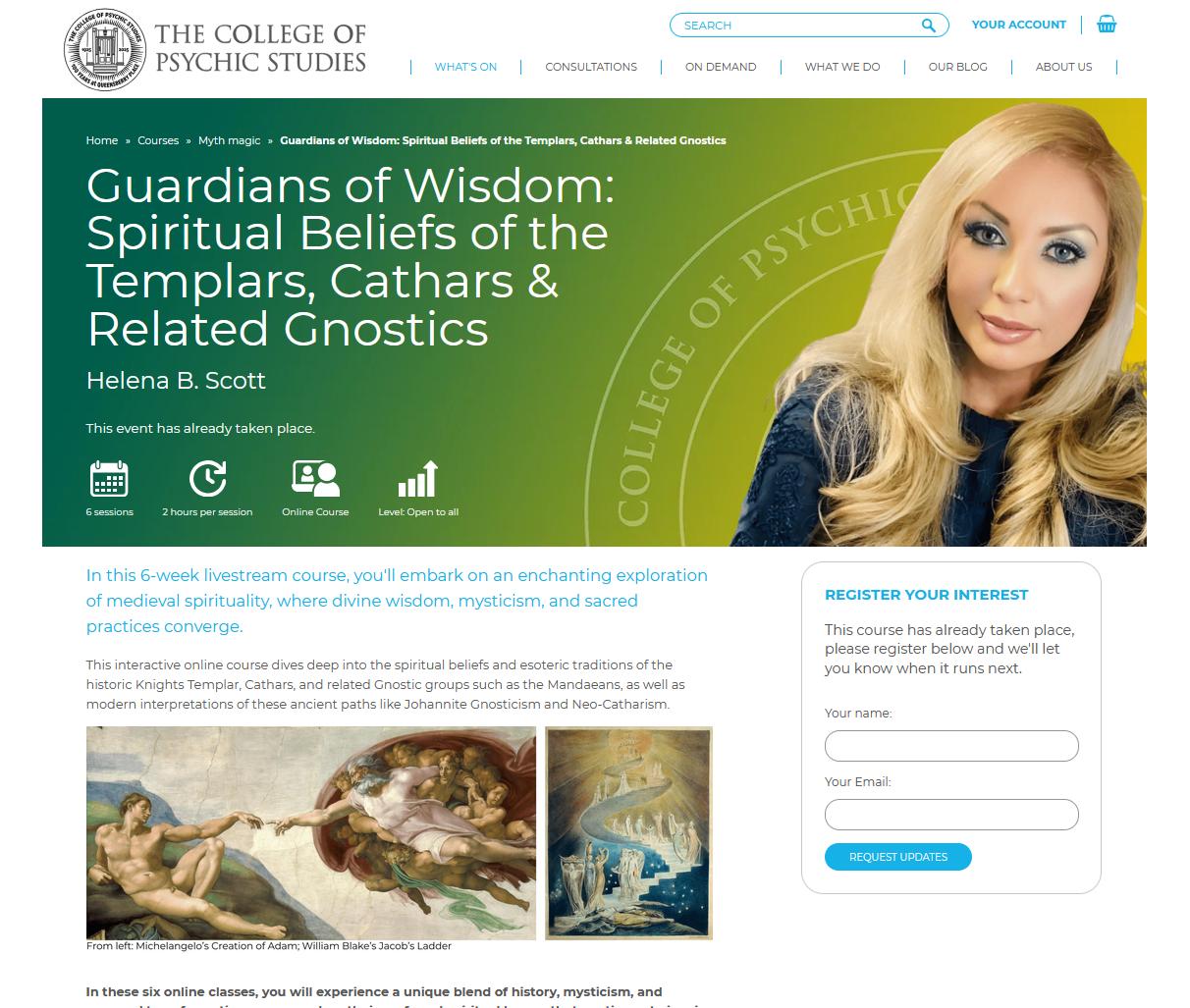
Guardians of Wisdom
Spiritual Beliefs of the Templars, Cathars & Related Gnostics
This College course brought together several strands central to Helena's work: the Knights Templar, Cathars, Gnostic traditions and the history of esoteric ideas. It also shows the continuity between her public historical research and her teaching on Gnosticism as a living field of study.
College of Psychic Studies · London · Click to enlarge
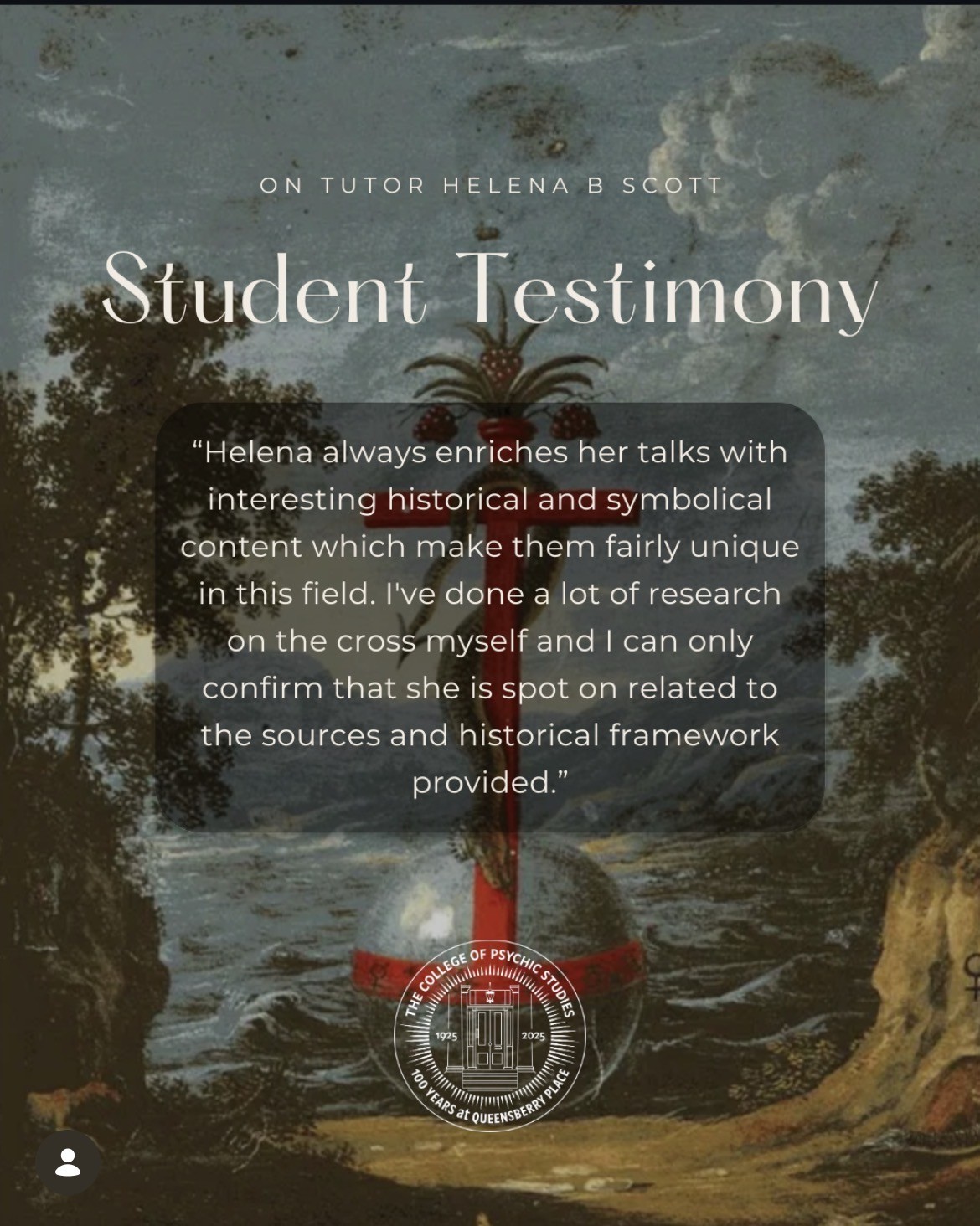
Student Testimonial · College Teaching · Click to enlarge
Upcoming · College of Psychic Studies · 17 November 2026
Gnosticism, Watchers & the Modern World
Helena's forthcoming online College lecture explores ancient Gnostic cosmology — the Demiurge, Archons, Watchers, secrecy, power and revelation — in dialogue with questions that continue to press upon the modern world. Drawing on Gnostic manuscripts, the Nag Hammadi library and related ancient sources, the lecture moves between historical scholarship, archetypal interpretation and contemporary relevance.
Helena's wider teaching practice at the College of Psychic Studies includes Gnosticism alongside alchemy, Western esotericism, symbolism, the Sacred Feminine and Jungian perspectives. The same source-led but accessible approach shapes her independent lectures, masterclasses and private study.
Selected Sources & Scholarship
Research foundations
Primary texts, translations, archives and scholarly conversations behind the public interpretation.
This Research World is written for a broad public, but its arguments are grounded in primary-source reading, manuscript evidence and modern scholarship. The following selection identifies some of the principal texts, scholars and repositories that recur across Helena's work.
Open selected sources & scholarship +
Nag Hammadi Library & Gnosis Archive
Primary-text translations and historical resources for the Nag Hammadi corpus and related Gnostic writings.
Lectures · Masterclasses · Research · Cultural Interpretation
Bring this research
into your programme, institution or project
Helena works with universities, learned societies, museums, heritage organisations, cultural institutions and specialist teaching bodies to turn complex material into rigorous, compelling public interpretation. Her approach is source-led, interdisciplinary and designed for audiences ranging from academic specialists to the wider public.
Gnosticism, alchemy, primary texts, Jung, the Sacred Feminine, research development and individually guided reading for students, researchers and serious independent learners.
Symbolic and depth-oriented exploration using Jungian, archetypal and psychospiritual approaches where alchemical or Gnostic imagery is meaningful to the individual's own process.
Gnostic and alchemical material can remain a subject of historical study or become a language through which to explore a period of transition, a loss of meaning, unresolved experience, inner conflict or the sense that an older identity no longer fits. Helena offers private one-to-one work for those who want to explore these traditions in a more personal and sustained way.
Sessions can draw upon Gnostic myth, alchemical imagery, Jungian and archetypal perspectives, shadow work and psychospiritual counselling according to the individual's needs. Alchemical themes such as the nigredo, dissolution, conjunction and renewal can provide symbolic containers for difficult experience, including past wounds and patterns that have not yet been fully integrated. The work is depth-oriented and psychospiritual, centred on meaning, consciousness, integration and the person's own process.
This page is the historical and interpretive home for Helena's work on Gnosticism and alchemy. The Jungian, Archetypal & Depth Psychology page takes up a different question: how Jung and later depth thinkers received these older symbolic traditions and used them to think about psyche and individuation. Related pathways also lead into the Sacred Feminine and the wider history of Western esotericism.
New research, forthcoming books, lectures, fieldwork, courses and occasional notes from Helena B. Scott.
By subscribing, you agree to receive occasional research news, publications, events and updates from Helena B. Scott by email. You can unsubscribe at any time. Privacy Policy.
Google Analytics helps understand how visitors find and use the site. If you decline, analytics cookies remain off and only limited cookieless measurement signals may be sent. It is not used for advertising here.