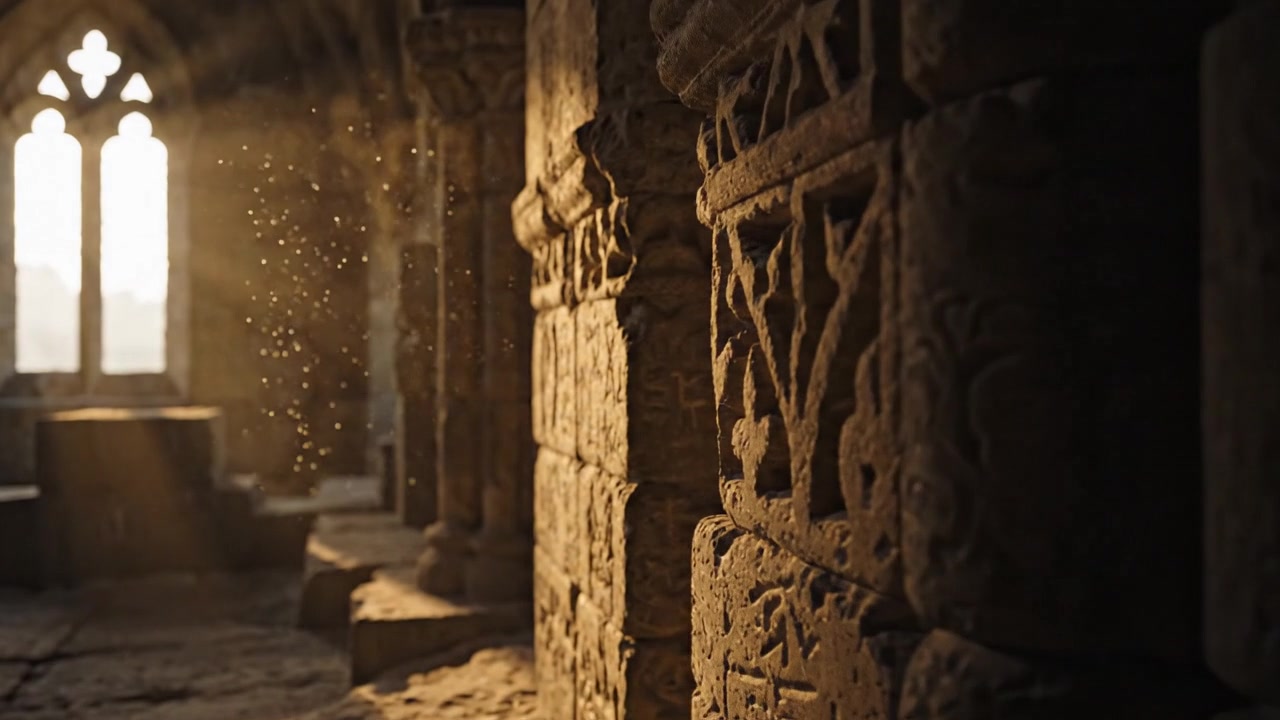
Ireland’s first digital atlas dedicated to recording and interpreting mason’s marks, medieval graffiti and historic symbols.
The Research Story
From field discovery to a national record
Every mark is material evidence: a trace of craft, belief, presence and memory.
01 · An Irish Beginning
The need began in the field
Marks of Ireland was conceived, founded, designed and developed by Helena B. Scott. It grows from more than twenty years of research into symbolism, mason’s marks and inscribed heritage, and from a practical problem encountered in her own historical and archaeological work: Ireland’s surviving evidence is exceptionally rich, yet dispersed across buildings, specialist publications, archaeological records, local archives and custodial knowledge.
Holy Cross and Kilcooley Abbey in County Tipperary are two of Helena’s principal research landscapes. Long-standing conversations with historians and custodians — including her good friend Liam Noonan, historian and custodian of Kilcooley Abbey — confirmed that the difficulty was not an absence of Irish research, but the absence of a single accessible framework through which that knowledge could be found, compared and extended.
02 · Evidence & Formation
Research shaped by evidence
The project develops directly from Helena’s MA research and fieldwork at Kilbarry, where she identified previously unrecorded archaeological features, including historic Masonic graffiti later entered into Ireland’s National Monuments Service records. Her postgraduate work was supervised by Dr Niamh NicGhabhann Coleman of the University of Limerick, whose doctoral formation under Professor Roger Stalley offered an important connection to the rigorous study of Irish medieval religious architecture and monastic material culture.
Its methodological foundations include Violet Pritchard’s pioneering work on English medieval graffiti, Matthew Champion’s survey-led practice, Colum Hourihane’s major study of mason’s marks in the medieval Irish archbishoprics of Cashel and Dublin, and William Harry Rylands’s early illustrated recording of mason’s marks in English ecclesiastical and monastic buildings. Roger Stalley’s scholarship remains a wider intellectual influence on Helena’s understanding of medieval Ireland.
Original Field Research · Kilbarry, Waterford
From field observation to Ireland’s National Monuments Record
Three archaeological features identified and reported by Helena B. Scott at Kilbarry Knights Templar Graveyard were confirmed by Ireland’s National Monuments Service and entered into the public record, with Helena recorded as identifier and reporter.
Marks of Ireland · Digital AtlasPublic release · November 2026
03 · A Comparative Field
Ireland within a wider landscape
Helena’s comparative field and documentary research extends through Ireland, Scotland and England, with developing work in Northern Ireland. It also reaches into northern Spain and the Camino de Santiago: a landscape she knows closely through her maternal family roots in Cantabria and the Camino del Norte, and through its exceptionally rich inheritance of Romanesque churches, pilgrimage architecture and carved stone. Comparable work elsewhere shows what sustained recording can reveal. The St Magnus Graffiti Project in Orkney recorded hundreds of graffiti, masons’ marks and related inscriptions at St Magnus Cathedral through archaeologist-led community survey, while the Scottish Stonemasons’ Marks Project is recording and comparing marks across medieval castles and churches to investigate craft networks and the mobility of masons.
The Iberian comparison is strengthened by Project SIGNO’s extensive catalogue of stonecutters’ marks across the peninsula. Helena’s formation in stone-craft history also draws on the French Compagnonnage traditions of the Children of Solomon, the Children of Maître Jacques and the Children of Père Soubise — traditions of geometry, journeying, initiation and transmitted skill. North Atlantic Norse inscriptions form a distinct comparative strand within her wider work on Norse culture, history, magic and memory.
Ireland does not lack marks, nor does it lack valuable scholarship. What it lacks is a dedicated national corpus capable of bringing mark-by-mark evidence into one coherent, searchable and publicly intelligible record. That fragmentation makes research cumbersome for historians and archaeologists and leaves the general public with no clear place to begin.
Marks of Ireland brings together field recording, documentary research, mapping and responsible interpretation for historians, archaeologists, heritage professionals, custodians, local communities and curious visitors. Its purpose is to catalogue the marks and recover the human stories they carry — creating new pathways into local memory, public history, heritage education and culturally grounded tourism.
Project Status · Public Release November 2026
Marks of Ireland is in active development.
The growing record brings together field documentation, mapping and interpretation across Ireland’s inscribed heritage, ahead of its public release in November 2026.
New research, forthcoming books, lectures, fieldwork, courses and occasional notes from Helena B. Scott.
By subscribing, you agree to receive occasional research news, publications, events and updates from Helena B. Scott by email. You can unsubscribe at any time. Privacy Policy.
Google Analytics helps understand how visitors find and use the site. If you decline, analytics cookies remain off and only limited cookieless measurement signals may be sent. It is not used for advertising here.