Grief · Memory · Continuing Bonds
Love does not end where a life ends.
Grief does not follow a schedule. Nor does the bond we form with someone necessarily disappear because they have died. For many people, relationship continues in another form: through dreams, memory, places, objects, anniversaries, habits, stories, symbols, or the sudden sense that someone remains woven into the fabric of ordinary life.
Helena works with people who want a thoughtful space in which to explore that continuing relationship. Her approach brings together the psychological understanding of continuing bonds with memory, symbolism, ritual, writing, history and spirituality and, where relevant and explicitly requested, her own mediumistic perspective.
This is not about prescribing what grief should look like. There is no correct timetable and no single way to remember. The work begins with the person, the relationship that has been lost, and what that relationship continues to mean.
Where there is unfinished business, a need to say goodbye, or a wish to honour a loved one or companion animal, Helena may also offer a one-off mediumistically informed farewell session. This is not an ongoing séance practice or repeated attempts to summon the dead. Helena's approach is that the deceased should be allowed their own rest; when this work is undertaken, its purpose is closure, remembrance and the possibility of completing what was left unsaid.
This consultation may include
—Grief, remembrance and continuing bonds
—Dreams in which the deceased appears
—Memory, story, photographs, objects and places
—Ritual and memorial practice — including significant dates
—Writing, letters and other forms of continuing dialogue
—Symbolic and archetypal exploration
—Spiritual reflection aligned with your own beliefs
—A one-off farewell or unfinished-business session, where appropriate
—Remote psychometry with meaningful objects, photographs or keepsakes
—Helena’s mediumistic perspective where requested
—Companion animal loss — including farewell work
A Personal Inheritance
It began with a star.
Helena's understanding of grief is not only academic or professional. It reaches back to childhood and to her grandmother, Mona.
Mona was a natural medium. When Helena was a child, her grandmother spoke with her about the presences she sensed, the impressions that came unbidden, and the voices and images that arrived from somewhere she could not always name. Helena came to understand that sensitivity as part of her own inheritance too — not simply an interest acquired later in life, but something with roots in her family and childhood.
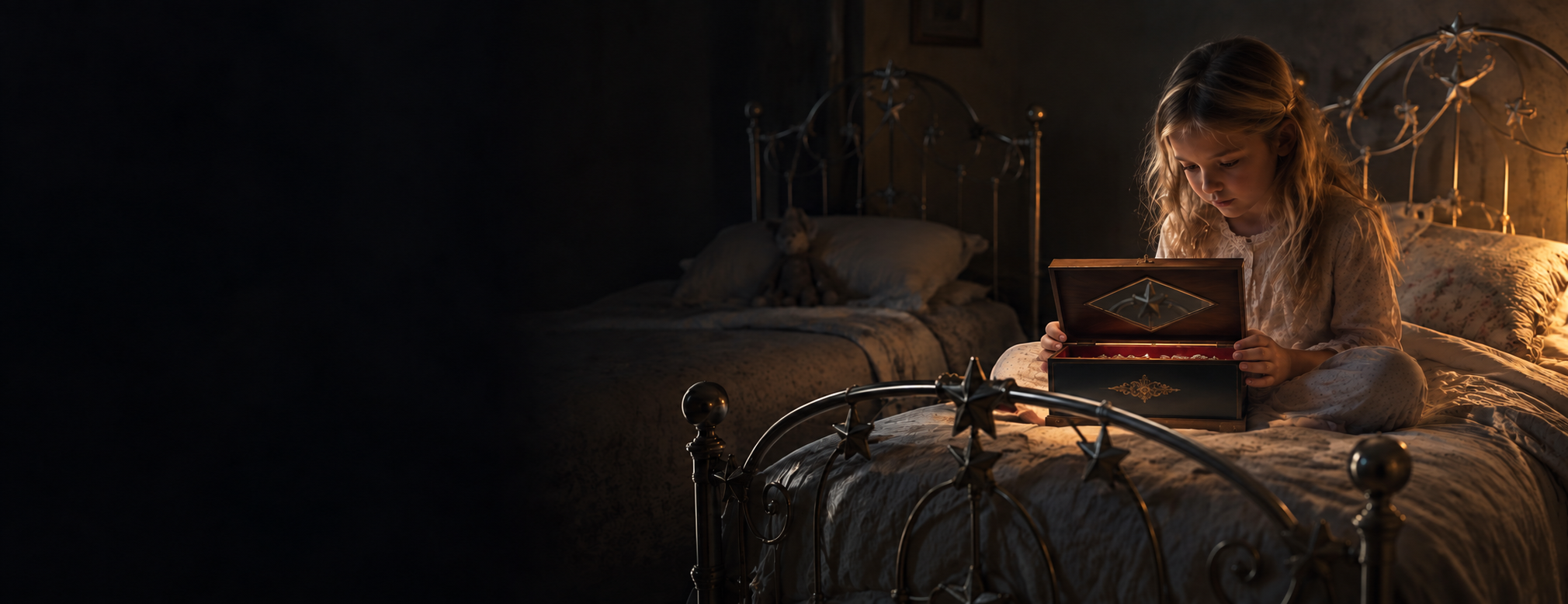
Helena was seven when Mona died. She did not know that her grandmother was dying. When Helena stayed with her grandparents, she would have sleepovers with Mona in a room with two ornate silver-coloured metal beds, their headboards decorated with little stars. The childhood room recreated in the hero image is based on Helena's memory of those visits and of the room in which she and her grandmother slept.
Near the end of Mona's life, she told Helena only that she was going to go away — for a long time. Helena, still a child and not understanding what her grandmother meant, asked the question that mattered to her: “What do I do if I miss you?” Mona answered: “Look for me in the stars.”
Only later did Helena learn that her grandmother had died of cancer. Whatever Mona had chosen to tell the adults around her, she appears to have understood that she was saying goodbye to her granddaughter; she simply found a language a seven-year-old could carry with her.
Little did Helena know how far that image would travel with her. Mona belonged to the paternal side of a family whose ancestry reaches through Spain, America and Egypt. The Egyptian ancestry lay extremely far back — long before the medieval period — and was something Helena would only trace much later. Mona herself would have had no reason to know of that distant connection.
As a child, Helena had already felt an unusual closeness to ancient Egypt and to the Book of the Dead. Only much later, through studying Egyptian religion and funerary traditions, did Mona's words acquire another resonance. Ancient Egyptian ideas of the afterlife associated the blessed or transformed dead with the stars; in that sense, the stars could be understood as the souls of the departed. The historical tradition is more complex than that single phrase, but for Helena the correspondence remains deeply poignant: her grandmother had told a seven-year-old child to look for her in the stars, without knowing of the very distant Egyptian ancestry Helena would later trace or the significance the stars would acquire in her own studies.
Stars have remained an important personal symbol throughout Helena's life. She still wears a five-pointed star necklace at times, and the symbol has acquired further layers through her later work on the Sacred Feminine. What began as a child's memory of the stars on her grandmother's bedstead became, over time, part of a much larger constellation of memory, ancestry, symbolism and research.
After Mona's death, Helena's father gave her the jewellery box that had belonged to her grandmother. Helena was seven years old. It was a small object, but it became one of those things in which memory seems to gather: pale wood-grain lid, dark body, delicate gold decoration, red interior, geometric mirror, one small stone now missing with age. Helena still has it. The box has travelled with her everywhere since she was seven years old.
The jewellery box held by the child in the hero image above is Helena's own box — the one that came to her from Mona. It is not a generic prop. The stars, the child and the box were chosen to carry a real story of bereavement, inheritance and the way an object can continue to hold a relationship long after a person has gone.
Objects · Places · Psychometry
What the dead leave in our hands
Grief often attaches itself to things that appear ordinary to everyone else: a piece of jewellery, handwriting, a chair, a scent, a recipe, a photograph, a particular flower, a set of keys, a box that has survived decades. These objects do not need to be valuable to become irreplaceable. Their importance lies in relationship.
The same is true of small sensory memories. A particular sweet, the colour of violets, a bedroom, the shape of a bedstead, a star: fragments can carry an entire person back into consciousness. They can hurt, comfort, surprise us, or change meaning as we grow older.
For Helena this also connects directly with psychometry — sometimes described as reading the “soul”, memory or energetic history of things. In psychometric practice, an object may become the focus for impressions experienced as images, emotions, bodily sensations, atmosphere or sudden knowing. Contemporary research into subjective psychometry experiences similarly records reports associated with old objects and places, including imagery, intense feeling and forms of direct knowing, while leaving open the question of how those experiences should ultimately be explained.
A useful distinction in the psychometric tradition comes from W. E. Butler's How to Develop Psychometry. Butler described an object's record as twofold: “inherent memory”, associated with the object's own individual existence, and “gathered memory”, the accumulation of impressions attributed to its associations with people. This is a traditional psychometric model rather than an established scientific mechanism, but it provides a useful discipline for practice.
A set of old keys, for example, may have passed through many hands and belonged to several generations. The deeper task is to receive the impression and then ask: what might this belong to? Is it connected with the material object itself, one particular owner, repeated human contact, the place in which it was used, or the reader's own associations? For Helena, that distinction is part of discernment.
This has also informed Helena's historical and cultural-heritage investigations. Her psychometric sensitivity and other modes of intuitive perception — including the clairs — can sometimes suggest a person, place, object, question or line of inquiry worth examining. They do not replace documentary, archaeological or material evidence. An intuitive impression may generate a research question; history still requires that question to be tested against sources.
That meeting point between material culture and intuitive perception is one of the unusual threads running through Helena's work. An inherited object such as Mona's jewellery box can therefore be approached simultaneously as a family artefact, a carrier of autobiographical memory, a material witness to a relationship and, within psychometric practice, an object through which further impressions may be explored.
A Private Gift · A Public Voice
Speaking about what had once remained behind closed doors
For many years Helena's mediumistic work remained private. She developed and worked with her abilities behind closed doors, in a part of life that was not easily discussed publicly and was not something everyone in her family was comfortable seeing spoken about.
That changed with Loftus: The Hall of Dreams. Published in 2018, the book marked the first time Helena decided to publicly share this aspect of her life and gifts. She dedicated the book to Mona, acknowledging the grandmother from whom she believes that sensitivity was inherited.
Publishing it required a choice: to keep an important part of her experience hidden because it made others uncomfortable, or to speak about it carefully and in her own voice. Helena chose the latter. That experience is part of why this consultation is intended to be a place where people can talk about grief, dreams, sensed presence, spiritual experience and continuing connection without embarrassment and without being pushed into either belief or disbelief.
Sometimes grief is difficult not only because someone has died, but because the relationship, the memories or the experiences surrounding that death do not fit easily into the language available to us. They still deserve room to be spoken.
Dream · Symbol · Presence
When the relationship continues
People may dream vividly of someone who has died, feel close to them in a particular place, encounter a recurring symbol, or experience what they understand as a presence. Such experiences can be profoundly comforting, unsettling, or both.
Helena works with several possible frameworks. A dream can be approached psychologically, symbolically, spiritually or through more than one framework at once. Where a client wishes to explore mediumistic or psychical interpretations, that can form part of the conversation; where they do not, it need not.
For some people, a single farewell session can offer a contained way to approach unfinished business: words that were never spoken, questions left unresolved, a wish to know how a loved one may be, or simply the need to say goodbye. Helena has undertaken this kind of work with both human and companion-animal bereavement. It may include remembrance, conversation, symbolic ritual and psychometry using an object, photograph or keepsake shown on screen or brought to the session. Such objects can also help recover the memories, associations and stories surrounding the relationship itself.
The work is designed as a respectful, bounded encounter in the service of remembrance and, where possible, resolution, with the emphasis on the client's own process rather than repeated dependence on mediumship.
Human & Animal Bereavement
No hierarchy of love
This work includes the death of parents, grandparents, partners, children, siblings, friends and other significant people, but it also fully includes companion animal loss. The depth of grief is not determined by whether the person or animal we loved fits somebody else's definition of a relationship that ought to matter.
There is no requirement to perform grief in a particular way here. The consultation is quiet, warm and non-prescriptive, with space for memory, tears, humour, anger, ambiguity, love and the strange coexistence of absence and continuing presence.
This work can also connect with the psychological support and therapy sessions Helena offers following bereavement. For some people, the need is not primarily to explore continuing bonds or a farewell, but to have sustained support while learning how to live with a profound absence. These sessions can offer a place to work through the emotional and psychological impact of loss, regain a sense of direction, and be supported and gently guided as life is rebuilt around what has changed — without asking anyone to leave the person or animal they loved behind.
The bonds we form with those we love do not simply dissolve at death. They change, and sometimes part of grieving is discovering what that changed relationship means.