
Intuitive and psychical experience can take many forms: impressions, presences, dreams that carry unusual weight, sudden knowing, sensitivity to people or places, spontaneous images, energetic awareness, altered states of perception or the sense of receiving information from a source one cannot immediately name.
For those who experience these things, the central question is often not simply whether they are “real”, but how to understand them, work with them responsibly and develop the discernment to distinguish perception from imagination, association or projection.
Helena offers structured development for people at different stages: those encountering psychical experience for the first time; those who have experienced unusual sensitivity since childhood; people returning to abilities they previously suppressed; and those who have already undertaken development and wish to deepen or consolidate their practice.
Her approach is grounded, discerning and historically informed, developing sensitivity alongside curiosity, critical thought and personal sovereignty.
Areas of Development
—Psychometry · objects · places · material impressions
—Clairvoyance · clairaudience · clairsentience · claircognizance
—Mediumistic awareness & responsible development
—Automatic · inspired · inspirational writing
—Trance, channelled & received material
—Meditation & receptive awareness
—Chakras · subtle bodies · aura · energetic perception
—Crystals · dowsing · intuitive methods of inquiry
—Grounding · energetic clearing · boundaries · protection
—Traditional approaches to cords, attachments, negative energies & psychic attack
—Symbolism · Tarot · dreams · archetypal imagery
—Spiritual growth, discernment & responsible practice
Perception · Discernment · Consciousness
Psychical Development as a Discipline
Helena is a natural medium whose psychical and mediumistic awareness preceded her formal training. She spent years developing and studying these capacities independently before undertaking more than a decade of sustained training and development through the College of Psychic Studies in London, followed by further advanced mediumship training at the Arthur Findlay College and specialist development with established practitioners including Tony Stockwell.
Her approach grows from lived experience as well as prolonged study and disciplined practice. It is informed by mediumship and spirituality, but also by her work as a historian, cultural heritage specialist and Jungian scholar, and by her studies in psychology, anthropology, Western esotericism, symbolism and the history of magic, the occult and witchcraft.
Psychical development is not a competition to produce phenomena or become “more psychic”. It is a discipline of perception: noticing how information arrives, recognising one's strongest modes of sensitivity, developing concentration and receptivity, establishing boundaries, questioning what is received and recognising when interpretation has begun to shape the original impression.
Greater sensitivity needs greater discernment.
Image planned · Psychometry
The Soul of Things · hands, historic object, material memoryPsychometry · Objects · Places · Memory
The Soul of Things
Psychometry is one of Helena's particular areas of practice and teaching. It explores impressions that may arise through contact with an object, place or material environment — sometimes described as reading the “soul”, memory or energetic history of things.
An impression may arrive as an image, emotion, bodily sensation, atmosphere, word, association, fragment of narrative or sudden knowing. Helena helps students develop psychometric practice systematically: becoming receptive without forcing an experience; recording what arises before interpretation begins; distinguishing observation from intuitive response; and developing ways of questioning and testing what has been perceived.
Her background as a historian and cultural heritage specialist gives this work an unusual additional dimension. Objects, buildings and landscapes already possess material histories, human associations and layers of memory. Psychometry can therefore become a meeting place between material culture, place, memory, intuitive perception and consciousness, without confusing intuitive information with historical evidence.
It can also become an extraordinary exercise in learning how you perceive.
The Clairs · Intuition · Mediumistic Awareness
The Languages of Perception
Not everyone receives information in the same way. Psychical development may involve clairvoyance, in which information presents visually; clairaudience, involving auditory impressions; clairsentience, in which information may be felt emotionally, atmospherically or physically; and claircognizance, the experience of knowing something without an immediately identifiable process of reasoning.
Clairsentience is particularly important within Helena's work because sensitivity is so frequently embodied. A change in atmosphere, unexpected physical sensation, emotion without an obvious cause or powerful response to a person, place or object can all become part of the perceptual field.
Learning to recognise one's own physical and emotional baseline, ordinary environmental or interpersonal cues, and what appears to arrive as an intuitive impression is central to discernment. Helena works with the individual rather than imposing a single model: the task is to discover how your own perceptual language works and then learn how to refine it.
Aura · Sensitivity · Grounding · Spiritual Development
The Ivy Northage Approach
Helena trained at the College of Psychic Studies for over a decade before returning as a lecturer and tutor. One of the important influences upon her approach is the work of Ivy Northage (1909–2002), one of Britain's most respected twentieth-century teaching mediums. Northage began teaching mediumship at the College of Psychic Studies in 1970 and taught there for many years, leaving an influential body of teaching including Mechanics of Mediumship.
Her approach is particularly relevant because psychic sensitivity was not simply about obtaining information. Development also involved understanding the person who is perceiving: their sensitivity, awareness, spiritual development and capacity to function in ordinary life.
Northage's teaching on the aura is especially important. Within her spiritual framework, the aura expressed individual spiritual identity and was affected by development, depletion and replenishment. Helena draws on this principle practically when helping students explore how they sense the world around them: atmosphere, other people, places, changes in their own physical or emotional state, and the effects of tiredness or poor grounding.
Sensitivity without self-awareness can become confusing. Development therefore includes recognising one's own baseline, grounding, replenishing energy, understanding personal boundaries, and learning when to become receptive and when to return attention fully to ordinary life.
Before learning to interpret what you sense, you need to understand how you sense.
Reception · Mediumship · Creativity · Trance · Discernment
Automatic, Inspired & Inspirational Writing
Writing can become a remarkable threshold between ordinary conscious intention and material that seems to arise from another level of awareness. Helena works specifically with automatic writing, inspired writing and inspirational writing, helping students recognise the differences rather than treating all receptive writing as the same phenomenon.
Automatic writing involves allowing words, phrases, symbols or passages to emerge with reduced conscious direction. Some people remain aware of what is being written; for others the process may feel unusually spontaneous, rapid or autonomous. Historically it appears within mediumship, Spiritualism, psychical research, occult practice and psychological investigations of unconscious processes.
Inspired writing retains greater conscious participation. An idea, image, phrase or understanding may arrive suddenly and with unusual clarity, but the writer remains actively involved in shaping it into language. Inspiration may be experienced intuitively, creatively or spiritually without necessarily being understood as communication from an external intelligence.
Inspirational writing, within mediumistic traditions, can describe a more receptive form in which the writer remains conscious and participates in the process, yet experiences ideas or language as being impressed upon or transmitted through the mind. It occupies an intriguing territory between ordinary authorship and more fully automatic or altered-state reception.
Helena helps students ask: How much conscious control is present? Where does the initial impulse seem to arise? Does information arrive as words, images, concepts or complete knowing? Does the writer experience themselves as creating, receiving, translating — or some combination of these?
Experience first. Record carefully. Distinguish the mode of reception. Interpret afterwards.

Yeats · George · Received Material
The symbolic system that emerged from George Hyde-Lees's automatic writing became central to the extraordinary collaborative project ultimately published by W. B. Yeats as A Vision.
Explore A Vision and the Yeatses' system →Photograph: Lady Ottoline Morrell · Public domain via Wikimedia Commons
Automatic Writing · Symbol · Creativity · Consciousness
Yeats · George Hyde-Lees · Received Material
The history of receptive writing provides extraordinary examples of the difficulty of drawing simple boundaries between creativity, mediumship, unconscious processes and spiritual experience. Helena's research into W. B. Yeats and George Hyde-Lees is particularly relevant. Both were members of the London Spiritualist Alliance, the organisation from which today's College of Psychic Studies developed, while George's automatic writing became integral to the symbolic system developed by the Yeatses and ultimately expressed in A Vision.
Their work raises questions that remain central to psychical development: Where does received material come from? What is the relationship between mediumship, inspiration, imagination, creativity, the unconscious and possible external intelligence? How should received material be questioned, interpreted and integrated?
Other historically significant examples of received spiritual writing, including Helen Schucman's account of the inner dictation associated with A Course in Miracles, allow different modes of reception to be considered comparatively rather than collapsed into a single category.
No single explanation needs to be imposed upon every experience. Learning to remain receptive without becoming uncritical of what is received is itself part of the work.
Chakras · Aura · Energy · Crystals · Dowsing
The Subtle Body
Psychical development is not concerned only with information. The body matters.
Helena's training and study in chakra systems, subtle-body traditions, energy work, crystals, meditation and spirituality informs an approach in which bodily awareness, energetic sensitivity and states of consciousness can be explored together.
Work may include chakras and subtle bodies, aura and energetic perception, crystals, dowsing, grounding and centring, energetic clearing, personal boundaries and protection, together with traditional practices concerned with cords, attachments and experiences interpreted as negative or intrusive energies.
These subjects require discernment rather than fear. An unsettling sensation does not automatically demonstrate an attachment, psychic attack or external entity. Helena's approach is to ground first, observe carefully, strengthen boundaries and avoid escalating fear, while exploring the spiritual and energetic frameworks through which such experiences have traditionally been understood.
Practices such as energetic clearing and cord-cutting can also be explored as intentional and symbolic practices for establishing boundaries, releasing difficult entanglements and redirecting attention away from relationships or patterns that no longer serve the individual.
Dowsing provides another practical exercise in sensitivity and discernment, while work with crystals can be situated within broader historical, mineral, energetic and spiritual traditions. Meditation remains foundational: developing concentration, receptive awareness, grounding and the ability to observe inner activity without immediately identifying with everything that arises.
The deeper purpose is to cultivate attention, stability, energetic awareness, discernment and spiritual growth.
Tarot · Symbol · Psyche
Beyond Fortune-Telling
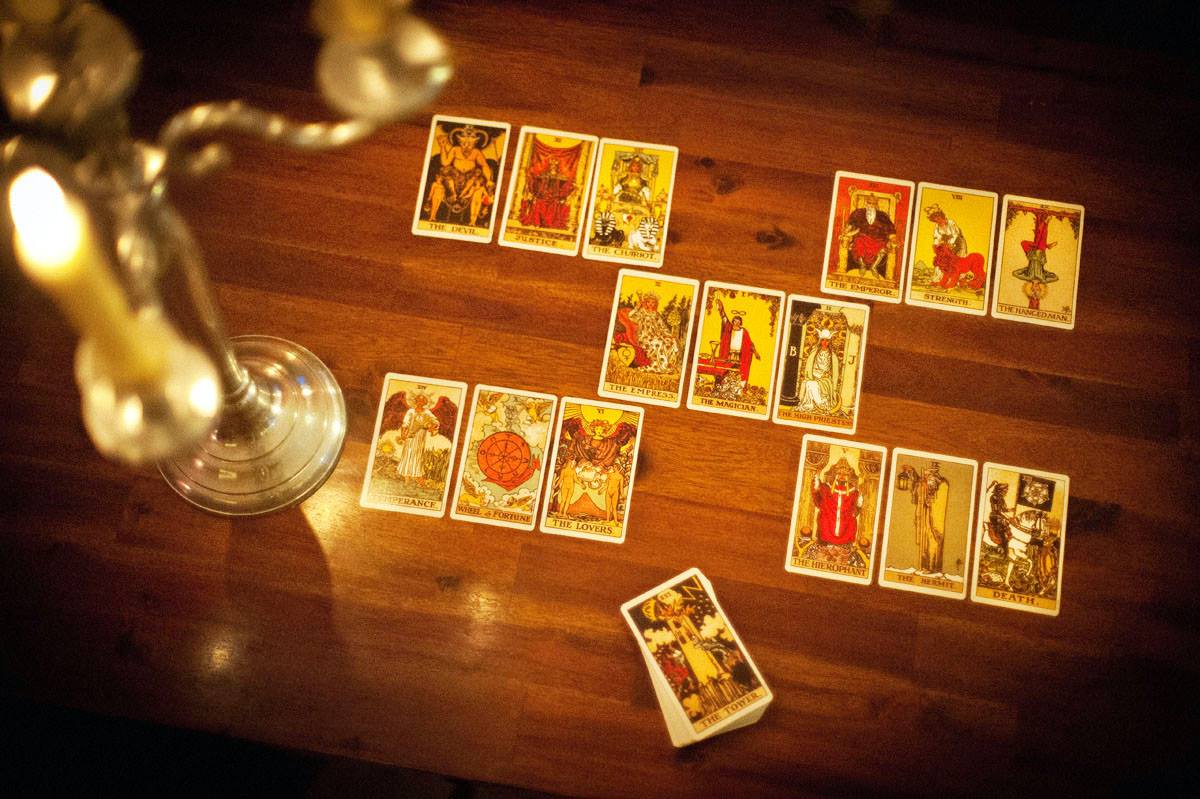
Psychical and spiritual experience frequently communicates through image and symbol rather than explanation. The Waite–Smith Tarot, created by A. E. Waite and Pamela Colman Smith within the wider world of the Hermetic Order of the Golden Dawn, carries a rich visual language of archetype, number, myth and esoteric symbolism.
Helena approaches Tarot as far more than fortune-telling. Read alongside Jungian attention to dreams, archetypes, projection and synchronicity, a card can become a symbolic mirror — bringing conscious questions into dialogue with unconscious association, intuition and symbol.
Less simply “What will happen?” than “What is this image revealing, constellating or asking to be understood?”
Explore Soul Archaeology · Tarot, Symbol & Psyche →History · Anthropology · Psychology · Spirituality
Experience in Context
One of the most distinctive aspects of Helena's approach is her ability to place unusual experiences within a much larger human history. What one culture or historical period describes as vision, prophecy, mediumship, spirit communication, trance, divination, inspiration, possession or revelation may be interpreted very differently within another culture, religious tradition or psychological framework.
Alongside her MA in Public History and Cultural Heritage (Hons.) from the University of Limerick, Helena's interdisciplinary formation includes a Diploma in the History of Magic, the Occult and Witchcraft, studies in anthropology, Jungian and archetypal psychology, psychospiritual counselling, spirituality and Western esotericism, alongside her extensive practical mediumistic development.
This enables consultation to move beyond simply asking “What happened to me?” towards deeper questions: How have experiences like this been understood before? What language have different cultures given them? What might psychology contribute? How have mediumistic and psychical traditions interpreted them? What does psychical research tell us? And where do different explanations genuinely diverge?
The College · Literature · Investigation
A Living Psychical Tradition
Helena's development belongs to a longer British history of mediumship and psychical inquiry. The College of Psychic Studies, originally the London Spiritualist Alliance, has long brought mediumship, literature, esotericism, psychical research and questions of consciousness into conversation.
Figures associated with this history include W. B. Yeats and George Hyde-Lees, and Sir Arthur Conan Doyle, creator of Sherlock Holmes and a former President of the Alliance. The College's own history — and Helena's more than a decade of training there before later returning as a lecturer — provides a living institutional context for her work.
This page does not attempt to retell the history of Spiritualism. What matters here is that psychical experience has generated institutions, archives, experiments, arguments and literature, as well as practical traditions of development.
Investigation · Evidence · Women in Psychical Inquiry
The Ghost Club · Harry Price
Helena is a former member of the Ghost Club, one of Britain's oldest organisations associated with the discussion and investigation of reported paranormal phenomena. Its historical membership also included W. B. Yeats.
Psychical researcher Harry Price joined the Club in 1927 and was instrumental in relaunching it in 1938. Under Price, women were admitted to the Ghost Club for the first time — a significant step within the longer, gradual history through which women gained greater access to organised psychical and paranormal investigation.
Price is relevant for another reason: his career represents the complicated attempt to investigate extraordinary claims rather than simply accept them, in a field where belief, scepticism, experiment, controversy and the exposure of suspected fraud often existed side by side.
Psychical inquiry need not begin with unquestioning belief or automatic dismissal. It can begin with a question: What actually happened?
Duke University · Parapsychology Laboratory
Experiment · Correspondence · Consciousness
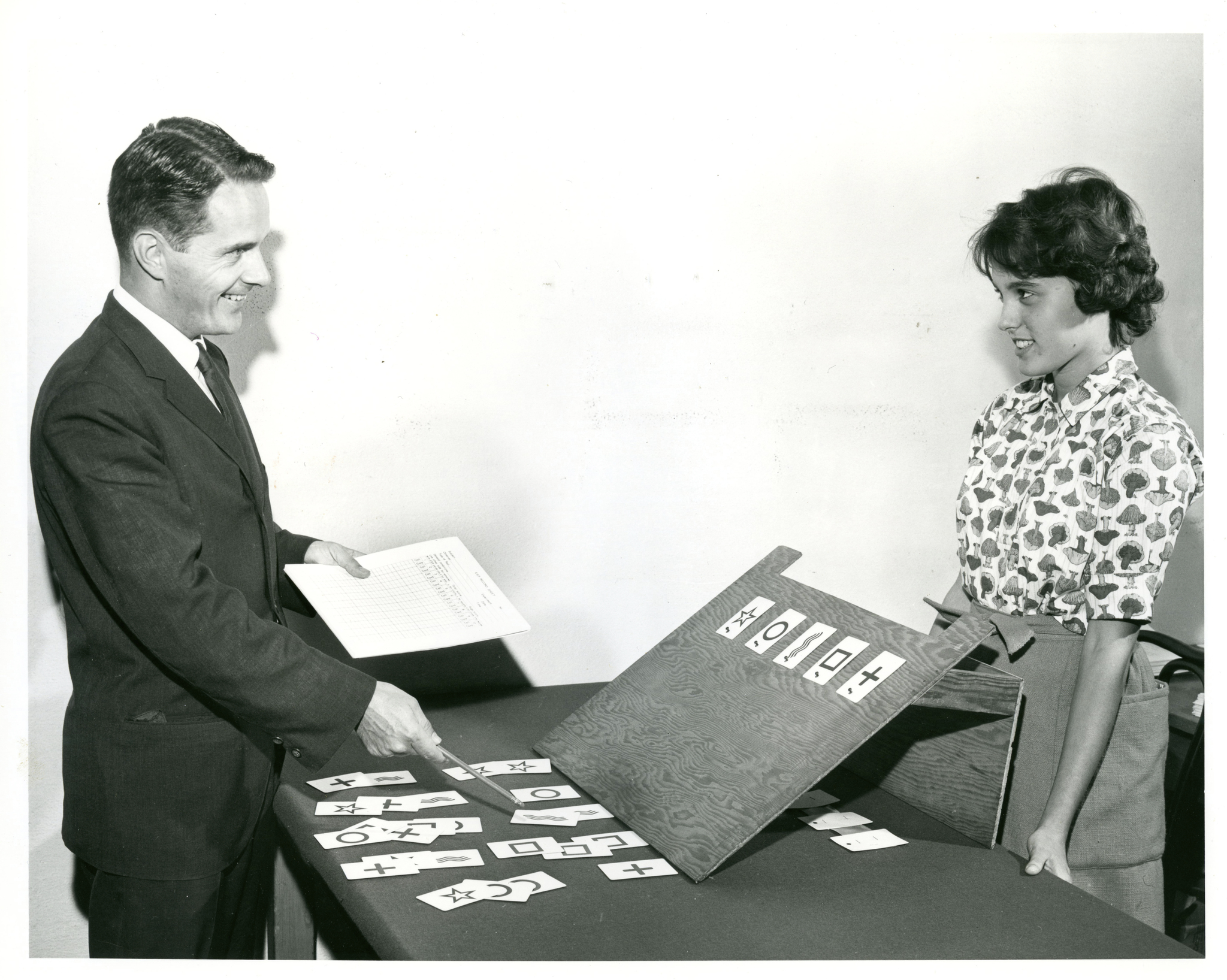
Duke University's archive preserves both photographs of the early Parapsychology Laboratory and the surviving correspondence between J. B. Rhine and C. G. Jung. The December 1934 exchange discusses telepathy, clairvoyance, precognition and the relationship of psyche to space and time.
View the actual Rhine–Jung correspondence at Duke →Explore Early Studies in Parapsychology at Duke →Undated Zener-card test · University Archives Photograph Collection · Duke University
C. G. Jung · J. B. Rhine · Duke University · Synchronicity
Consciousness · ESP · Psychical Research
Another strand of this history asks an even larger question: what might psychical phenomena tell us about consciousness itself?
At Duke University, J. B. Rhine developed experimental methods for investigating extrasensory perception, concentrating particularly on telepathy, clairvoyance, precognition and psychokinesis. C. G. Jung followed Rhine's work closely, and Duke University Libraries preserve correspondence between the two men across their long engagement with these questions.
The connection matters because Rhine's experimental ESP research became important to Jung's thinking about synchronicity. Jung was asking whether meaningful relationships between psyche and event might exist that could not be adequately described through ordinary linear causality.
For Helena, the intersection between Jungian psychology, ESP, psychical research and consciousness moves the discussion beyond “Am I psychic?” towards something larger: What might these experiences tell us about consciousness itself?
How does information enter awareness? What is intuition? What is unconscious perception? What is projection? What do we mean by ESP? How should we understand meaningful coincidence? And are conventional models of consciousness sufficient to account for every form of human experience?
These questions do not require premature answers. They require experience, observation, historical understanding and discernment.
Explore the J. B. Rhine & C. G. Jung correspondence — Duke University Libraries →Practice · Experience · Learning Together
Masterclasses · Courses · Small-Group Development
Alongside private one-to-one development, Helena periodically offers lectures, masterclasses, courses and small-group training in psychical and spiritual development.
Group development offers something individual consultation cannot always reproduce: the opportunity to practise with other people. Participants can undertake structured exercises in psychometry, intuitive perception, the clairs, symbolism, energetic awareness, meditation and other forms of development; compare the different ways in which people receive information; and begin to recognise their own perceptual strengths within a carefully held learning environment.
Particular masterclasses may concentrate on psychometry, clairsentience, mediumistic development, automatic, inspired and inspirational writing, Tarot and symbolism, subtle-body awareness, crystals, dowsing, energy practice, meditation, grounding and spiritual development. Lectures and seminars can explore the deeper historical, psychological, anthropological and esoteric contexts behind these practices.
Helena is also developing future residential retreats and research-led learning journeys in Ireland and abroad, bringing psychical and spiritual development together with carefully chosen places connected to psychical research, mediumship, esoteric history and related traditions. These experiences are intended to combine teaching and practical development with meaningful engagement with the histories and landscapes in which these traditions developed.
Helena works with small groups so that teaching can remain focused and participants have meaningful opportunities for practice, discussion and individual guidance.
Ability · Responsibility · Spiritual Growth
Development with Discernment
Helena works privately with people at very different stages: from those beginning to recognise intuitive sensitivity to experienced practitioners wishing to deepen psychometry, mediumistic awareness, meditation, symbolic work, energy practice, automatic, inspired or inspirational writing, or particular modes of perception.
Development is never measured simply by how many unusual experiences occur. It involves learning when to open, when to question, when to step back, how to establish boundaries, how to remain grounded, how to recognise the limits of what can be known and how psychical sensitivity might become part of a mature spiritual life.
The work cultivates perception with discernment, sensitivity with boundaries, openness with critical intelligence, and ability with responsibility.
The aim is to develop both the ability and the person who carries it.