
Intimacy brings together body, psyche, personal history, desire, trust, vulnerability and meaning. Helena offers individuals and couples a mature, non-judgemental space in which to explore not only what may be difficult within intimate relationships, but what makes them deeper, more alive and more sustaining — emotionally, physically and spiritually.
Sessions may explore communication, recurring relational patterns, boundaries, trust, differences in desire, changes in intimacy across life transitions, embodied connection and the relationship between security and erotic vitality. Individuals do not need to be in a relationship to undertake this work; the focus may also be their own relationship with sexuality, embodiment and intimacy.
At the heart of this work is a simple but profound question: how can two people meet deeply without ceasing to be fully alive themselves?
ANCIENT WISDOM FOR CONTEMPORARY INTIMACY
Eros · The Beloved · Union · Transformation
Ancient traditions understood eros as capable of transforming more than the body. The Song of Songs — the Bible's great erotic love poem — celebrates mutual desire, sensuality, longing and embodied love, while its Jewish and Christian reception opened equally extraordinary mystical interpretations of the Beloved and sacred union.
The Song of Songs held extraordinary importance within medieval spirituality. Bernard of Clairvaux — Cistercian abbot, ardent Marian theologian and a major spiritual figure in the formative Templar world — devoted 86 sermons to the Song of Songs. His connection with the emerging Order was both spiritual and familial: Hugues de Payns, first Master of the Temple, was his relative and worked with Bernard in the formation of the Latin Rule, while André de Montbard, fifth Master of the Order, was Bernard's maternal uncle.
In his Sermones super Cantica Canticorum, Bernard repeatedly returns to the Song's language of Bride and Bridegroom, longing, desire, the kiss and union, reading erotic language as a mode of mystical encounter. For Helena, this is especially significant because Bernard stands at the intersection of several traditions central to her research: Cistercian spirituality, Marian devotion, the Knights Templar, the Sacred Feminine and the medieval understanding of love as a transformative spiritual force. The erotic and the sacred were not necessarily opposites. Desire itself could become a language of transformation.
Helena brings these sources into conversation with ancient Tantric traditions of embodiment and sacred union; Sophia and Gnostic spirituality; the alchemical marriage of Sun and Moon; medieval troubadour traditions of fin'amor; the Grail quest; and mystical traditions of the Beloved. Each of these historically distinct traditions preserves a different way of asking what desire, intimacy, embodiment and union might mean.
The relationship between Sophia, gnosis, eros and spiritual transformation is particularly important within Helena's exploration of Western esoteric traditions. Her thinking is also informed by writers she particularly values, including Tobias Churton and Gnostic Mysteries of Sex: Sophia the Wild One and Erotic Christianity.
The troubadours add another dimension: longing, the Beloved and sometimes impossible love. Their fin'amor, placed in conversation with Grail literature and the transformative quest, allows desire to become something more than acquisition or possession. Sufi traditions offer another profoundly different language of the Beloved; in writers such as Ibn ʿArabi, human beauty, longing and love can open toward contemplation of the Divine Beloved.
Dante Alighieri carries this tradition of the Beloved into one of its most extraordinary literary expressions. Associated with the poetic culture of the Fedeli d'Amore — the “Faithful of Love” — Dante transforms his love for Beatrice into a journey that moves from human longing towards spiritual revelation. In the Divine Comedy, Beatrice becomes far more than the memory of an earthly beloved: she is guide, wisdom and mediator, leading Dante towards the culminating celestial vision of the Mystic Rose in Paradiso. Love becomes a path of knowledge and transformation. These themes are particularly important within Helena's research into the Sacred Feminine, medieval traditions of love and the Knights Templar. She has lectured on these connections and is currently developing an upcoming book exploring this field.
THE BELOVED
Longing · Recognition · Impossible Love · Encounter
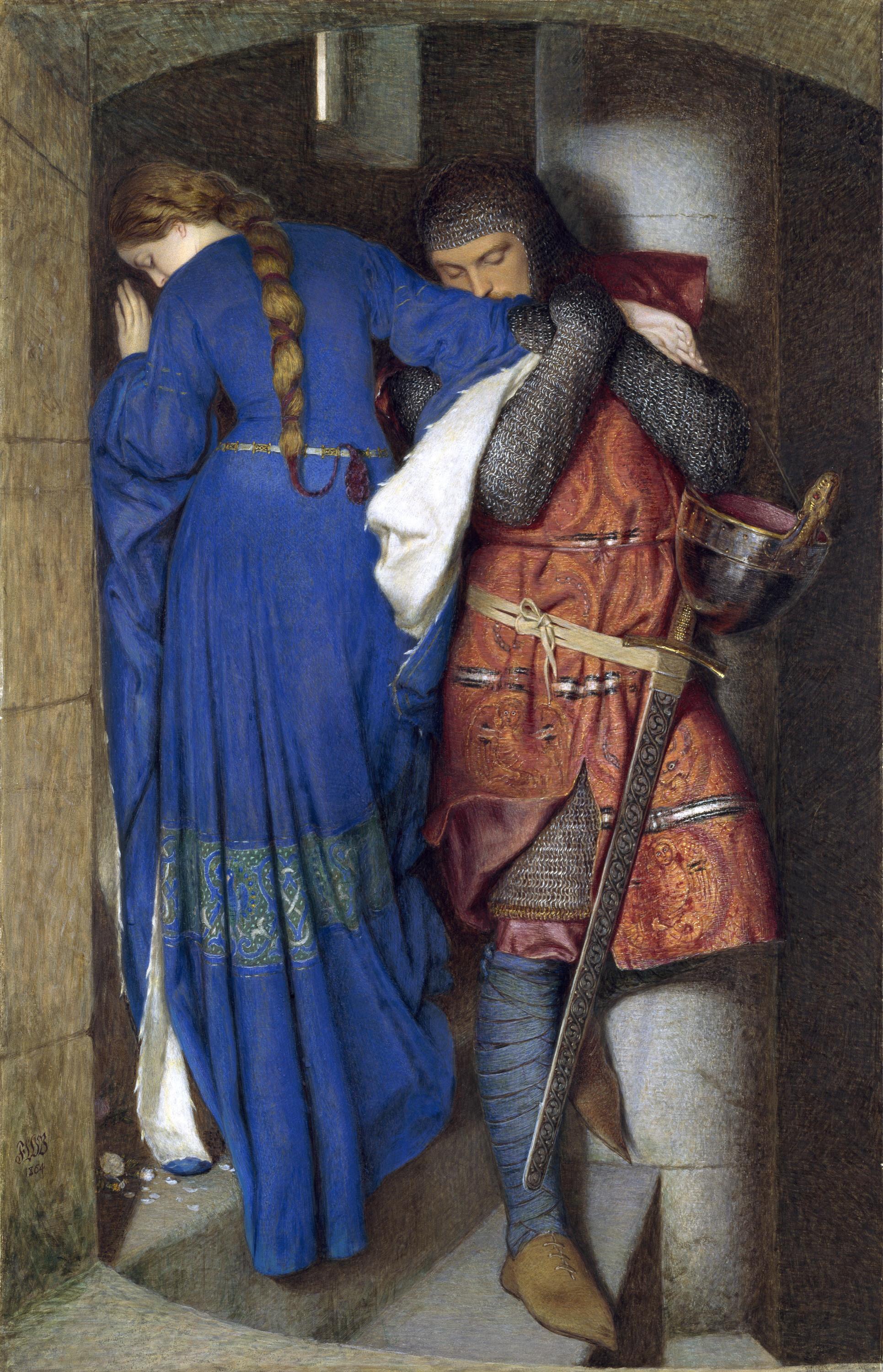
Frederic William Burton's Hellelil and Hildebrand, the Meeting on the Turret Stairs (1864) captures something that relationship theory alone cannot: the intensity of recognition between two people for whom the moment of encounter has become absolute.
Inspired by a medieval Danish ballad translated by Burton's friend Whitley Stokes, the story concerns Hellelil's forbidden love for Hildebrand. Rather than depict its violence and tragic conclusion, Burton chose the lovers' final meeting: an extraordinarily restrained image of tenderness, desire, separation and impossible love.
Helena places the image in conversation with the Song of Songs, troubadour fin'amor, Grail traditions and mystical traditions of the Beloved. Across very different cultures and periods, love repeatedly appears not simply as possession or compatibility, but as longing, recognition, vulnerability and transformation through encounter with another.
The purpose of contemporary intimacy is not to romanticise tragic or impossible love. But these traditions understood something easily lost through familiarity: the other person must remain someone to encounter, not someone we cease to see.
EROS AS TRANSFORMATIVE FIRE
Desire · Sovereignty · Sun & Moon · The Living Spark
Eros is more than desire alone. In the work of W. B. Yeats, erotic longing, love, imagination and spiritual aspiration repeatedly become forces of transformation — a fire capable of disturbing the established self and drawing it toward something not yet known. Desire, in this sense, can become catalyst: creative, embodied, psychological and spiritual.
Alchemy offers one of the most powerful images of this mystery in the marriage of Sun and Moon. Here that union is not reduced to a purely psychological metaphor. The coniunctio can speak simultaneously to physical and erotic union, the meeting of two people, psychological transformation and spiritual relationship. Body and spirit need not be enemies.
Aleister Crowley's Liber AL vel Legis offers a striking image of individual sovereignty: “Every man and every woman is a star.” Within the same Thelemic cosmology, Hadit is the secret centre, the infinitely concentrated point of experience and living fire within the star. Read symbolically alongside the marriage of Sun and Moon, it offers a compelling image for intimacy: two living centres entering relationship without either being extinguished by the other.
Desire needs that fire. A relationship may offer security, companionship and devotion, but erotic vitality also depends upon curiosity, difference, presence and the continuing experience of the beloved as another person — another centre of mystery, desire and becoming.
BODY · LANGUAGE · SOUL
Tantra · Embodiment · Anam Cara · Irish Ways of Knowing
Sacred sexuality is not concerned only with ideas. The body matters. Helena's study and training in Tantric spirituality, chakra and subtle-body traditions, energy work, Gnostic spirituality and Western esoteric traditions informs an approach in which embodiment, desire, attention and relationship are explored as interconnected dimensions of human life.
The chakra systems themselves emerge from the much older textual and contemplative worlds of Tantra, rather than from the modern wellness culture with which they are often associated today. Helena's interest lies in recovering this deeper historical and spiritual context: exploring the subtle body not as decorative symbolism, but as part of sophisticated traditions concerned with embodiment, consciousness, energy and transformation.
Helena's longstanding engagement with Gnostic traditions brings another dimension through Sophia, gnosis and the possibility that embodied human experience can become a vehicle for transformation, grounded in her wider study of Gnosticism, Western esotericism and the Sacred Feminine.
Within an Irish context, John O'Donohue's anam cara — the soul friend — offers another beautiful language for profound encounter. It is not a Tantric tradition and should not be treated as one, yet its understanding of intimacy, recognition, friendship, embodiment and the inner life can enter into meaningful dialogue with traditions in which genuine encounter involves far more than physical attraction.
“Love is the only light that can truly read the secret signature of the other person's individuality and soul.”
John O'Donohue · Anam Cara: A Book of Celtic Wisdom
The late Manchán Magan, whose work Helena greatly admires, approached embodiment from another direction. In Focail na mBan, his recovery of neglected Irish-language vocabulary surrounding women's bodies, sexuality and lived experience opened a wider conversation about language, bodily knowledge, cultural memory and the ways shame can obscure what a culture once knew.
DEEPER RELATIONSHIPS
Body · Psyche · Spirit
The historical and spiritual traditions explored here are not offered as prescriptions for modern relationships, nor as substitutes for the realities of communication, consent, boundaries and individual circumstances. Instead, Helena brings ancient sources, historical research, Jungian and archetypal thought, embodied traditions and contemporary perspectives on intimacy into conversation with the lives people are actually living.
The purpose is practical as well as reflective: to help individuals and couples understand themselves and one another more deeply; recognise patterns that diminish connection; recover curiosity, desire and embodied presence; and explore intimacy at the level of body, psyche and spirit.
Because the aim is to remain alive to one another.