Private Consultation · Agency · Symbol · Feminine Mysteries
Feminine Empowerment & the Sacred Feminine
A historically grounded, Jungian and spiritually informed exploration of feminine identity, sovereignty, wisdom, creativity and the Sacred Feminine — for women and men seeking a deeper relationship with the neglected or emerging dimensions of the self.
The Sacred Feminine is not one goddess, one tradition or one idea of what a woman should be. Across history it has appeared as Wisdom, Mother, Sovereign, Initiatrix, Lover, Guardian, Saviour, land, water, darkness and light. Helena's work brings these traditions into conversation with the questions people carry now: Who am I beneath the roles I have inherited? What has been silenced or excluded? What does sovereignty mean in my own life?
Drawing upon historical research, Jungian and archetypal thought, Gnostic and esoteric traditions, mythology, sacred landscape and more than a decade of study and teaching, Helena approaches the Sacred Feminine as both historical tradition and living inner reality. The work is open to women and men alike: masculine and feminine are explored as symbolic and archetypal dimensions of human experience, with room for each person's own identity, relationships and lived experience.
What We May Explore
—Feminine identity, sovereignty, voice, creativity and agency
—Masculine and feminine within the psyche; individuation and integration
—Sophia, Mary Magdalene, Isis, Hekate and Sacred Feminine archetypes
—Gnosticism, sacred texts and feminine spiritual authority
—Marion Woodman, embodiment and feminine consciousness
—Descent, initiation, transformation and the union of opposites
—Irish goddess traditions, sovereignty and sacred landscape
—Black Madonnas, Grail women and the hidden feminine in Western tradition
—Personally meaningful spiritual practice and major life transitions
The purpose is to bring what has been divided back into relationship — body and spirit, instinct and intellect, action and receptivity, solar and lunar consciousness — as part of the movement toward greater wholeness.
The Feminine Within · Integration & Individuation
Wholeness does not require one half of the self to defeat the other.
Drawing particularly upon C. G. Jung, Marion Woodman and Erich Neumann, Helena explores what happens when qualities associated with the feminine — embodiment, intuition, receptivity, relatedness, creativity, instinct and cyclical experience — are exiled or undervalued. Woodman's work on embodiment and feminine consciousness is especially important here, alongside Neumann's exploration of the Great Mother and Jung's understanding of individuation.
Masculine and feminine are approached as archetypal and symbolic polarities that may be meaningful within any person. The aim is integration rather than reversal: bringing apparent opposites into conscious relationship, close to Jung's understanding of individuation and the coniunctio. This work can therefore be as meaningful for men as for women.
Wisdom · Light · Mediation
Sophia · Mary Magdalene · Isis · Hekate Soteira
Helena's teaching on Gnosticism and the Sacred Feminine gives particular importance to Sophia — Divine Wisdom — and to Mary Magdalene, whose significance extends far beyond the later popular image of the repentant sinner. Canonical and non-canonical traditions preserve her as witness, disciple and bearer of knowledge; she offers a powerful lens through which to explore spiritual authority, vision, knowledge and the feminine voice.
Isis occupies an equally important place in Helena's work: Mother, mourner, magician and sovereign, associated across her long religious history with kingship, transformation, wisdom and illumination. Alongside her stands Hekate, whose philosophical and theurgical dimensions — particularly the Hekate of the Chaldean Oracles and later traditions surrounding Soteira, “Saviour” — open questions of mediation, transformation and the relationship between worlds. These figures are never collapsed into a single universal Goddess; their histories and differences matter.
Isis in Ireland · Huntington Castle, Co. Carlow
At Huntington Castle, the Fellowship of Isis created an extraordinary modern Irish centre devoted to restoring recognition of the Divine Feminine. Helena's filmed exploration of the temple allows this tradition to be encountered within its actual setting.
Filmed by Michael Benson · Storyboard by Helena B. Scott · Subsequently edited by Helena B. Scott. With thanks to Alexander Durdin-Robertson and Huntington Castle.
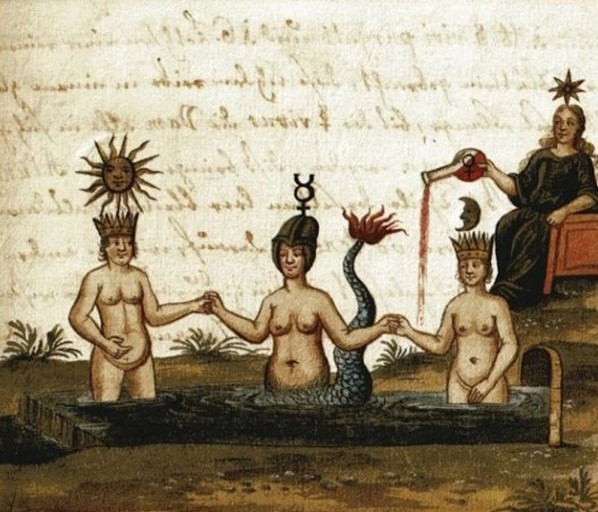
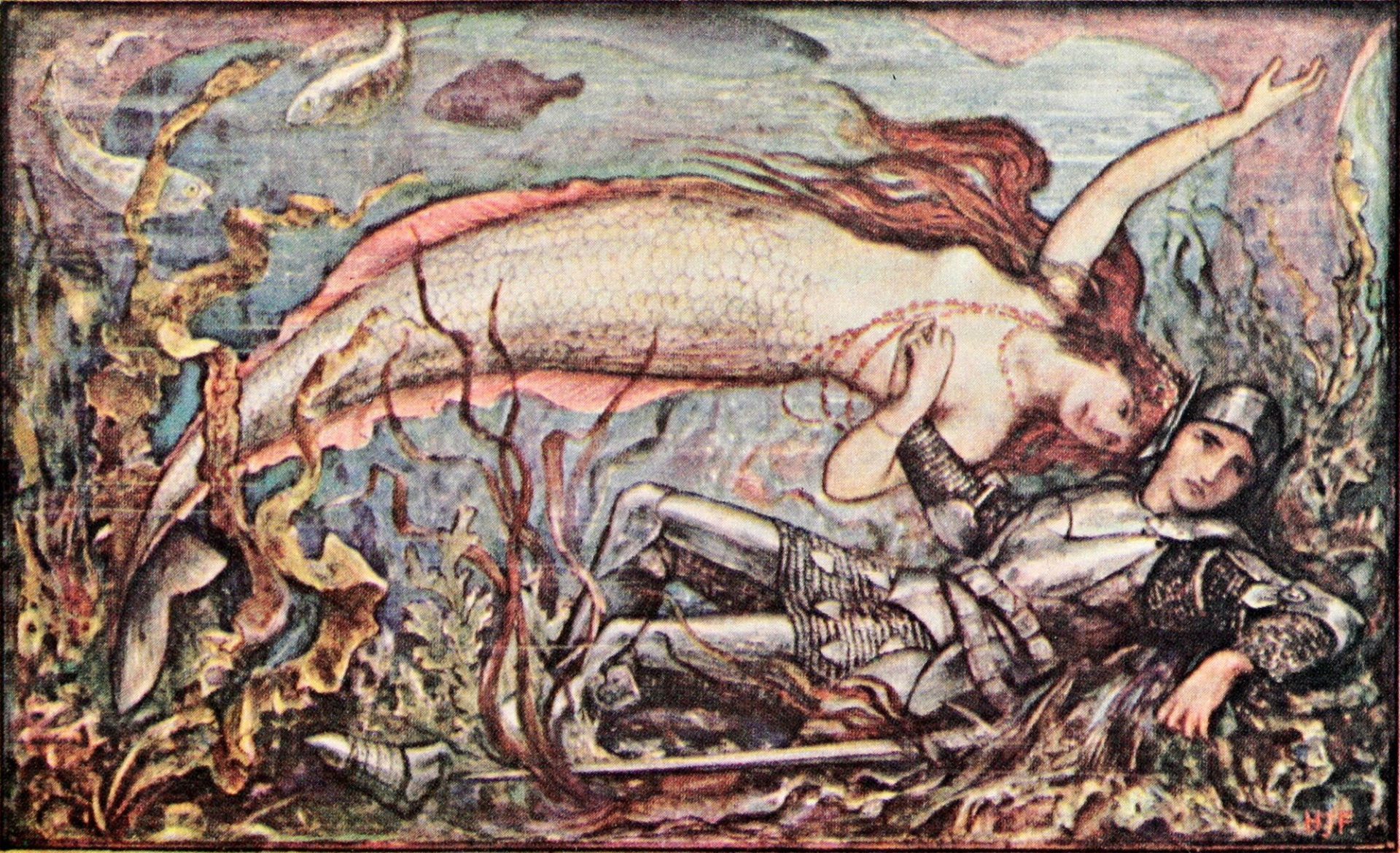
Across Helena's research and teaching, the mermaid emerges as an initiatrix: a liminal feminine figure inhabiting the threshold between worlds, drawing the seeker beyond the familiar and becoming a catalyst for spiritual transformation. Mermaids are also critical to Helena's interpretation of the Grail quest: threshold figures who call the seeker beyond the known world and toward the ordeal, revelation and transformation that the quest demands.
In Helena's interpretive framework, the mermaid can be read in dialogue with Sophia — Divine Wisdom — as a feminine figure of revelation, descent, knowledge and transformation, carrying an archetypal resonance with feminine wisdom that appears from the depths and asks for a changed consciousness.
Clavis Artis, an alchemical work attributed pseudepigraphically to Zoroaster · German manuscript tradition, late 17th–early 18th century; surviving copies/catalogues are associated with the 1738 Clavis Artis tradition · Mermaid, Sun & Moon · Click image to enlarge
The Clavis Artis image provides a particularly rich example of the symbolic language Helena decodes in her workshops and talks. Rather than treating such an illustration as decorative occult imagery, she asks who the figures are, what they are doing, which planetary and alchemical signs they carry, and how the composition relates to other images within the Western alchemical tradition. Here the mermaid mediates between the crowned solar and lunar figures, effecting their symbolic marriage: a visual image of conjunction, polarity and transformation. Above them, Hermes pours copper from a vessel into the water in which the mermaid and the solar and lunar figures stand. The eight-pointed star above him belongs to a well-established Mercurial vocabulary within the Western esoteric tradition. Its later codification is particularly explicit in Liber O vel Manus et Sagittae (1909), where Mercury is assigned the number eight and the octagon and octagram as its lineal figures, and is further associated with Thoth, Hod and the caduceus. The text even prescribes an eight-pointed star for a Mercurial working. Hermes is therefore a significant agent within the image's larger language of mediation, conjunction and alchemical transformation.
Alchemy can therefore be read on more than one level. Alongside its historical concern with substances and transformation, its imagery became extraordinarily fertile material for spiritual alchemy and depth psychology. Helena connects this symbolic language with the Grail quest, Jung's coniunctio and individuation: the difficult movement through division, encounter and transformation toward a more encompassing wholeness. Within that journey, the mermaid is not merely an enchanting creature of folklore. She is wisdom-bearer, catalyst and initiatrix — a figure of the depths who stands at the threshold of transformation.
The Soul of the World
Hekate Soteira · Anima Mundi · Sacred Place · The Thirteenth Cone
Helena's work asks whether the feminine can be encountered not only within the individual psyche but through world, image, place and landscape. Hekate Soteira, especially as encountered through the Chaldean Oracles and their later theurgical reception, offers an ancient image of mediation, cosmic order and passage between worlds. In a very different modern psychological tradition, James Hillman's anima mundi — the Soul of the World challenges the assumption that psyche exists only inside us.
These questions also enter comparative dialogue in Helena's work with W. B. Yeats's A Vision and the enigmatic Thirteenth Cone, alongside traditions concerned with polarity, sacred mediation and the reconciliation of opposites. Mircea Eliade's work on hierophany, sacred space and initiation provides another historical-comparative lens. These are dialogues across traditions, not claims of direct historical transmission.
For Helena, the Sacred Feminine is also encountered through place. Ireland's modern Irish name, Éire, descends from Ériu, the eponymous goddess of Ireland: a sovereignty goddess and personification of the land. Irish tradition also preserves the names Banba and Fódla, her fellow sovereignty figures and poetic names for Ireland. The Norse knew the island as Írland and its people as Írar. Linguistically, those Old Norse forms are traced to the Irish name Ériu; alongside that history, Helena places them in comparative dialogue with the distinct Norse goddess Eir, associated with healing and medical skill. The resemblance is evocative within her Sacred Feminine work, while the two names remain historically distinct.
Ireland is also a threshold place. It was once on the edge of the known world and what was unknown, beyond the Atlantic. That position is vividly visible on the great 15th-century Venetian world map of Fra Mauro, created in Venice in the mid-1400s, where Ireland sits at the Atlantic fringe of the mapped world. Medieval Irish writers themselves were conscious of inhabiting an island at the western edge of the world, while the ocean beyond became the imaginative terrain of voyages, otherworld islands and St Brendan's journey. In medieval European imagination this liminality became startlingly literal at St Patrick's Purgatory, Lough Derg: the celebrated cavern was understood as a gateway to the next world, drawing pilgrims from across Europe who sought to cross, physically and spiritually, a boundary between this world and the hereafter.
That sense of deep time is written into the landscape itself. Brú na Bóinne — Newgrange, Knowth and Dowth preserves one of Europe's most important concentrations of prehistoric megalithic art and ritual landscape; Newgrange was constructed around 3200 BC, centuries before the great pyramids of Giza and Stonehenge. Helena approaches such places as landscapes in which extraordinary antiquity, water, seasonal light, death, renewal and cultural memory continue to meet. Ireland's holy wells add another layer: places where water, healing, pilgrimage, local memory and older landscape traditions meet Christian devotion.
Within Helena's symbolic and Jungian work, the threshold also opens naturally toward alchemy. The nigredo — the dark, dissolving stage in which an old form can no longer hold — offers a powerful language for liminal experience: descent before transformation, uncertainty before renewal. The feminine landscape can therefore be approached not as something passive, but as an initiatory terrain in which descent, water, darkness and return belong to a larger movement toward transformation and wholeness.
Her thinking has also been enriched by the work of the late Irish writer and documentary-maker Manchán Magan, particularly his attention to Irish language, landscape and the cultural meanings carried within words and place. Helena knew Manchán briefly through a professional exchange, and his work remains an important point of inspiration in her continuing exploration of feminine presence within Ireland's landscape.
The Hidden Feminine in Western Tradition
Templars · Cistercians · Magdalene · Black Madonnas · Grail Women
Helena's historical research repeatedly returns to a question often obscured by conventional narratives of medieval religion and knighthood: where is the feminine? Her work on the Knights Templar and the Cistercian world examines Marian devotion, sacred imagery and the feminine dimensions of traditions usually narrated through men, warfare and institutional power.
Her wider research and teaching encompasses Mary Magdalene, Black Madonnas, Grail traditions and the women surrounding the Grail, including her Grail Mermaidens teaching, alongside Christian, Gnostic, pagan Irish and Norse traditions. Fieldwork, lectures and research in Ireland and internationally — including her work in Transylvania, once part of the medieval Kingdom of Hungary (Regnum Marianum, the “Kingdom of Mary”) — place these questions within actual landscapes, texts, buildings and cultural memory.
The Wounded Feminine
Memory · Inheritance · Recognition · Restoration
Across centuries, the feminine has repeatedly been constrained, silenced, idealised, feared and, at times, demonised. Women's spiritual authority, sexuality, embodied knowledge and autonomy have often been subjected to structures that determined which forms of feminine power were acceptable and which were dangerous. Older goddesses and female sacred figures did not simply disappear through one universal historical process, but many were displaced, transformed, condemned or absorbed as religious worlds changed.
Helena approaches this history not only as something that happened in the past, but as an archetypal and cultural inheritance. The wounded feminine may surface in contemporary life through shame around the body, difficulty inhabiting authority, fear of visibility, disconnection from instinct and creativity, the compulsion to please or perform, or the sense that one's deepest nature must somehow be made smaller in order to belong.
Recognition is part of restoration. To encounter the wounded feminine is not to remain inside the wound, nor to define women through suffering. It is to ask what has been exiled — personally, culturally and symbolically — and what might now be reclaimed. In Helena's work, the restoration of the Goddess within becomes a language for that process: the recovery of sovereignty, embodied wisdom, creativity, eros, spiritual authority and a relationship with the feminine that is no longer organised around shame or diminishment.
This restoration is unfinished culturally as well as individually. Legal and social equality have transformed women's lives, but equality has not erased the deeper historical patterns through which feminine authority has been devalued. The Sacred Feminine therefore becomes more than an object of historical study: it becomes a way of recognising what has been wounded, remembering what has been lost, and consciously restoring value to the feminine within ourselves and within the culture.
In Crossing to Avalon, psychiatrist and Jungian analyst Jean Shinoda Bolen, M.D. reflects on the symbolic transformation of the feminine: the open red rose, once associated with Aphrodite and mature sexuality, later becoming a Marian symbol, and a number identified by Barbara Walker with Aphrodite acquiring an entirely different meaning within Christian symbolism.
“Six hundred sixty-six, according to Barbara Walker, was Aphrodite's sacred number. In Christian theology it became a demonic one.”
Jean Shinoda Bolen, M.D. · Psychiatrist · Jungian Analyst · Author · Crossing to Avalon: A Woman's Midlife Quest for the Sacred Feminine (1994)
When the Feminine Is Excluded
Integration · Psyche · Culture · Society
What happens — to an individual, a relationship, an institution or a culture — when qualities associated with the feminine are repeatedly devalued?
Helena's work centres on the consequences of imbalance: when embodiment, relationship, receptivity, intuition, vulnerability, care and the living world are subordinated to relentless productivity, domination, abstraction or control. Marion Woodman argued that the feminine principle — which she explicitly distinguished from biological gender — brings presence, relatedness and a capacity to hold connection rather than continually splitting experience into opposing camps. For Woodman, its suppression damages men as well as women and becomes a cultural problem, not merely a private one.
“The great work of our time is to bring the feminine into this culture.”
Marion Woodman
Jung likewise understood individuation not as the victory of one pole over another, but as a movement toward the Self as a greater wholeness. Consciousness must encounter what it has excluded and hold the tension of opposites until a more encompassing relationship becomes possible. In this sense, integration is not about becoming less masculine or more feminine: it is about embracing the opposites within us and becoming more whole.
“The feminine, like the masculine, demands an equally personal representation.”
C. G. Jung · Answer to Job · CW 11, §753
Research · Publishing · Teaching
This is a living body of work.
These consultations grow from a continuing programme of historical research, writing, fieldwork and international teaching. Selected current projects show where Helena's Sacred Feminine work is developing next.
Forthcoming Book & Research Institute
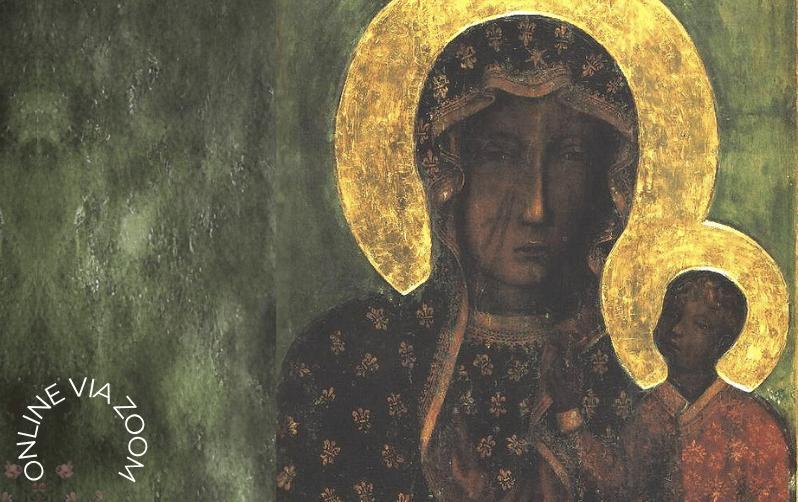
Black Madonnas and the Dark Mother
Helena's forthcoming book with Holythorn Press and the developing Dark Mother Institute bring together Black Madonna research, sacred landscape, the Dark Mother, depth psychology and the Sacred Feminine.
Helena brings her MA research, medieval texts, papal material and archaeological evidence into dialogue with the frequently overlooked feminine dimensions of the Templar world.
For those who wish to move beyond a single consultation, The Way of the Priestess offers a longer-form journey into Sacred Feminine study, archetypal exploration, spiritual development, symbolism, practice and personal integration.
You do not need to arrive with a particular belief, language or prior knowledge.
You may come with a question, a transition, a recurring image or dream, a sense that something within you has been silenced, lost or is asking to be reclaimed, or simply a desire to understand your relationship with the feminine more deeply. There is no prescribed path and nothing you are expected to believe. The work begins with your own experience and unfolds from what is meaningful to you.
Helena B. Scott, MA is a public historian, cultural heritage specialist and Jungian scholar whose interdisciplinary practice draws upon depth and archetypal psychology, psychospiritual counselling, symbolism, historical research and more than a decade of study within psychical and spiritual traditions.
New research, forthcoming books, lectures, fieldwork, courses and occasional notes from Helena B. Scott.
By subscribing, you agree to receive occasional research news, publications, events and updates from Helena B. Scott by email. You can unsubscribe at any time. Privacy Policy.
Google Analytics helps understand how visitors find and use the site. If you decline, analytics cookies remain off and only limited cookieless measurement signals may be sent. It is not used for advertising here.