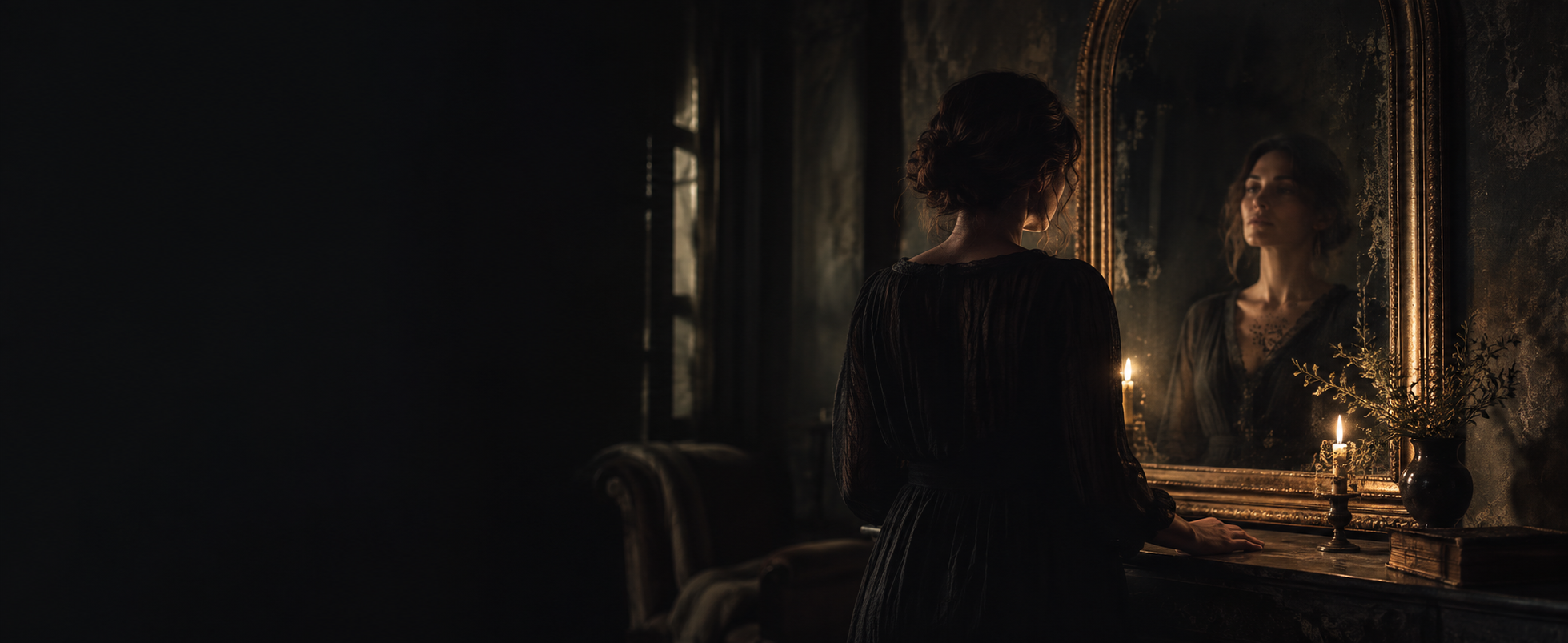
Difficult or coercive relationships, family-of-origin wounds and periods of upheaval can leave a person separated from their own voice, instincts, confidence and inner direction. Reclaiming the self is not about returning to who you were before. It is an opportunity to understand what has happened, recognise what has been silenced or surrendered, and begin recovering agency, discernment, creativity and a more deeply inhabited sense of self.
For Helena, this work began with questions she needed to answer in her own life. Having experienced difficult and coercive relationship patterns extending from childhood into adulthood, she wanted to understand the people she had encountered, why particular patterns could repeat, and what happened psychologically when a person's sense of self, judgement and agency were gradually diminished.
Those questions were part of what led Helena to study psychology. She wanted not only to understand and change the patterns within her own life, but eventually to help others recognise dynamics that she herself had once lived through without the knowledge or support to fully understand them.
Almost twenty years ago, a therapist recommended Jean Shinoda Bolen's Goddesses in Everywoman. The book gave Helena an early language for recurring archetypal patterns in women's lives and opened the path towards C. G. Jung, archetypal psychology and, in time, formal study. That long enquiry developed through Jungian psychology and Shadow Work, archetypal psychology, psychospiritual counselling, dream work and a wider body of research concerned with relationship patterns, projection, trauma, embodiment, the unconscious and the recovery of the self. It also brought particular importance to the work of Marion Woodman and to Helena's own work with figures such as Medusa, Sophia and the Sacred Feminine.
Helena approaches each person's experience on its own terms. Her personal history is one reason she brings a deep understanding of how difficult it can be to recognise a pattern while one is still living inside it — and how transformative it can be when something that once seemed confusing finally becomes intelligible.
As a Jungian scholar, Helena draws on C. G. Jung's work on shadow, projection, complexes and individuation, alongside later Jungian and archetypal perspectives including Marion Woodman's work on psyche, embodiment and the feminine and Jean Shinoda Bolen's exploration of archetypal patterns in women's lives. Her relevant qualifications include a Diploma in Jungian Psychology, a Certificate in Shadow Work from the C. G. Jung Centre Dublin, a Certificate in Psychospiritual Counselling, and further study of archetypal psychology with Dr Laurence Hillman through Meridian University. Her full academic and specialist formation is available on the Credentials & Expertise page.
Myth and sacred text can also offer languages for experiences that are difficult to approach only intellectually. Helena's work with Medusa is particularly important here: across mythology, cultural history, Jungian and archetypal interpretation, she explores questions of silencing, othering, rage, the gaze, protection, power and the reclamation of voice. Her three-hour masterclass, Medusa Awakens: Reclaiming the Shadow, the Voice & the Sacred Feminine, develops this work in depth. Where relevant, consultation may also engage figures and texts associated with the Sacred Feminine, including Sophia and The Thunder, Perfect Mind, always as sources for reflection and interpretation rather than psychological prescription.
Medusa · The Gaze · Rage · Voice
What happens when we stop looking at Medusa as the monster — and begin to ask what she is guarding?
Medusa occupies an important place in Helena's work on reclamation. Across mythology, material culture, Jungian and archetypal interpretation, her image opens questions of shadow, silencing, rage, the gaze, protection, boundary, power and the recovery of voice. Helena's three-hour masterclass, Medusa Awakens: Reclaiming the Shadow, the Voice & the Sacred Feminine, develops this work in depth.
The Sword · Discernment · Boundary · Embodiment
What happens when an archetype moves from the imagination into the body?
For Helena, the sword has become an important symbol of discernment, sovereignty, boundary and choice. Drawing upon Jungian ideas of individuation and her wider work with the Sacred Feminine, she explores the sword not as an image of aggression, but as an archetypal invitation to stand differently: to recognise what belongs to us, what does not, what must be protected and what may finally be released.
This enquiry also informs The Ten Swords: A Tetraktys of Feminine Strength, developed within Helena's experimental Helena Wellness system: ten historical and mythic feminine figures through which different expressions of faith, freedom, inheritance, influence, mystery, vengeance, strategy, mastery, resistance and independence can be explored. Alongside symbolic and historical study, Helena has returned personally to sword practice, interested in what changes when an archetypal image is encountered not only intellectually, but through posture, movement, breath, balance, attention and the physical experience of taking up space.
Helena Wellness
Explore the wider wellbeing research and the developing Helena Wellness app.
This strand is particularly relevant to women's empowerment: not because strength requires aggression, but because embodied symbolic practice can open questions about presence, boundaries, courage, voice and the right to occupy one's own space.
Helena also acknowledges the work of Sabina Storberg, founder and creator of WeaponUp Sword Yoga. Helena is a member of the WeaponUp community and values its contemporary use of sword practice in dialogue with mindful movement, breath, balance, presence and embodied strength.
Primary Source · Nag Hammadi Codex VI · c. 2nd–3rd century CE
The Thunder, Perfect Mind — a feminine voice of paradox and multiplicity
The Thunder, Perfect Mind survives in Coptic as the second treatise of Nag Hammadi Codex VI. Its author, place and exact date of composition are unknown, although a second- or third-century CE setting is considered plausible; the surviving Coptic manuscript itself dates to approximately the mid-fourth century. The work was probably composed originally in Greek. It is voiced in the first person by an unnamed feminine presence whose extraordinary declarations move through paradox and apparent contradiction. Heard rather than simply read, the text's rhythm, multiplicity and insistence can become especially powerful.
This musical interpretation offers an opportunity to encounter that voice through sound as well as scholarship — as an experiential companion to Helena's exploration of Sophia, the Gnostic feminine, shadow, integration and the recovery of disowned aspects of the self.