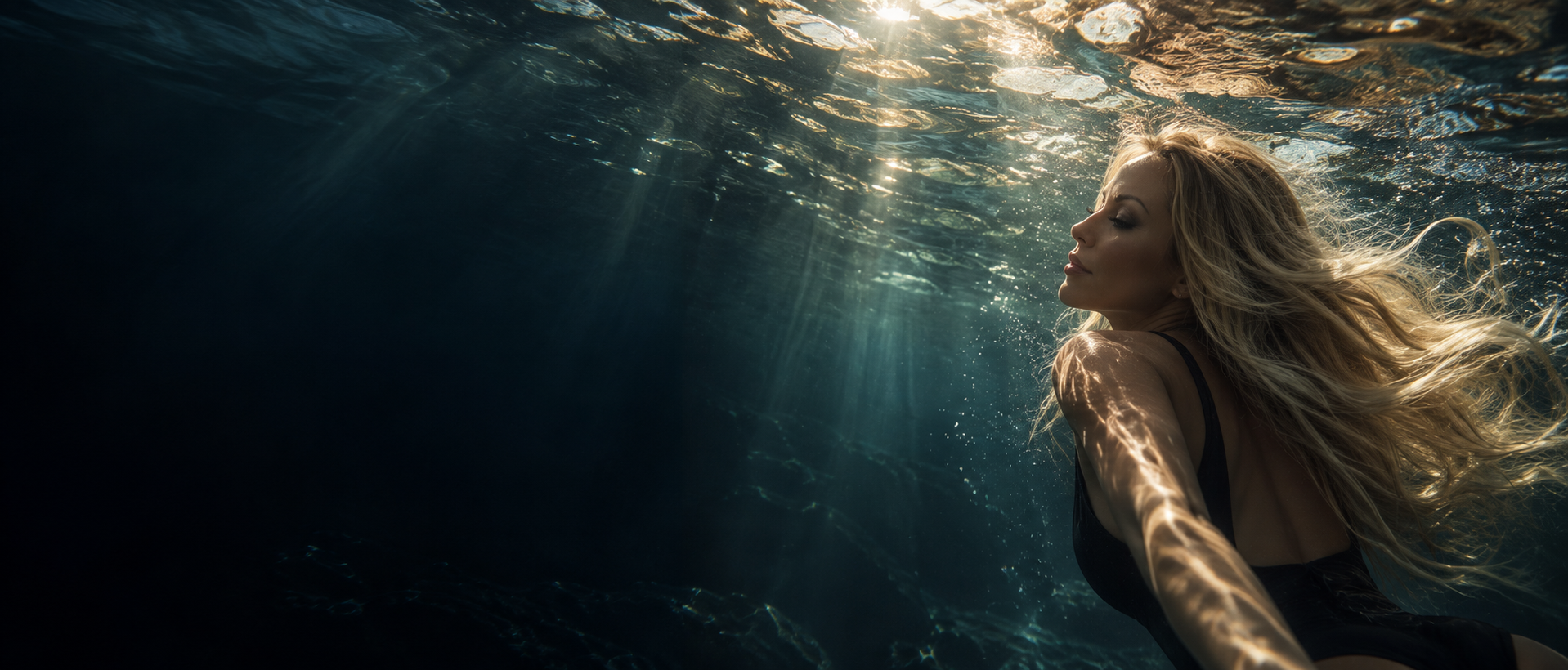
For Helena, water is not an abstract wellbeing concept. It has been one of the constants of her life. She began swimming very young and discovered, long before she had language for it, that immersion changed how she felt. When life became overwhelming, water was where the noise softened. It remains so today: whenever possible, Helena begins the day with a swim, using the rhythm of water and movement to release tension, clear the mind and return to herself.
That relationship grew into a life around the sea. Swimming, surfing, scuba diving and sailing have all been significant parts of Helena's life, and she has remained a marine naturalist at heart. She is also trained in underwater archaeology, bringing another dimension to her relationship with submerged landscapes, material culture and the histories held beneath the water. She spent years volunteering in marine conservation, including shark research, and has supported ocean-protection activism and organisations working for marine life. Water also runs through her work as a historian, cultural heritage specialist, Jungian scholar and lecturer: sacred wells, healing waters, mermaids, the Grail, the Sacred Feminine, medieval spirituality, sea magic and the symbolic depths of the unconscious repeatedly meet at the shoreline.
This consultation brings those strands together. It is for people who feel drawn to water, who know intuitively that they feel different beside it or within it, or who want to build a more deliberate relationship with water for restoration, creativity, reflection, embodiment and reconnection.
Consultation & Practice
—Your personal relationship with water, swimming and the sea
—Blue Mind and water-centred restorative practice
—Stress release, attention, reflection and embodied awareness
—Water, dreams, creativity, emotion and the unconscious
—Sacred wells, springs and historic healing-water traditions
—Water, the Sacred Feminine, mermaids and archetypal symbolism
—Sacral-chakra symbolism, creativity, sensuality and emotional flow
—Sea-centering, shower meditation and accessible everyday practices
—Creating a sustainable personal ritual around water and nature
Sessions can be practical, reflective, symbolic or a combination of all three. You do not need to live beside the ocean or be a strong swimmer. The work can begin with something as simple as walking beside water, swimming where appropriate, consciously bathing or showering, working with breath and imagery, or noticing what happens to attention and feeling when water becomes part of a deliberate practice.
Blue Mind · A Living Legacy
The science caught up with something water-lovers already knew
One of the people who gave modern language to this experience was Helena's late friend, marine biologist Dr Wallace J. Nichols. His landmark book Blue Mind explored the science behind why being near, in, on or under water can support calm, connection, attention and wellbeing. Nichols described a relationship with water that Helena recognised immediately from her own life: the shift in state that can occur when we leave the overstimulation of everyday life and return to blue space.
Helena continues to share and advocate for this work as part of keeping J's legacy alive. The Blue Mind movement and resources remain available online, and his revised tenth-anniversary edition of Blue Mind continues that invitation: to understand our attraction to water not as a luxury, but as a meaningful part of human wellbeing.
“The term ‘blue mind’ describes the mildly meditative state we fall into when near, in, on or under water.”
Dr Wallace J. Nichols · In memory
This is not about making extravagant promises for water. It is about taking seriously something many people already recognise in their own bodies: we often breathe differently, think differently and feel differently around water. A consultation helps turn that recognition into a practice that belongs to your actual life.
A Family Story · Water & Recovery
Sometimes the way back begins in water
Helena's understanding of water as restorative is also profoundly personal. When her son was very young, the family went through an extraordinarily difficult period that required a long process of recovery. Drawing on her own experience as a former lifeguard and lifelong swimmer, Helena introduced him to the water. Swimming became part of rebuilding confidence, movement and trust — and eventually the beginning of a shared family relationship with the sea.
Sailing was already a significant part of Helena's own life. While living in Spain, she sailed competitively at semi-professional level, including match racing, offshore regattas and ocean racing. She later brought her son into that world too. What began in extraordinarily difficult circumstances became one of the most positive things mother and son shared: swimming, sailing, movement, attention, trust, weather, sea and the experience of learning together. Helena has consciously passed on to her son the love of water and the ocean that shaped her own life. It reinforced something she had known intuitively since childhood — water can give us a different place from which to begin again.
A life on the water · Mediterranean Spain · Semi-professional sailing, ocean racing and a lifelong relationship with the sea. Read more in About Helena →
That experience also sits within a much wider understanding of water and rehabilitation. Aquatic and hydrotherapy programmes are used clinically because buoyancy reduces the effective load on joints and limbs, while the water itself provides graded resistance and support for movement. NHS physiotherapy guidance notes that buoyancy can make movement easier by supporting the body, and contemporary rehabilitation research continues to study aquatic therapy for mobility, balance, pain, range of movement and functional recovery.
Helena knows the restorative potential of water through her own recovery as well. In 2004, a serious horse-riding accident dislocated her shoulder, fractured multiple bones in her arm and shattered her elbow joint. Reconstructive surgery left the elbow held together with internal metalwork. Recovery took two years, during which she was unable to drive and many ordinary parts of independent life became difficult or impossible. She was told that she might never regain full use of the arm. Alongside physiotherapy and rehabilitation, Helena spent many mornings working in the pool, where buoyancy allowed her to move and strengthen the injured arm with less loading than was possible on land. She ultimately recovered with a loss of only around 15 degrees of movement and returned to ordinary life — driving, swimming and later sailing. Today she lives normally and, apart from being careful not to place excessive weight through the reconstructed arm, the injury does not require ongoing care. Most people would never know that she had shattered her elbow unless she told them. For Helena, that recovery remains an extraordinary example of what water, rehabilitation and perseverance can make possible.
The consequences did change some parts of her life. Helena eventually gave up horse riding and falconry because another major injury to the reconstructed arm could have serious practical consequences. But the experience deepened rather than diminished her relationship with water. For Helena, those long hours in the pool were not incidental to recovery: water gave her a supported environment in which to rebuild movement, strength and confidence when her body could not yet tolerate the same demands on land.
The evidence is strongest around rehabilitation, mobility and musculoskeletal or neurological function rather than sweeping claims that water is a cure-all. Systematic reviews and clinical studies continue to examine aquatic therapy across rehabilitation contexts, including balance, functional mobility and upper-limb and shoulder rehabilitation. A 2025 scoping review documented its use across shoulder and other upper-extremity rehabilitation, while NHS guidance describes hydrotherapy as a physiotherapy approach in which water supports the body and facilitates movement.
These experiences are part of why healing has become such an important thread through Helena's work. She has encountered recovery not only as a historical subject, but through serious injury, chronic health challenges and the experience of supporting someone she loves through a long period of recovery. That lived perspective sits alongside her research into healing across history — from sacred wells, ritual waters and older traditions of restoration to contemporary wellbeing, psychology and technology. It also informs her current exploration of Wellness, Healing & Wellbeing and her work developing human-centred digital and AI approaches to wellbeing. For more about the wider research and projects behind this work, visit About Helena.
Sacred Water · History · The Feminine
Before wellness, there were sacred waters
Human beings have sought renewal at springs, rivers, wells and seas for millennia. Water marks thresholds: birth, purification, initiation, pilgrimage, blessing and return. In the opening imagery of Genesis, the Spirit moves upon the face of the waters before the ordered world emerges. Across other traditions, too, water precedes form and carries the language of origin.
That history is especially tangible in Ireland, where Helena now lives. More than 3,000 holy wells are recorded across the island, many associated with saints, pilgrimage, local traditions of cure and continuing devotional practice. Helena's historical work explores these sacred and healing waters alongside medieval sacred landscape and the symbolic world surrounding the Knights Templar and Grail traditions. Her College of Psychic Studies lecture The Knights Templar: Soul Alchemy, Waters of Wisdom & Grail Mermaidens examines why water, water-bearers and mermaid imagery matter within her research into Templar spirituality, feminine wisdom and transformation.
The medicinal imagination of water reaches much further back. In Book XXXI of his Natural History, Pliny the Elder devoted an entire chapter to the uses of sea-water, recording its ancient therapeutic use in bathing, fomentations, wounds, fractures and other conditions. These are historical medical claims rather than modern clinical evidence, but they show how old the association between seawater and healing really is. Ireland preserves another strand of that relationship in its traditional seaweed baths: Atlantic seawater and freshly gathered seaweed became an established part of coastal bathing culture, with hundreds of bath houses estimated to have existed by the beginning of the twentieth century.
Water is also an extraordinary image of relationship: hydrogen and oxygen joining to become something neither is alone; surface and depth; containment and flow; life and dissolution. In Helena's work it frequently intersects with the Sacred Feminine, not because water belongs exclusively to the feminine, but because traditions of womb, vessel, well, sea, moon, emotion, intuition and generation have repeatedly gathered around it.
Mermaids · Grail · The Deep
The sea is also a language of the psyche
Helena has lectured internationally on mermaids, sea traditions and ocean protection, including her work at the College of Psychic Studies. In June 2024 she delivered her Spanish-language talk Mermaids: Discover the Myths, Learn their Magic, Awaken the Siren for the Covenant of the Waters Symposium, bringing together the regenerative energy of water, mermaid archetypes, healing, sea magic and ecological consciousness. Later that year she spoke at the Ancestral Pathways Conference 2024 on mermaids as ancestral archetypes and ancient priestesses who pour the waters of wisdom into the world.
Beneath the surface · Scuba, submerged landscapes and the living sea · Covenant of the Waters Symposium · 22 June 2024
Her research treats the mermaid not as a decorative fantasy figure but as a powerful liminal archetype: part human, part other; able to move between conscious surface and unknowable depth. This has a particularly rich Jungian resonance. C. G. Jung repeatedly used the sea and ocean as images of the collective unconscious — the immense psychic depth beneath individual consciousness from which archetypal images emerge. In Psychology and Alchemy, he described the sea as a symbol of the collective unconscious because unfathomed depths lie beneath its reflecting surface. The mermaid belongs naturally to this symbolic geography: an archetypal being who inhabits the threshold between surface and depth, consciousness and the unconscious, the human and the more-than-human.
Mermaids are catalysts for transformation and figures of initiation, but they are also ocean warriors — guardians of the blue world whose archetype can call us not only toward inner change, but toward ecological awareness, reciprocity and protection of the seas. Read Jungianly, the mermaid can therefore become both inhabitant and messenger of those deep psychic waters: a figure who rises from the archetypal sea carrying material that asks to be encountered, integrated and transformed. Her published College essay Sea Magic: Where Myth, Memory & Magic Flow brings together maritime traditions, mermaids, Norse Seiðr, sacred feminine imagery and the living presence of the sea.
This symbolic dimension can enter a consultation through dreams, recurring water imagery, creative blocks, emotional transitions or a sense of being called back to the sea. Water is traditionally connected with feeling, imagination and flow; in chakra symbolism it is associated with the sacral centre — emotion, creativity, sensuality and sexuality. Helena often finds that some of her own clearest ideas arrive in water, when ordinary cognitive effort loosens and another form of attention becomes possible.
Ocean Advocacy · The Blue Heart
To love the sea is also to protect it
The restorative relationship cannot be one-way. Helena's connection with the ocean has always included advocacy: years of volunteer marine-conservation work, involvement with shark research, past support for Sea Shepherd and continuing support for those defending marine ecosystems and wildlife. For Helena, the mermaid as ocean warrior belongs here too: a figure of fierce relationship with the sea, reminding us that enchantment without stewardship is incomplete.
Dr Sylvia Earle — “Her Deepness” — has been one of Helena's enduring inspirations. Helena first encountered her work in her early twenties, when she bought one of Earle's books — a treasured volume she still owns today. Earle's combination of ocean exploration, scientific curiosity and fierce advocacy for the living sea helped shape Helena's own understanding that loving the ocean also carries a responsibility to protect it. Her life showed a young Helena that the ocean could become vocation as well as wonder.
“No water, no life. No blue, no green.”
Dr Sylvia Earle · Mission Blue
Dr Sylvia Earle · Protect What Gives Us Hope · Mission Blue · Explore Mission Blue →
If this work deepens someone's relationship with water, Helena hopes it also deepens reciprocity: attention, gratitude, stewardship and the desire to protect the places and beings that make the blue world possible. The sea is not simply a resource we visit to feel better; it is the living system on which terrestrial life depends.
For more about Helena's wider background in water, maritime experience, underwater archaeology, marine conservation, historical research and teaching, visit About Helena.
Everyday Practice
You do not need an ocean outside your door
Water practice can be remarkably simple. Helena often recommends beginning with what is available: a morning swim where safe and practical; a walk beside the sea, river or lake; sitting near water without a screen; or turning an ordinary shower into a short centering practice using breath, attention and white-light imagery. The point is not performance. It is to create a reliable moment in which the nervous system, body and imagination are given permission to change pace.
For some clients, the work may connect naturally with Energy, Chakras & Subtle Body, particularly around the sacral centre, embodiment and energetic practice; with Soul Archaeology where water is emerging through dreams, archetypes or major life transitions; or with Wellness, Healing & Wellbeing where the focus is on building a wider restorative practice.
We come from water, live through water and return to it again and again — for movement, memory, imagination, solace and life itself. Sometimes healing begins simply by remembering that relationship.