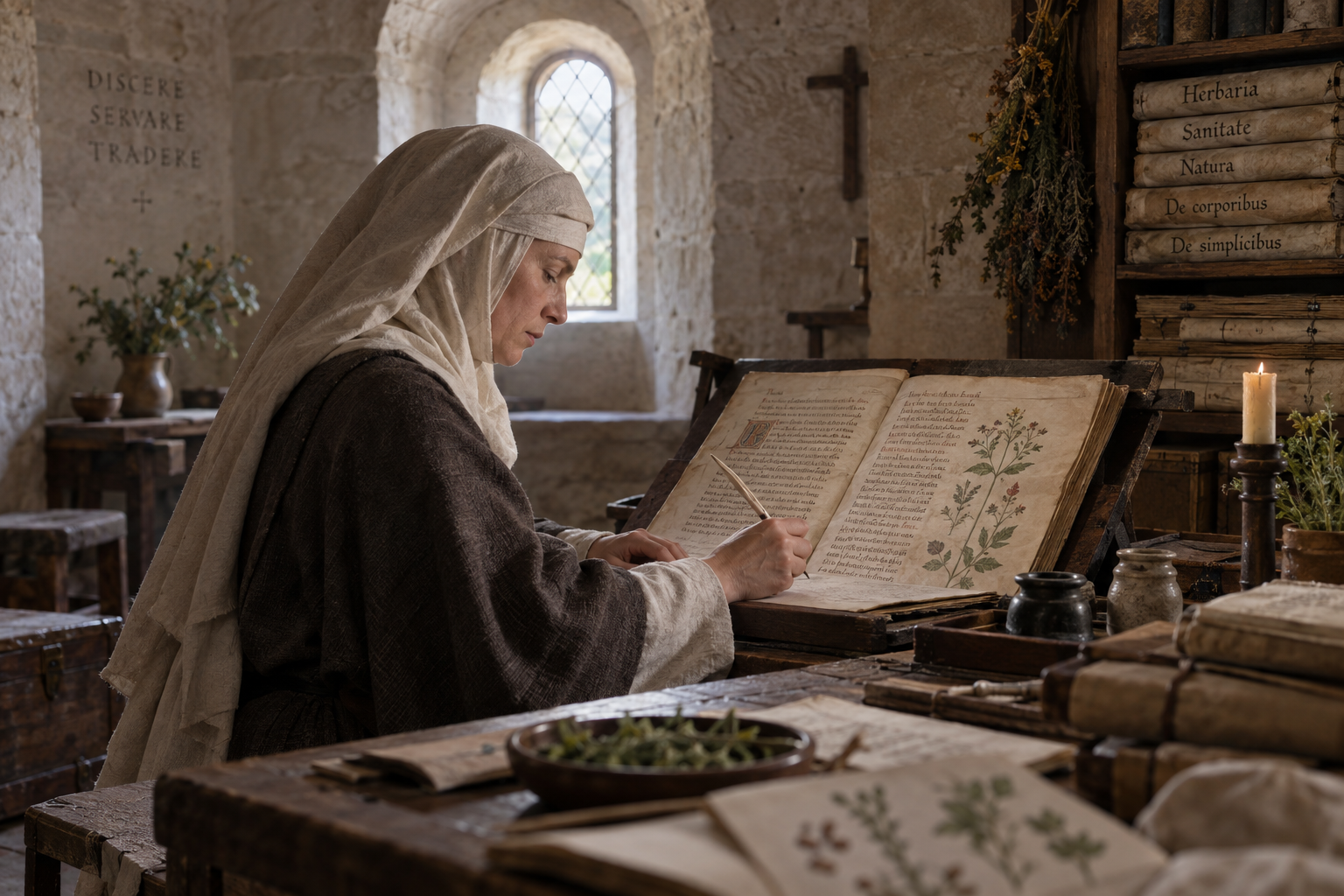
Mind · Body · Spirit · History · Nature · Human Wellbeing
Wellness, Healing & Wellbeing
A deeply integrative approach to wellbeing, bringing together mind, body and spirit with practical reflection, historical knowledge, nature, psychology and Helena's interdisciplinary research into healing — from medieval medicinal traditions to contemporary human-centred technology.
—Historical healing traditions and medicinal knowledge
—Developing a sustainable personal wellbeing practice
For Helena, wellbeing is fundamentally holistic. Nourishment, movement, sleep, stress, emotional life, relationships, environment, creativity, spirituality and our sense of meaning continually affect one another. The body cannot always be understood without the mind; the inner life cannot simply be separated from physical experience; and neither exists independently of the world in which we live.
Helena's fascination is specifically with the Cistercian approach to healing — a tradition in which care of the body, the soul, the emotions, spiritual life and the natural world could be understood as parts of an interconnected human whole. This is not a modern wellness idea projected backwards onto the Middle Ages. It is visible within early Cistercian thought itself, and nowhere more strikingly than in the circle around Bernard of Clairvaux and his close friend William of Saint-Thierry.
A private consultation can explore food and everyday nutrition, rest, movement, breathwork, meditation, time in nature, water, body awareness, emotional and spiritual wellbeing, life transitions and the practices that may help an individual build a more sustainable relationship with their own wellbeing. The starting point is the person: their history, circumstances, body, inner life, environment and what they are actually trying to change.
“Believe me, you will find more lessons in the woods than in books. Trees and stones will teach you what you cannot learn from masters.”
Bernard of Clairvaux · Letter 106
For Helena, Bernard's words offer an extraordinary starting point for thinking about healing and wellbeing. Bernard was the influential Cistercian abbot who co-wrote the Latin Rule of the Knights Templar with Hugh de Payens, the Order's first Grand Master, and later wrote In Praise of the New Knighthood. His relationship with the emerging Order was also personal: he was connected by family ties to both Hugh de Payens and André de Montbard, the fifth Grand Master, two men traditionally counted among the earliest knights and founders of the Knights Templar.
This concern was not abstract for Bernard. His health was severely impaired from the early years of Clairvaux and remained fragile throughout his adult life. His own experience of illness, rest, diet and medical care gives an added dimension to a body of writing deeply concerned with the ordering and healing of the human person. In De consideratione, written for Pope Eugenius III, Bernard's practice of consideratio — reflective, contemplative attention — has even been studied by modern scholars as a form of spiritual therapy: a way of restoring inner order amid exhaustion, responsibility and pressure.
The connection becomes still clearer in William of Saint-Thierry, Bernard's closest friend and one of the most important thinkers of the early Cistercian world. Their friendship was both personal and intellectual, and their exchanges helped shape the developing spirituality of the Cistercian movement. William came to Clairvaux while ill, and the conversations the two men held there became important to the development of their mystical thought. In his remarkable De natura corporis et animae — On the Nature of the Body and the Soul, William drew upon Greek and Arabic medical knowledge as well as Christian theology to consider the human being physically and spiritually. For William, health involved bodily balance, but the soul was not irrelevant to that balance: body and soul belonged to an intimately connected understanding of the person.
William's work is also part of Helena's own teaching. She has worked extensively with his writings and has introduced students to some of his meditative and contemplative practices, exploring them not simply as medieval religious texts but as part of a much larger Cistercian understanding of the relationship between body, soul, contemplation and wellbeing.
That is the Cistercian tradition that fascinates Helena: a genuinely holistic concern with body, soul, contemplation, food, medicinal knowledge, environment and the preservation of health. Bernard's observation about the woods expresses the same principle in another register — knowledge does not exist only in books. It can also be encountered through landscape, water, plants, movement, the body, contemplation and our relationship with the natural world.
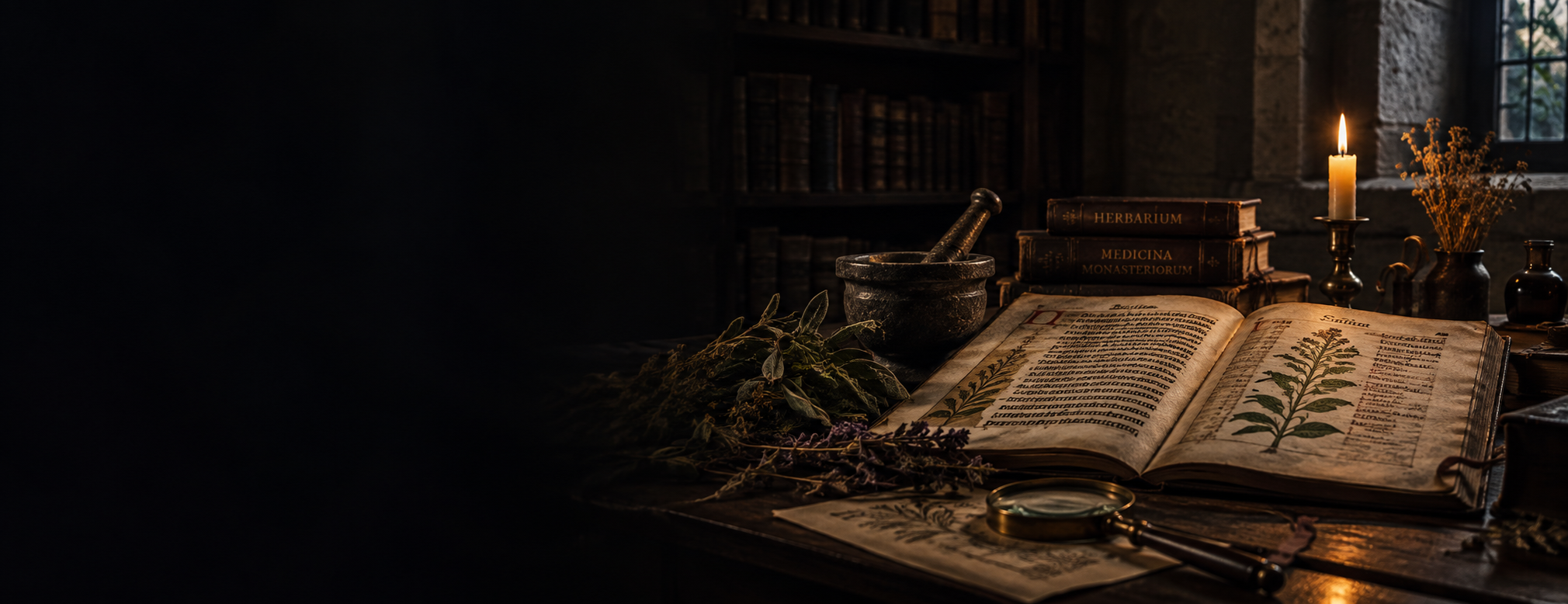
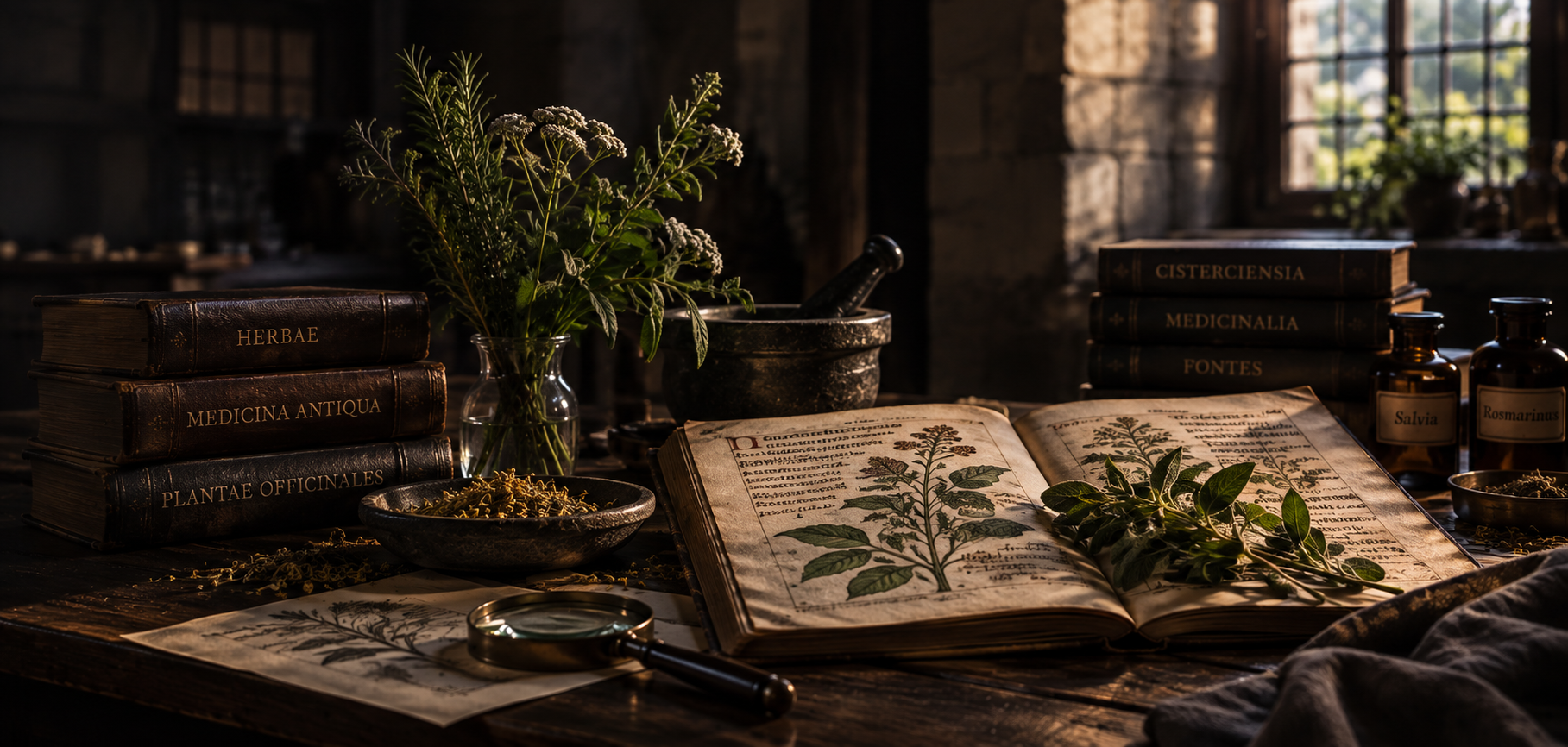
MEDIEVAL MEDICINAL KNOWLEDGE · MANUSCRIPT · PLANT · PRACTICE
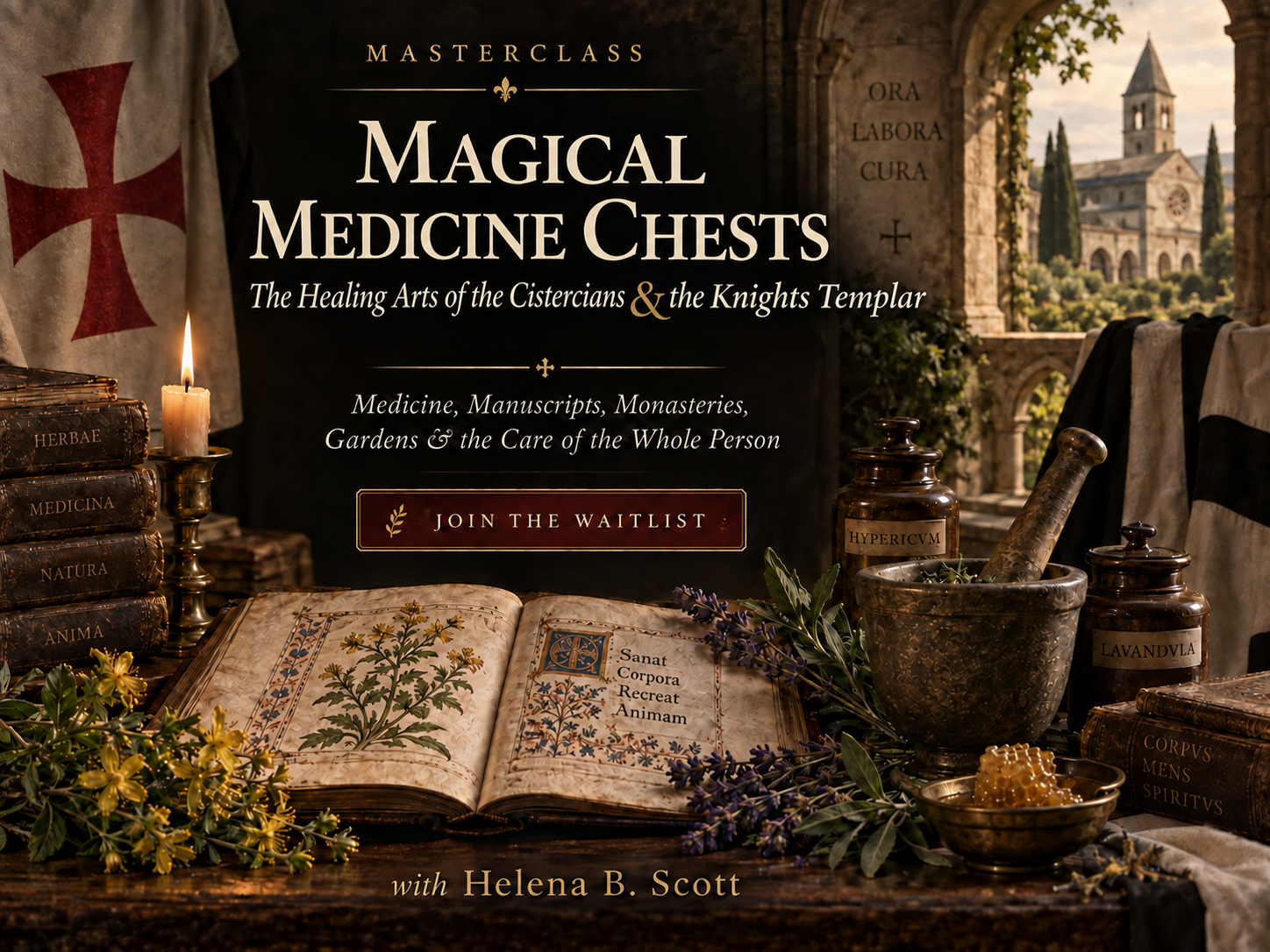
Magical Medicine Chests: The Healing Arts of the Cistercians and the Knights Templar
Long before “wellness” became a modern industry, medieval religious communities were asking enduring questions about health, food, plants, environment, spiritual life and care. These questions have become an important strand of Helena's historical research.
Her work on the Knights Templar and Cistercians began years before her MA and continued throughout her postgraduate research in Public History and Cultural Heritage. From this developed her specialist masterclass, Magical Medicine Chests: The Healing Arts of the Cistercians and the Knights Templar, exploring monastic and Templar approaches to medicine, infirmaries and hospitals, medicinal plants, food, gardens, herbs, honey, hygiene and the relationship between bodily and spiritual care.
The Knights Templar are remembered overwhelmingly as warriors. They were also caring for the sick. Their Rule makes explicit provision for sick brothers, while later Templar statutes and other historical evidence reveal infirmaries, physicians, medicines, specialised diets, syrups, surgical treatment, bloodletting and personnel responsible for caring for brothers who were ill or wounded.
For Helena, Templar healing is particularly fascinating precisely because it remains overshadowed by the military history of the Order — and by the widespread assumption that care of pilgrims and the sick belonged principally to the Hospitallers. Her research asks us to look again at that picture. Behind the military Order was also a culture of care.
Hospitality · Pilgrimage · Care · Medicine
Hospital Did Not Mean What It Means Today
The medieval hospital was not simply the clinical institution the word suggests today. It belonged to a much wider culture of hospitality and care. Such houses could offer travellers, pilgrims, the poor and vulnerable food, shelter, rest and assistance; monastic infirmaries could provide more particular care for members of a religious community who were sick or unable to care for themselves.
The Knights Hospitaller are rightly famous for their hospitals and care of pilgrims. They were not, however, the only military order engaged in healing. The Knights Templar maintained their own infirmaries and medical provision, and evidence from medieval Ireland also points to hospitals associated with the Order.
The Crusading world brought Latin Christian communities into sustained contact with Byzantine, Islamic, Jewish and other medical cultures of the eastern Mediterranean. Helena's Healing Arts research explores this world of exchange: physicians, surgeons, apothecaries, battlefield medicine, medicinal substances and the practical knowledge demanded by pilgrimage, disease and traumatic injury. The warrior and the healer were not necessarily opposites.
Tomar · Portugal
From the Templars to the Order of Christ
One of the most remarkable places through which this history can be explored is Tomar in Portugal. The great Templar castle and headquarters at Tomar subsequently became the Convent of Christ, home of the Portuguese Order of Christ, through which the Templar legacy in Portugal continued after the suppression of the Order of the Temple.
Its later Enfermaria and Botica — infirmary and pharmacy — preserve an extraordinary continuation of healing culture at this former Templar centre. The exhibition A Botica do Real Convento de Thomar reconstructed this world through the convent pharmacy, infirmary, medicinal preparations and the relationship between body, spirit, nature and care.
In her Healing Arts masterclass, Helena introduces this exhibition as an important public-history case study, placing its interpretation alongside primary sources and wider research so that students can move from the written record into the material world of medicines, vessels, books and spaces in which care actually took place.
Ray Swi-hymn · CC BY-SA 2.0 · Cropped and tonally adjusted; adapted image shared under CC BY-SA 2.0
Rights-cleared documentary and comparative imagery. The pharmacy interior and vessels provide material context; the architectural image shows the Convent of Christ itself. The official Botica project remains the authority for its collection.
Some of the most significant evidence Helena uses in her teaching does not come from modern interpretations of the Templars at all. It comes directly from medieval primary sources.
Over years of research, Helena has worked through a substantial body of primary-source material in several languages, following evidence for Templar healing practices, medical care, food, medicinal substances, gardens, infirmaries and the wider culture of health within the Order. Some of these sources have already been shared with students in her masterclasses. Others have not yet been made public.
One manuscript in particular has a significant connection with Helena's research into the Knights Templar in Ireland and the work that developed through her MA dissertation. What it reveals about healing within the Order forms part of continuing research that Helena is deliberately holding back for fuller treatment.
Some of this material will be explored through the Templar Academy. The rest will have to wait for the book.
Signature Masterclass · Primary Sources · Material History
Magical Medicine Chests
The Healing Arts of the Cistercians and the Knights Templar
Created by Helena from years of historical research, this signature masterclass follows evidence across medieval primary sources, material culture, Templar regulations and monastic medicine. It explores how health, illness, food, medicinal plants, gardens, infirmaries and hospitals were understood — and how knowledge moved between cultures during the Crusades.
Participants receive a specially prepared companion booklet and their own herbarium, transforming the subject from something encountered only on a screen into material that can be studied, identified and remembered.
Selected sources are opened carefully, separating what the historical record can support from the mythology that later accumulated around the Order.
Signature Masterclass · Created and taught by Helena B. Scott · Select image to enlarge
Inside the Masterclass · Reconstructed History · Tomar
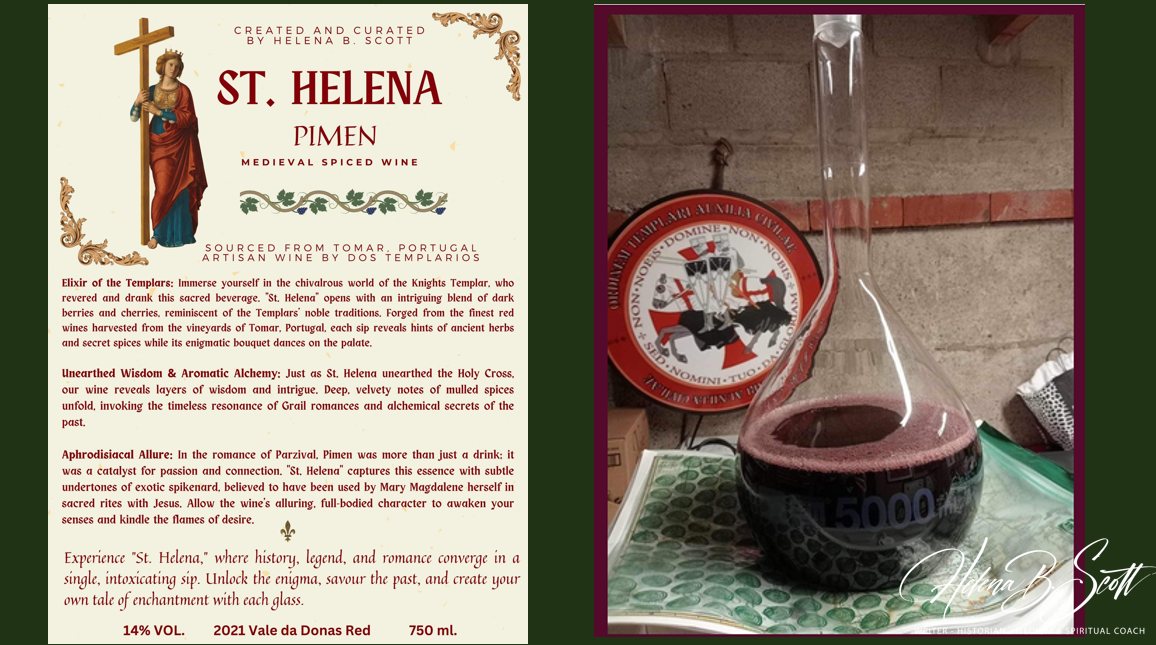
St Helena Pimen
A distinctive element of the masterclass is Helena's reconstruction of a medieval pimen — a richly spiced wine that brings documentary research into direct contact with taste, scent and material culture.
Created with members of a modern Knights Templar order using Herdades dos Templários wine from the vineyards of Tomar, St Helena draws on the wider culture of medieval medicinal and ceremonial wines, Grail romance, and the Templars' relationship with vineyards, production and trade.
Its name honours St Helena, important within Templar devotion and remembered for the discovery of the True Cross — an apt patron for a historically grounded act of material reconstruction. Select the image to enlarge.
RECOVERING THE LOST LIBRARIES OF HEALING · PRIMARY SOURCES · MEDICINAL PLANTS
Recovering Knowledge · Not Romanticising It
Hildegard of Bingen & the Lost Libraries of Healing
The survival of medieval medical and botanical manuscripts raises another compelling question: what did earlier cultures know about plants, food and the maintenance of health — and what can responsible contemporary research learn from them?
Hildegard of Bingen belongs naturally within that investigation. Abbess, writer, composer, visionary and observer of the natural world, Hildegard wrote about plants, foods, bodies, illness and nature within a medieval understanding of creation in which human health could not easily be separated from the environment surrounding it.
One modern research tradition Helena particularly admires is the work associated with the late Dr Johannes Gottfried Mayer and the Forschergruppe Klostermedizin. Mayer spent decades investigating medicinal knowledge preserved in medieval manuscripts and the plants appearing within them. Together with researchers and practitioners including Pater Kilian Saum, this work helped return forgotten monastic knowledge to serious scholarly and public discussion.
Manuscript · Plant · Historical Medicine
The method resonates strongly with Helena's own philosophy: recover the knowledge · understand its context · distinguish evidence from assumption · ask what remains meaningful now.
Maryculter · Kilbarry · Living Landscape
From Manuscript to Medicinal Garden
Helena's interest extends beyond manuscripts to the landscapes in which knowledge was practised. Her research into Maryculter Templar Priory in Aberdeenshire, Scotland, and the medicinal plants associated with its historic herb garden became one inspiration for thinking about how the working landscapes surrounding Templar houses might be interpreted today.
During her MA research into the Knights Templar in Ireland's south-east, Helena learned that work was taking place to restore the gardens at Kilbarry in County Waterford, a Templar site central to her dissertation. She contacted the project and offered to share research into plants that might historically and plausibly have been cultivated and used within such a landscape.
The idea was to recover something of a working and healing landscape: medicinal and useful plants, food, herbs, bees and honey, and the relationship between a religious community and the land that sustained it.
Plant · Text · Place · Material Knowledge
The Ancient Apothecary
This historical research also informs Helena's developing work around the ancient apothecary: recovering and interpreting medicinal, botanical and practical knowledge preserved within historical sources.
A plant named in a medieval manuscript is more than a word on a page. It has a physical identity, habitat, season, history of cultivation and use, and often a complex trail of changing names across languages and centuries.
Bringing those fragments together requires historical research, botanical identification, translation, material culture and increasingly the intelligent organisation of large bodies of interconnected information. The ancient apothecary therefore sits at the meeting point between cultural heritage and contemporary knowledge systems.
Food · Plants · Nature · Water
Healing Is Also a Relationship with Place
Historical healing traditions repeatedly return us to apparently ordinary things: food, sleep, plants, movement, water, air, gardens, seasons and community. Helena's contemporary wellbeing work retains that sense of relationship.
Food and nutrition can be approached as nourishment rather than punishment or perfection. Movement can become a means of returning to the body rather than simply measuring performance. Nature can provide a different quality of attention. Meditation and breath can create moments of stillness. Symbol and ritual can help give form to experiences that are difficult to articulate.
Water has a particularly important place within Helena's work. Her lifelong relationship with swimming, sailing, surfing and scuba diving; her experience of aquatic rehabilitation; her historical research into sacred wells and healing waters; and her friendship with the late Dr Wallace J. Nichols, author of Blue Mind, have developed into a separate strand of consultation around Ocean Therapy & the Healing Power of Water →
Psyche · Meaning · Inner Life
Wellbeing Is More Than the Absence of Symptoms
There are dimensions of wellbeing that cannot be reduced to diet, exercise or productivity. People also need meaning, connection, creativity and a relationship with their inner life.
Helena is a Jungian scholar, with specialist formation in Jungian psychology, archetypal psychology, shadow work and psychospiritual counselling. This informs the way she approaches recurring patterns, periods of transition, creativity, dreams, identity, loss, purpose and the relationship between conscious intention and the less visible forces shaping a life.
The body is not excluded from the psyche, and the psyche is not excluded from the body. Where deeper archetypal work becomes appropriate, this can connect naturally with Soul Archaeology; where energetic sensitivity becomes central, with Energy, Chakras & Subtle Body.
Helena Wellness
From Medieval Manuscripts to Modern Wellbeing
Helena's historical research has increasingly led to a contemporary question: how can complex knowledge be organised so that it genuinely helps people understand and participate in their own wellbeing?
That question lies behind Helena Wellness, a developing digital wellbeing and knowledge system bringing together carefully structured information around food, movement, rest, emotional wellbeing, contemplative practice, nature, historical knowledge and sustainable everyday habits.
The intention is not to hand human judgement over to technology. It is to make complex information more intelligible, more navigable and more useful, while leaving the individual increasingly capable of understanding patterns, asking better questions and making informed decisions.
Helena's applied-AI work in wellbeing has grown from two distinct systems, both rooted in lived need rather than technology for its own sake.
Helena Wellness began with Helena herself. Living with Hashimoto's, a chronic autoimmune thyroid condition, led her to want a more coherent way of bringing together the different dimensions that shape everyday wellbeing: food and nutrition, movement, rest, stress, emotional and psychological patterns, contemplative practice, nature and the knowledge needed to make sense of them. The developing system therefore includes psychology as part of wellbeing rather than treating physical and inner life as unrelated domains.
A separate AI-supported system grew from Helena's experience of developing practical tools within her own family to make complex educational and organisational demands more manageable and support greater independence. It transforms complex information into manageable steps, supports planning and reduces unnecessary cognitive load. The system provides scaffolding designed to strengthen human capability and independence.
Together, these two very different projects produced a much larger research question: when does AI genuinely support human autonomy — and when does assistance begin to create dependency?
That question now informs Helena's developing work around human autonomy, wellbeing and AI: how intelligent systems might support agency, judgement, confidence and self-direction without gradually replacing the capacities they were originally designed to strengthen. Technology should preserve the conditions under which responsible human judgement remains possible.
Masterclasses · Templar Academy · Book · Research
A Living Research Programme
Helena continues to develop her research into Magical Medicine Chests: The Healing Arts of the Cistercians and the Knights Templar, including medicinal and botanical knowledge preserved within historical sources, infirmary practice, hospitals, gardens, food, honey and the landscapes surrounding medieval religious houses.
The dedicated masterclass opens part of that archive to students now. The developing Templar Academy will allow selected subjects to be explored at greater depth.
And Helena is finishing a book on this subject, built from years of research and primary sources in several languages. Some of that evidence has already astonished students in her classes. Some has never yet been shown publicly.
What the sources reveal about the Templars' capacity for healing is far richer than the familiar story of warrior monks — and some of that knowledge still has something to teach us.
The wider research also opens possibilities for museums, heritage organisations, researchers, educators and technology partners: new ways of recovering, interpreting and responsibly reconnecting people with complex historical knowledge that might otherwise remain inaccessible in manuscripts and specialist publications.
Where Do We Begin?
A Private Consultation
You do not need to arrive with a perfectly defined problem. You may simply know that something feels out of balance: nourishment, rest, movement, stress, creativity, your relationship with nature or your inner life — or perhaps you want to step away from the overwhelming volume of contemporary wellness information and think more coherently about what wellbeing actually means for you.
A consultation begins there. Together, we can look at the wider pattern, identify what matters most, explore practices and resources appropriate to your circumstances, and create a realistic direction for what comes next.
The purpose is to help you understand what wellbeing means within the context of your own life — and what might genuinely support it.
Healing, for Helena, is not the recovery of one forgotten remedy. It is the recovery of a way of thinking — one in which body, soul, nature, knowledge and human agency are allowed to belong to the same conversation.
Helena B. Scott, MA is a public historian, cultural heritage specialist and Jungian scholar whose interdisciplinary practice draws upon depth and archetypal psychology, psychospiritual counselling, symbolism, historical research and more than a decade of study within psychical and spiritual traditions.
New research, forthcoming books, lectures, fieldwork, courses and occasional notes from Helena B. Scott.
By subscribing, you agree to receive occasional research news, publications, events and updates from Helena B. Scott by email. You can unsubscribe at any time. Privacy Policy.
Google Analytics helps understand how visitors find and use the site. If you decline, analytics cookies remain off and only limited cookieless measurement signals may be sent. It is not used for advertising here.