Living Research Institute · Digital Archive · Public Launch 31 October 2026
The Dark Mother Institute
History · Black Madonnas · Sacred Feminine · Psyche · Landscape
A Living Archive
Recovering the histories that darkness has kept
Founded by Helena B. Scott, MA — public historian, cultural heritage specialist and Jungian scholar, the Dark Mother Institute is a developing research initiative and living archive bringing together Black Madonna research, the Sacred Feminine, sacred landscape, medieval religious culture, Jungian, archetypal and depth psychology, and the wider cultural and esoteric traditions through which dark feminine imagery has endured.
The Institute grows from Helena's continuing archival and field research and from a larger question at the heart of her work: what happens when we return to the objects, places, texts and traditions themselves — and listen again to histories that have been overlooked, minimised or separated from one another?
Her current research includes overlooked and little-known Madonna material alongside previously unknown Black Madonna images and traditions absent from the established record, as well as comparative fieldwork across Europe. In 2026 this included research in Hungary — historically styled the Regnum Marianum, the Kingdom of Mary — and Transylvania, as part of a wider enquiry extending through Spain, the Mediterranean and traditions carried into Latin America. Specific discoveries and locations remain unpublished while the research is in progress.
The Institute is a living research space where historical evidence, material culture, sacred geography and the symbolic life of the psyche remain in conversation while each retains its own evidential character.
The Dark Mother Institute · Research environment · Public launch 31 October 2026
History Before Archetype
The Black Madonna as sacred image, presence and question
Black Madonnas sit at the meeting point of history, devotion, material culture, pilgrimage, landscape and memory. The Institute begins with that historical and physical reality: surviving images, documentary traces, churches, routes, local traditions and the communities that have lived alongside them.
From there, Helena's work opens into questions of symbolism, the Sacred Feminine and the Dark Mother as an archetypal image of descent, shadow, transformation and renewal. She is not only mother or nurturer: she may also appear as destroyer, threshold-keeper and the force through which an old order is broken so that another may emerge.
In the late-antique Chaldean Oracles, Hekate acquires an extraordinary cosmological role as a mediating, life-giving power between worlds — a tradition later scholarship has explored through the figure of Hekate Soteira. This aspect of the Dark Mother as intermediary, generative power and cosmic bond forms one of the deeper intellectual currents behind the Institute, opening a comparative conversation across the distinct traditions gathered here.
The sequence matters: historical world first; documented reception second; archetypal and esoteric interpretation only then.
Evidence Before Interpretation
Interdisciplinary, while keeping the evidence distinct
This allows historical objects, texts and traditions to retain their own integrity while opening them to wider interdisciplinary questions.
Within depth and archetypal psychology, the work enters into conversation with Erich Neumann's The Great Mother and his exploration of the nurturing and terrible poles of the maternal archetype, while the comparative study of sacred image, myth and religious experience also places the Institute in dialogue with the work of Mircea Eliade. These interpretive conversations sit alongside the historical evidence and enlarge the questions it can open.
This allows the Black Madonna to remain what she is historically while also asking why these dark feminine images continue to exert such extraordinary symbolic force across cultures and generations.
Black Madonna · Sacred Presence · Living Memory
The image survives. The questions remain.
Ancient Voice · Nag Hammadi Codex VI,2
“For I am the first and the last. I am the honored one and the scorned one. I am the whore and the holy one. I am the wife and the virgin. I am <the mother> and the daughter.”
Translation Matters · A Voice That Resists Definition
The language of Thunder, Perfect Mind is itself part of the enquiry. George W. MacRae’s influential translation renders the speaker, “I am <the mother> and the daughter.” A later collaborative translation by Hal Taussig, Jared Calaway, Maia Kotrosits, Celene Lillie and Justin Lasser draws renewed attention to the text’s grammatical and gendered instability and to the difficulty of fixing its speaker within a single identity.
This matters to the Dark Mother Institute because Thunder does not simply reverse one hierarchy by replacing a masculine voice with a feminine one. Its speaker repeatedly refuses the categories through which she is being defined: holy and profane, wife and virgin, mother and daughter, honoured and rejected. The contradiction is not a problem to be solved. It is part of the text.
What changes when translation allows the contradiction to remain?
Scholarship in Conversation · Remembrance of Sophia
Kirsten Kinsley’s 2026 Pacifica dissertation, The Remembrance of Sophia: An Alchemical Hermeneutical Approach to the Poem “Thunder, Perfect Mind”, brings Thunder into dialogue with Sophia, Jungian depth psychology, alchemical hermeneutics, individuation and the tension of opposites, creating a particularly relevant contemporary conversation with questions explored by the Institute.
The Institute is also concerned with the recovery of feminine voices preserved in texts, images and traditions that resist the categories later imposed upon them. These sources are brought into conversation with their distinct historical origins, contexts and lines of transmission kept visible.
Documentary in Progress · Jean L. Donohue · Confirmed Participant
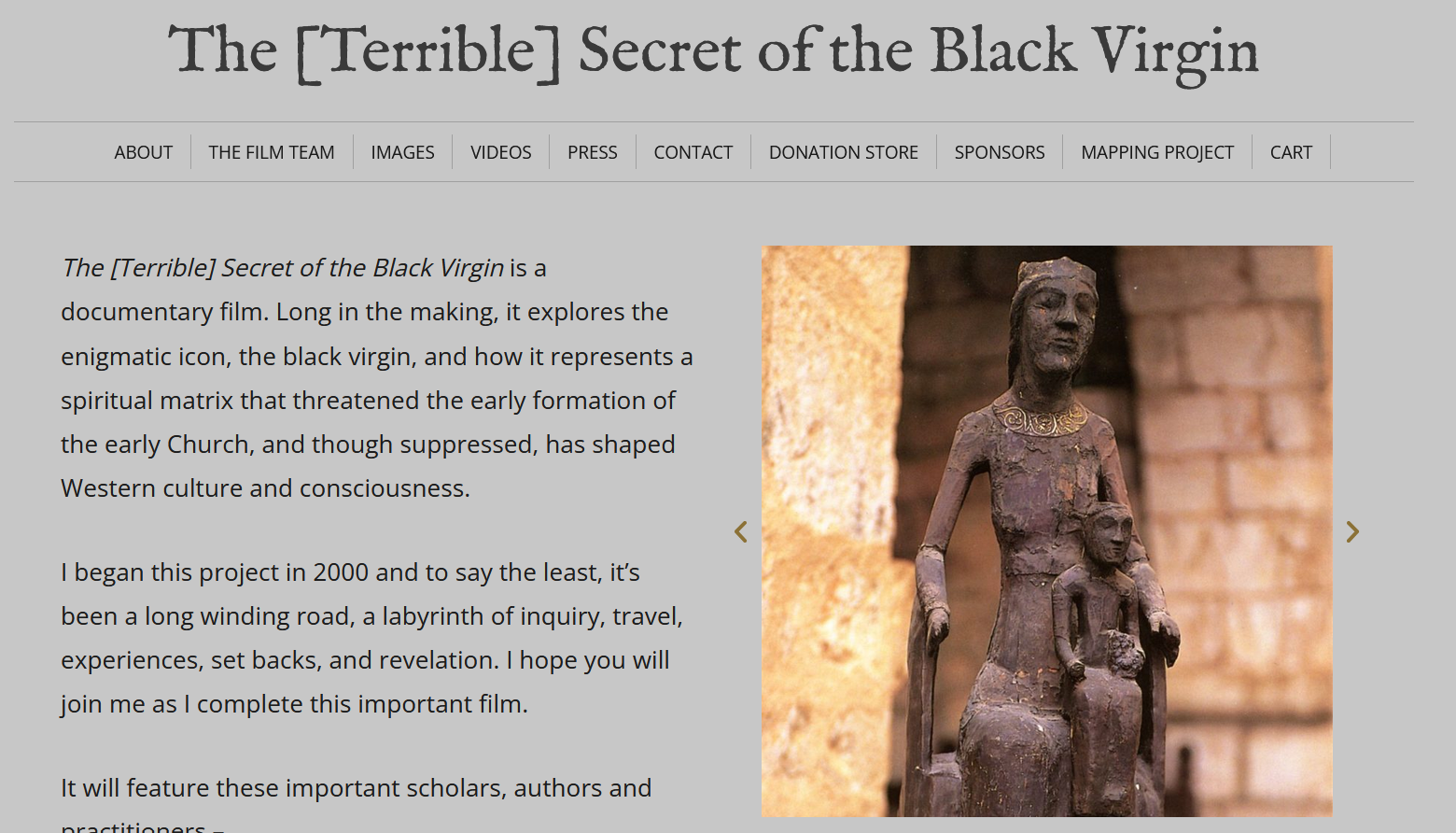
The [Terrible] Secret of the Black Virgin
Filmmaker Jean L. Donohue’s long-running documentary follows the enigmatic Black Virgin across sacred landscapes, symbols and traditions of the Sacred Feminine. The project asks where these dark Marian images come from, why they became associated with heterodox or initiatory traditions, and how they intersect in later interpretation with Mary Magdalene, Isis, Gnosticism, the Knights Templar, Cathars and Rosicrucian traditions.
Helena B. Scott Joins the Documentary
Helena B. Scott has been formally invited by filmmaker Jean L. Donohue to participate in The [Terrible] Secret of the Black Virgin, joining an international group of researchers, authors and practitioners whose work has explored the Black Virgin, the Sacred Feminine and related religious and esoteric traditions.
Helena is honoured to contribute to this long-running documentary project and will also be joining the film’s official website as a featured participant.
The [Terrible] Secret of the Black Virgin · Jean L. Donohue · Official documentary website · Documentary capture · Visit the project ↗
Featured Voices
An international constellation of researchers, authors and interpreters
Ean Begg
Lynn Picknett
Clive Prince
Margaret Starbird
Tim Wallace-Murphy
Dr Annine van der Meer
Marko Pogačnik
Suzanne Bessiere
Michel Armengaud
Julie Scott
Helena B. Scott
11th Confirmed Participant · 2026
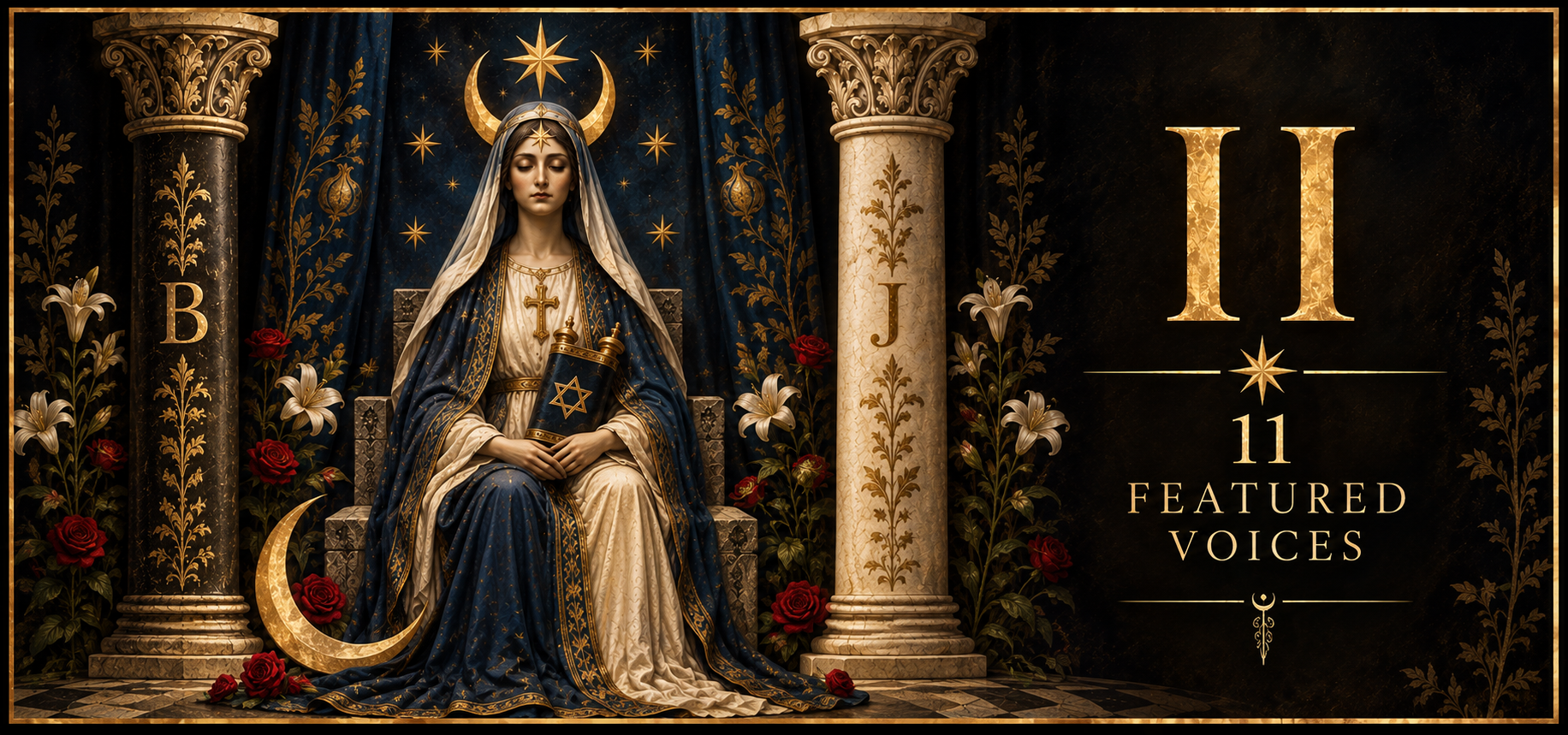
Eleven arrived here by circumstance rather than design: two ones, two pillars, and the Priestess between them — a quiet correspondence of threshold, intuition and the Sacred Feminine.
Jean’s publicly shared film material and official documentary site trace the project’s continuing development, research and international contributors.
What is lost when the feminine cannot be integrated?
Across history, feminine authority has repeatedly been narrowed, idealised, feared, disciplined or divided into acceptable and unacceptable forms: virgin and whore, mother and destroyer, holy woman and witch, wisdom and temptation.
Depth psychology asks what such divisions cost — not only women, but the cultures that inherit them. Within a Jungian frame, the feminine wound can be approached as a wound of disconnection: from body, instinct, eros, creativity, darkness, receptivity, cyclical life and forms of knowing that have too often been devalued when they could not be contained within sanctioned images of femininity.
Helena approaches the feminine wound as a varied cultural and psychological pattern rather than a single universal experience, and as a question that concerns women and men alike. In Jungian terms, the refusal of the feminine can also wound masculine development: the man who cannot enter into relationship with the anima risks remaining cut off from feeling, relatedness, receptivity and dimensions of his own psychic life. Equally, a woman may remain estranged from the animus and from forms of agency, discernment and inner authority symbolically associated with it. These are archetypal and psychological categories rather than prescriptions about biological sex or gender.
The Feminine Is Not Gender
“The great work of our time is to bring the feminine into this culture.”
For Woodman, the feminine is not synonymous with biological sex or assigned exclusively to women. It names a principle of presence, relatedness, embodiment and receptivity that may be lived — or suppressed — in women and men.
The Initiated Masculine · Strength Through Integration
Integration deepens the masculine by bringing strength into relationship with a fuller range of human capacities. In Jungian terms, this means entering into conscious relationship with qualities that may have been excluded: feeling, receptivity, relatedness, intuition, embodiment and care.
The mature masculine is strengthened by this encounter. Its strength becomes more conscious, relational and whole.
The initiated warrior is the warrior whose power has entered into relationship with consciousness: strength tempered by discernment, action by reflection, courage by compassion, and the capacity to fight by the wisdom to know when — and what — is worth fighting for.
The Institute is therefore concerned with a larger problem of integration. The uninitiated warrior who can recognise only force, conquest or opposition offers one image of a masculine principle severed from relationship with the feminine; its counterpart is not the rejection of the masculine, but a movement towards conscious relation between apparent opposites.
What a person or a culture refuses to integrate does not simply disappear.
The Dark Mother is not only an image outside us. In Jungian, archetypal and depth-psychological terms, she can name what has been refused within us: shadow, rage, instinct, grief, erotic life, destructive truth and the power of transformation. Wholeness does not require us to become darkness. It asks that light and dark, masculine and feminine, cease to be strangers.
The Goddess does not need to return. She needs to be re-membered.
Absence · Captivity · Restoration · Sovereignty
The Forsaken Feminine
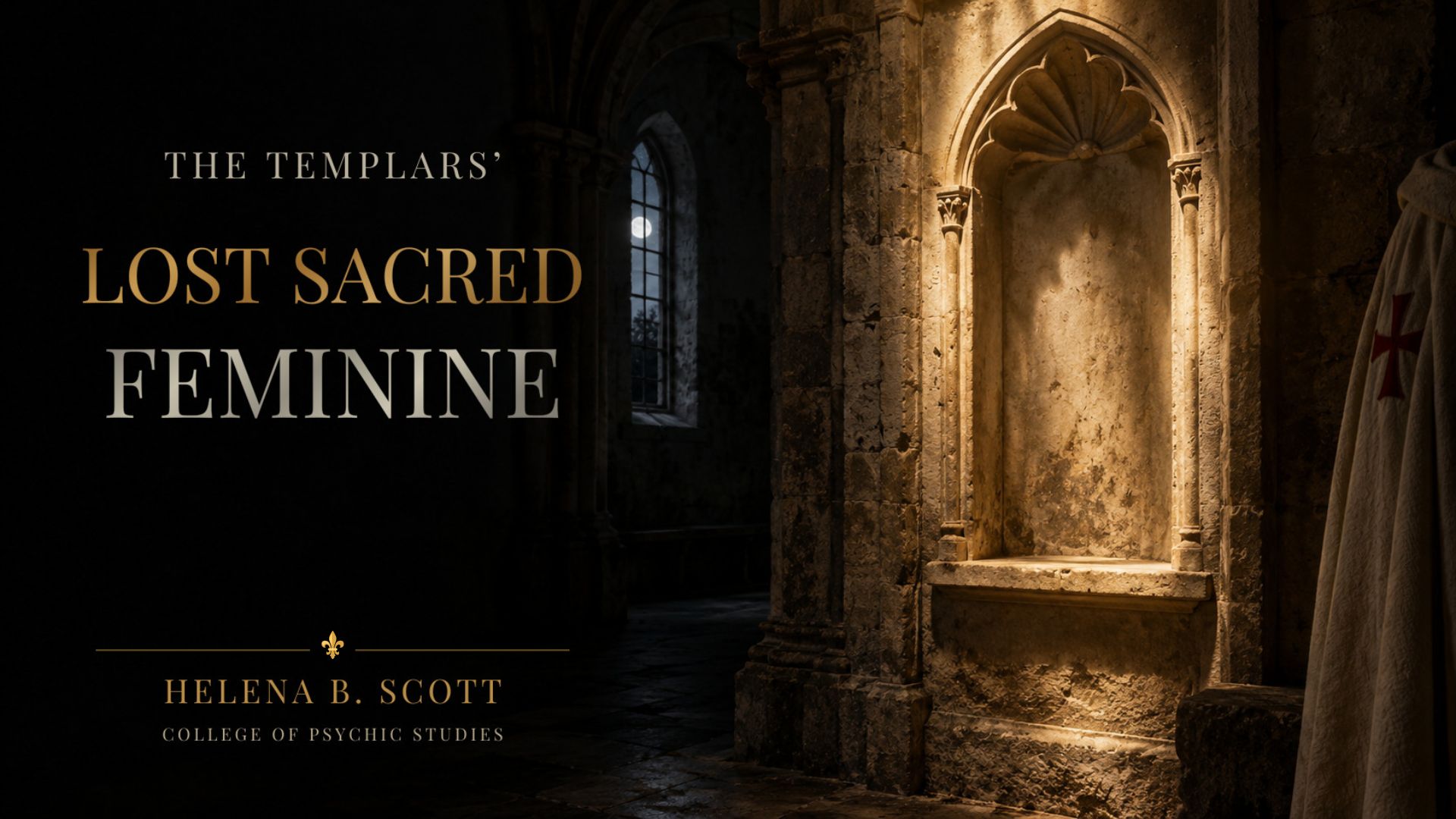
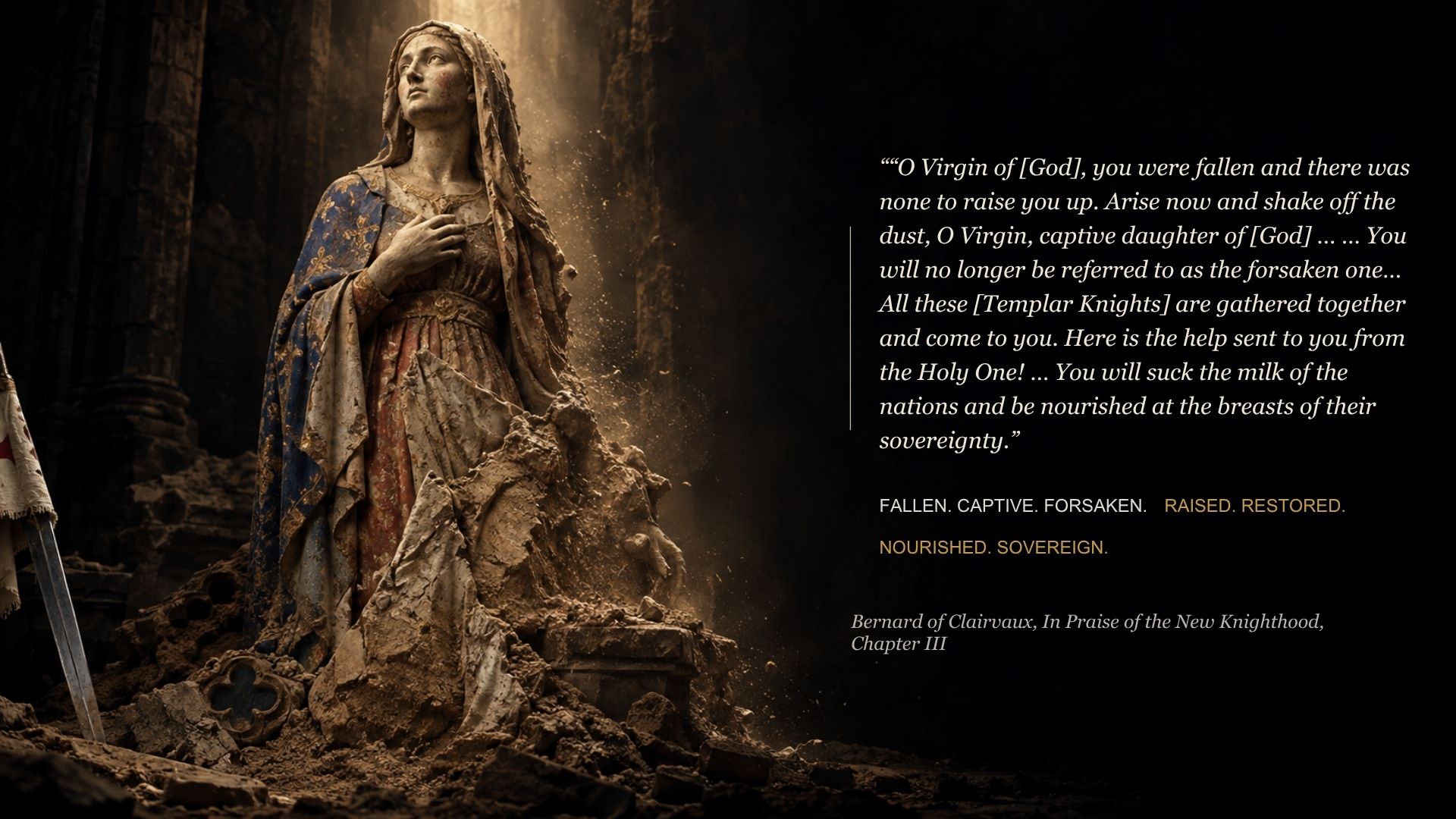
These two images form the visual threshold of Helena’s The Templars’ Lost Sacred Feminine, presented at the College of Psychic Studies. The first asks what has disappeared from the familiar history of the Temple: an illuminated Marian niche stands empty while the knight remains at its edge. The second turns to Bernard of Clairvaux’s language in Chapter III of In Praise of the New Knighthood, where a feminine figure is addressed as fallen, captive and forsaken — then called to rise, shake off the dust, receive nourishment and recover sovereignty.
For Helena, the movement is one of restoration — not the return of something that had vanished, but the recovery of a presence that had never entirely disappeared. Nor was that presence simply forgotten. At different moments, feminine voices, images and forms of authority were censored, suppressed, marginalised or deliberately buried, while others were obscured through loss, reinterpretation and the changing priorities of history. Yet traces remain in texts, devotional imagery, women, saints, relics, landscapes and the material history of the medieval Temple. What has been separated can be recovered, restored to relationship — and re-membered.
The Templars’ Lost Sacred Feminine · College of Psychic Studies · Helena B. Scott · click to enlargeBernard of Clairvaux · In Praise of the New Knighthood · Chapter III · Fallen · Forsaken · Raised · Restored · click to enlarge
Together they express the argument more precisely than either image alone: absence is followed by recovery; the forsaken feminine is not merely rediscovered, but restored. This is one of the places where Helena’s Templar research and the Dark Mother Institute meet: restoration becomes an act of historical recovery and, at the archetypal level, of re-membering.
A pattern begins to emerge here. Across the material explored by the Institute, the feminine repeatedly appears as fallen, displaced, fragmented, captive or forgotten. Yet this is rarely the end of the story. She is called to rise. What has been forsaken is recovered. What has been separated is brought again into relationship. What has lost its place is restored to sovereignty.
In Helena’s Templar research, this pattern acquires particular force through Bernard of Clairvaux’s language of the fallen and forsaken feminine who is commanded to rise from the dust. Read alongside the wider evidence for women, Marian devotion and feminine imagery surrounding the medieval Temple, the passage opens a question larger than any single image: what does it mean to restore the feminine to a history from which she has been diminished, displaced or forgotten?
Restoration, in this sense, is not the invention of something new, nor the return of something that ceased to exist. It is an act of recognition: to recover what remained, restore what was displaced, and re-member what had been separated from the whole.
Re-membering · Isis and the Broken Whole
Gathering what has been scattered
In the Osirian myth, Isis searches for the scattered fragments of her dead husband, Osiris, gathers what has been dismembered and restores the broken body. Her work is not the denial of death or darkness. She enters the place of rupture, searches for what has been lost, and gathers what has been scattered.
This makes Isis a powerful image for the work of re-membering: recovering what has been scattered, forgotten, wounded, exiled or deliberately obscured, and bringing it again into relationship with the whole.
Psychologically, that image can speak to the fragmented parts of ourselves — the grief, shadow, instinct, memory or identity that consciousness has been unable or unwilling to hold. Within a spiritual or devotional practice, Isis may also be approached or invoked as a sacred presence in times of rupture, loss or fragmentation — when what has been scattered asks to be sought, recognised and brought again into relationship with the whole.
Isis does not teach us that nothing will be broken. She teaches us how to gather the pieces.
A Necessary Conversation
Difficult conversations need to be had. Texts need to be revisited. Images, traditions and voices diminished by inherited categories need to be encountered again. Recovering the Goddess means returning to the complexity of feminine divinity, authority, embodiment and symbolic life wherever texts, objects, landscapes and historical evidence allow us to find it — and asking what has been lost when that complexity is denied.
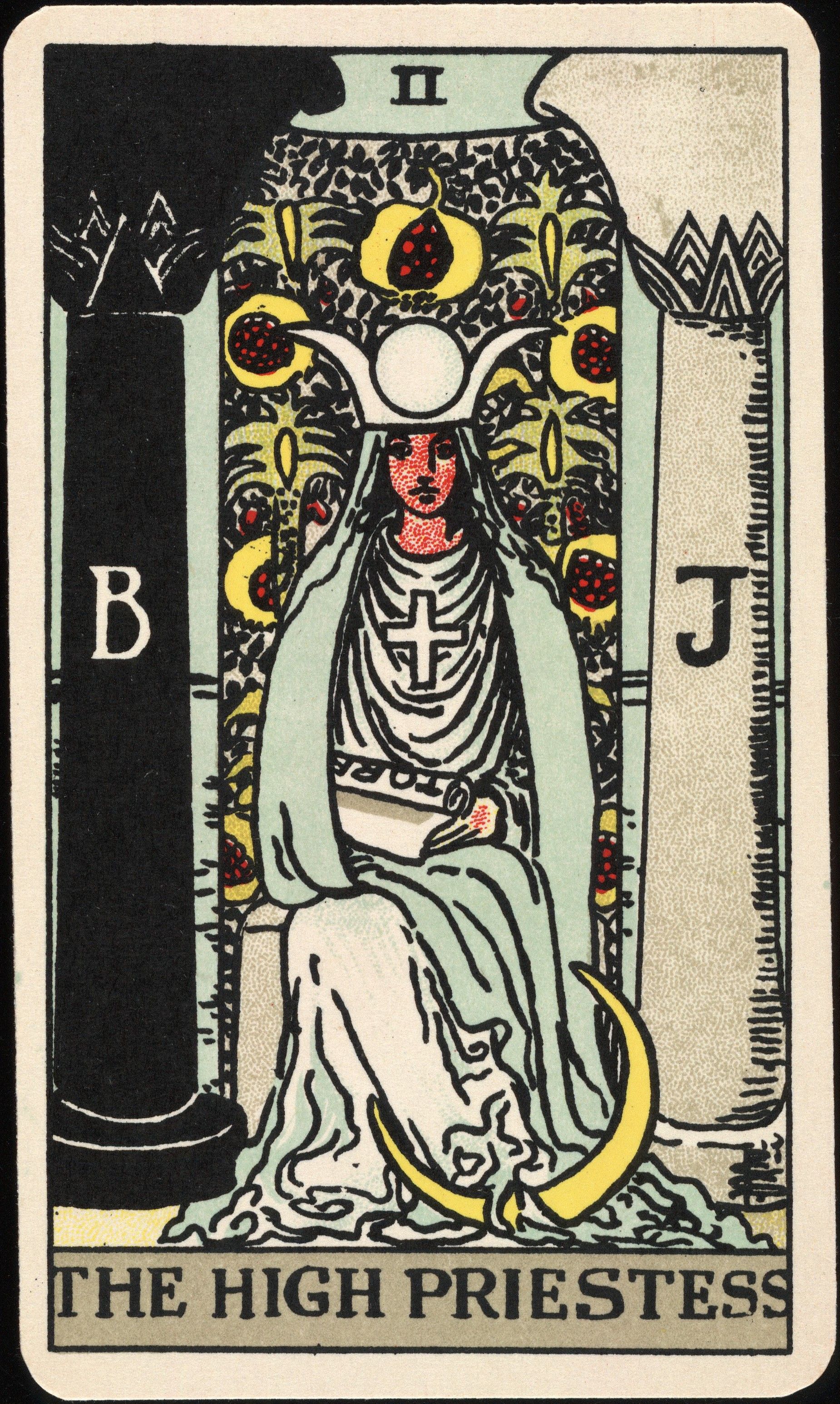
The High Priestess · Waite–Smith Tarot · Pamela Colman Smith · first published 1909 · Cary Collection of Playing Cards, Beinecke Rare Book and Manuscript Library, Yale University
The Priestess · The Thunder · The Whole
An image that returned at the threshold
The High Priestess has accompanied Helena through some of her most important lectures on the Sacred Feminine and Jungian psychology. At the Jung Society of Melbourne, Helena began From Lead to Gold: Gnosticism, Alchemy and the Roots of Depth and Archetypal Psychology with the card present, telling the audience that by the end of the lecture they would understand why she was there.
For Helena, the answer lay in Thunder, Perfect Mind. The Priestess became not an illustration of the ancient text, nor a claim about the historical intentions of the Waite–Smith deck, but a living symbolic correspondence: the feminine that refuses reduction to one pole — virgin and whore, mother and daughter, honoured and scorned, light and darkness held without the annihilation of either.
Thunder is whole. She does not resolve paradox by choosing one side of it. She contains the tension.
The Conjunction of Opposites
For Helena, this question belongs to the same wider enquiry that runs through her work on the Knights Templar, symbolism and individuation: the encounter and tension between apparent opposites, and the possibility of a third position that does not simply abolish either pole. The cross can become an image through which such conjunctions are contemplated; Jungian individuation similarly concerns the difficult movement towards a more conscious relation with what the ego has excluded. Thunder, Perfect Mind gives this paradox a radically uncompromising voice: its speaker is not reduced to one sanctioned identity, but speaks through opposites without surrendering her wholeness.
Living Symbolism · A Personal Note
The Priestess Who Would Not Be Put Away
The Priestess has become an almost permanent presence in Helena’s recent lectures and talks, but her place in Helena’s work began much earlier. While returning a tarot deck to its box some years ago, the High Priestess remained standing out from the other cards and then fell free. When Helena tried to return her to the pack, she would not sit comfortably among them. Helena eventually stopped trying to put her away.
She gave the card a special place on her desk, beside a small bust of the Egyptian goddess Bastet, where the Priestess remains within sight as Helena writes, researches and goes about her day. Looking back, Helena understands that moment as part of a much larger process of re-membering. For a long period of her life, she had learned to place the sacred feminine within herself to one side. Making room for the Priestess became, symbolically, part of making room for that dimension of herself again: a personal act of re-membering that Helena understands as part of the wider work of healing the feminine wound — recovering a relationship with forms of feminine sacredness, authority, embodiment and knowing that many women have learned to silence, diminish or place outside themselves. And because the feminine is not the possession of one sex, this work also belongs to the larger human task of restoring it to conscious relationship within ourselves and within the lives we share.
A profound turning point came while Helena’s friend Cáit Brannigan — Druid, Bean Feasa and ordained Priestess Hierophant of the Western Mystery Tradition, and a member of the Fellowship of Isis — was helping her work through ancestral issues. Cáit told Helena that she needed to embrace and integrate the feminine more fully into her life and work. During one of their sessions, Helena entered a vision in which she experienced what she understood as an initiation into priestesshood. She could not then have known where that invitation to make room for the feminine would lead.
In the years that followed, the Priestess became part of Helena’s lived symbolic language. That re-membering began to shape the direction of her research, leading her towards a number of previously unknown Black Madonnas — images and traditions absent from the established Black Madonna record — some of which will be revealed in her forthcoming book. Helena experiences the Priestess as continuing to guide aspects of that enquiry — an intuitive presence that draws attention, raises questions and sometimes seems simply to say: look here.
She would not go back into the box. In time, Helena understood that neither could the feminine be put away again.
A Global Conversation
Across a wider sacred geography
The Institute is deliberately international in scope. Black Madonna traditions belong to a European and Mediterranean landscape of movement, pilgrimage, devotion, exchange and cultural memory, with related traditions extending far beyond Europe. The developing archive will create pathways between places and traditions that are too often studied in isolation.
Ireland also enters this wider enquiry as a historically liminal landscape. Medieval St Patrick's Purgatory at Lough Derg became famous across Europe as a place where the boundary between this world and the next might be crossed. Such threshold geographies matter to Helena's understanding of the Dark Mother as places in which cultures repeatedly imagined descent, ordeal, passage and return.
The method begins with the evidence. From there, new patterns become visible when sources are allowed to speak across boundaries.
★★★★★★★
Intellectual Constellation · Seven Stars
Texts, thinkers and traditions in conversation
The Institute develops through conversation between primary texts, material evidence, historical scholarship and Jungian, archetypal and depth-psychological thought. These traditions illuminate one another here without being treated as a single lineage. The seven shown here are selected doorways into a much wider field of texts, thinkers, objects and traditions — an orientation, not an exhaustive canon.
Lectures · seminars · workshops · publications · museum and heritage programmes
V
Research With Us · Work With the Institute
Scholarship, commissioning and collaboration
The Dark Mother Institute welcomes conversations with scholars, researchers, museums, libraries, archives, heritage sites, custodians, cultural organisations and others whose work intersects with Black Madonnas, sacred feminine traditions, material culture, sacred landscape, depth psychology and related fields.
Future collaborations may include research exchange, invited scholarship, exhibitions and interpretation, lectures and public programmes, digital heritage projects, archival and field research, and institutional partnerships.
For research, commissioning, collaboration or institutional enquiries, contact Helena B. Scott.
The Institute is closely connected to Helena's forthcoming book with Holythorn Press, a pioneering multidisciplinary study of Black Madonnas and the Dark Mother, bringing new research, previously unknown Black Madonna material, and overlooked or little-known traditions into conversation with history, material culture, sacred landscape and archetypal interpretation. The book and Institute share a research world, but they are not the same project: the Institute is designed to continue growing beyond publication through new research, fieldwork, essays, teaching, collaborations and future public-history and exhibition work.
Some of Helena's central discoveries, locations and developing interpretations remain deliberately unpublished while the research and book are in progress. The public Institute will reveal this work gradually and with appropriate historical context.
Public Launch · 31 October 2026
Enter the Dark Mother research world
Until launch, explore Helena's wider Sacred Feminine research, forthcoming publications, lectures and teaching.
New research, forthcoming books, lectures, fieldwork, courses and occasional notes from Helena B. Scott.
By subscribing, you agree to receive occasional research news, publications, events and updates from Helena B. Scott by email. You can unsubscribe at any time. Privacy Policy.
Google Analytics helps understand how visitors find and use the site. If you decline, analytics cookies remain off and only limited cookieless measurement signals may be sent. It is not used for advertising here.